This learning resource is available in interactive and printable formats. The interactive worksheet can be played online and assigned to students. The Printable PDF version can be downloaded and printed for completion by hand.
This engaging history reading passage focuses on Laozi, the legendary founder of Daoism, and explores his teachings and their impact on ancient China. Students will learn about Laozi’s life, his philosophy of living in harmony with nature, and how Daoism influenced Chinese society, government, and daily life. The passage is aligned with California HSS 6.6.3 and CCSS RI.6.1 standards, making it suitable for middle school history classrooms. Included are a glossary of key terms, a simplified version for struggling readers, as well as Spanish translations. Multiple-choice and writing activities help students analyze cause and effect, use evidence, and understand significance. Graphic organizers and a timeline support comprehension and critical thinking. This resource also features a read aloud audio component and a public domain image with citation for classroom use.
CONTENT PREVIEW
Expand content preview
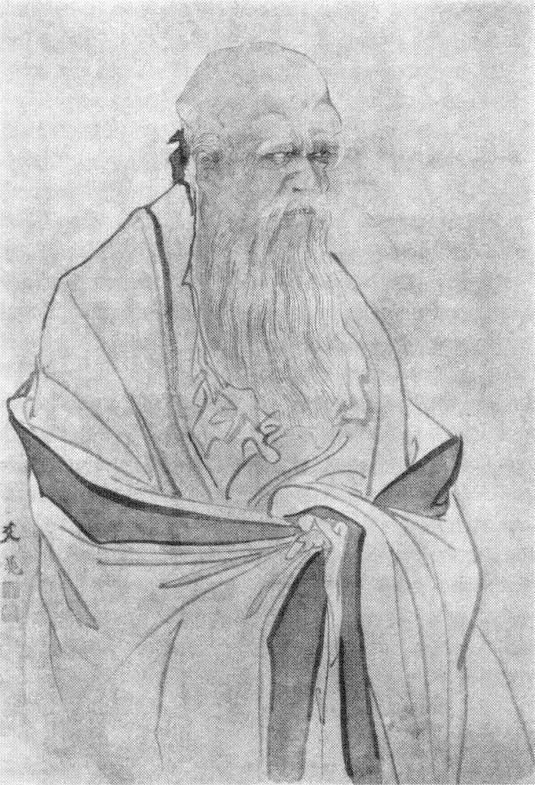
"Laozi" / Wikimedia Commons (Public domain).
Laozi, an ancient Chinese philosopher, is widely regarded as the founder of Daoism, a major philosophical and spiritual tradition that began in China over 2,000 years ago. According to legend, Laozi lived during the sixth century BCE, though some historians debate the exact dates of his life. His teachings, collected in the famous text called the Dao De Jing, emphasize simple living and harmony with nature. Laozi’s ideas have shaped not only Chinese philosophy but also daily life, government, and art across centuries.
The core principle of Daoism is the concept of the Dao, often translated as "the Way." The Dao is seen as the natural order of the universe, a force that flows through all things. Laozi taught that people should align themselves with the Dao by practicing wu wei, or "non-action." This does not mean doing nothing, but rather acting in a way that is natural and effortless, without forcing things. Archaeological evidence, such as bamboo manuscripts found in ancient tombs, supports the early spread of Daoist ideas by the third century BCE. These texts show how Daoism influenced both the ruling class and common people.
Laozi’s teachings encouraged rulers to govern with kindness and avoid harsh laws. In the Dao De Jing, Laozi wrote, “Governing a large country is like cooking a small fish. Do not overdo it.” This suggests that leaders should not interfere too much but instead create a peaceful society. During the Han Dynasty (206 BCE–220 CE), Daoism became one of China’s main philosophies, shaping government policies and religious practices. Rituals, temples, and even traditional Chinese medicine were influenced by Daoist beliefs. Laozi’s ideas about balance and harmony became central to Chinese thought.
Daoism also shaped daily life. People were encouraged to appreciate simplicity, spend time in nature, and seek inner peace. Daoist art often features flowing water, mountains, and clouds, symbolizing the ever-changing yet balanced world. The concept of yin and yang—the balance of opposite forces—came to represent how harmony creates a stable society. Over time, Daoism has continued to influence Chinese culture and is still practiced today.
Laozi’s legacy endures because his teachings address universal themes: balance, respect for nature, and finding peace in a changing world. By understanding the Dao, people can live happier and more meaningful lives. The spread of Daoism from ancient China to other parts of Asia demonstrates its lasting significance in world history.
Studying Laozi and Daoism helps us connect to broader themes in ancient history, such as the relationship between humans and nature, and the ways ideas shape societies.
Interesting Fact: According to one legend, Laozi left China riding a water buffalo, leaving behind the Dao De Jing as a guide for future generations.
Who is Laozi known as?
Founder of DaoismFirst Chinese emperorInventor of paperConfucian philosopher
What is Dao?
Natural orderKing's titleA type of foodA city
What is the Dao De Jing?
Main Daoist textA Chinese cityType of governmentFamous temple
Why did Laozi say rulers should not overdo it?
To have peaceful societyTo win warsTo make more moneyTo build bigger cities
How did Daoism influence daily life?
Simple living, harmony with natureStrict rulesNew citiesFarming only
What does 'wu wei' mean?
Effortless actionHard workWriting poemsLearning math
Daoism began over 2,000 years ago. True or false?
TrueFalse
What is 'yin and yang'?
Opposite forces in balanceChinese leadersA type of foodA city in China
Perfect For:
👩🏫 Teachers
• Reading comprehension practice
• Auto-graded assessments
• Literacy skill development
👨👩👧👦 Parents
• Reading practice at home
• Comprehension improvement
• Educational reading time
🏠 Homeschoolers
• Reading curriculum support
• Independent reading practice
• Progress monitoring
Reading Features:
📖
Reading Passage
Engaging fiction or nonfiction text
❓
Comprehension Quiz
Auto-graded questions
📊
Instant Feedback
Immediate results and scoring
📄
Printable Version
Download for offline reading
🔊
Read Aloud
Voice-over with word highlighting
Reviews & Ratings
No reviews yet. Be the first to share your experience!
Related Content
Life in Ancient China
This comprehensive history reading passage explores daily life and social structure in Ancient China, focusing on the ro...
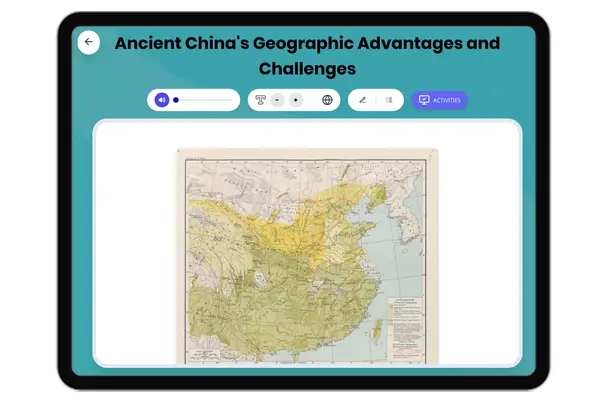
Geography of Ancient China
This passage examines the geographic advantages and challenges faced by Ancient China, exploring how natural features li...
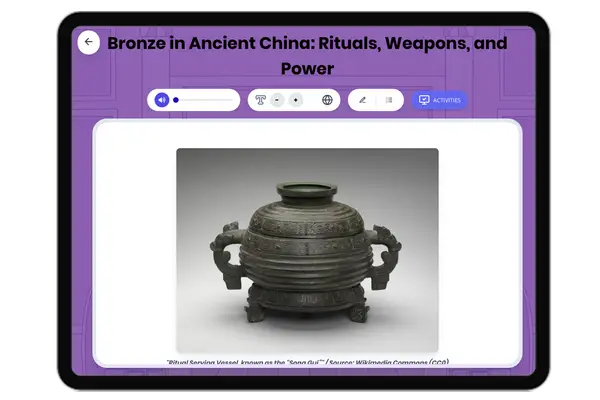
Bronze in Ancient China
This passage explores the significance of bronze in Ancient China, focusing on its use in rituals, weapons, and expressi...
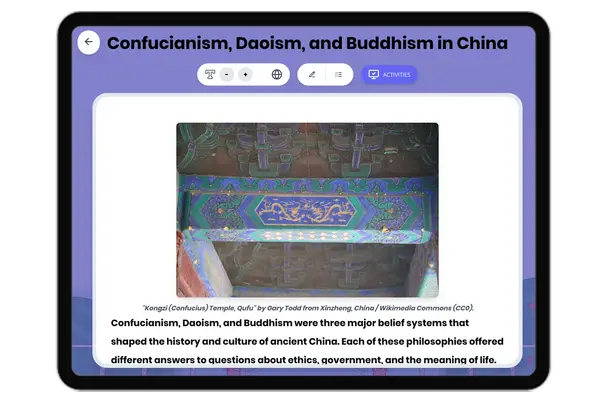
Confucianism, Daoism, and Buddhism in China
This rigorous ancient history reading passage explores the development and impact of Confucianism, Daoism, and Buddhism ...
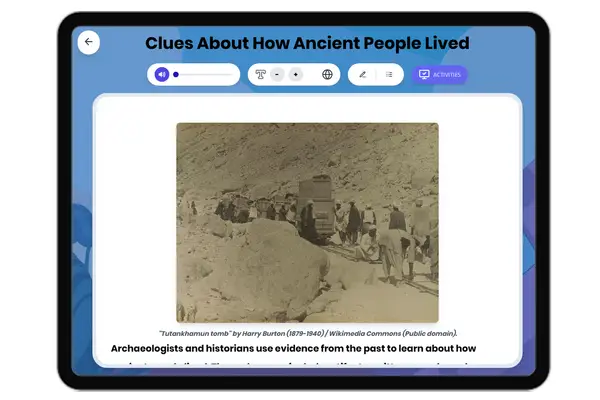
Evidence in Ancient History
This engaging history reading passage investigates how archaeologists and historians discover clues about how ancient pe...
Ancient Theocracy
This engaging history reading passage explores the concept of theocracy in ancient civilizations, where priests and reli...
Ancient Canaan
This educational passage explores the land of Canaan, the historical homeland of the ancient Israelites. Students will l...
The First Emperor: Qin Shi Huangdi Unites China
This comprehensive reading passage explores the rise of Qin Shi Huangdi, the first emperor who united ancient China. Stu...
Shi Huangdi: First Emperor of China
This rigorous history reading passage explores the remarkable reign of Shi Huangdi, the first emperor of China, and his ...
Ban Zhao: China's Woman Scholar
This passage explores the life and legacy of Ban Zhao, one of ancient China's most respected scholars and the author of ...
Ancient Philosophy
This reading passage takes students on a journey through the philosophical traditions of ancient Greece, India, and Chin...
Ancient Literature
This passage explores the importance of ancient stories and poems from civilizations such as Greece, India, and Israel. ...
Geography of Ancient Israel
This passage explores the rich geography of Ancient Israel, focusing on how landforms, climate, and natural resources sh...
Ancient Money Barter
This passage explores the fascinating evolution from barter to the earliest coins in ancient civilizations, focusing on ...
Ancient Writing Systems
This engaging history reading passage explores the origins and evolution of ancient writing systems, including cuneiform...
Ancient Science and Medicine
This comprehensive reading passage explores the development of science and medicine in ancient civilizations, including ...
Ancient Agriculture Farming
This passage explores the transformative impact of farming on ancient societies, examining how the Neolithic Revolution ...
Social structures in Ancient World
This passage explores the organization and significance of family life in ancient societies, focusing on how extended fa...
Ancient Mathematics
This passage explores the essential role of mathematics in ancient civilizations, including Mesopotamia, Egypt, Greece, ...
Trade Across Ancient India
This history reading passage explores Ancient India's trade networks and their impact on global connections. Students wi...