Leakeys at Olduvai Gorge
Interactive passage with audio narration, comprehension questions, and printable PDF.
By completing this purchase you agree to our Terms of Use and Privacy Policy. Your subscription renews automatically until you cancel. You can cancel anytime from your account settings. All sales are final and non-refundable. Digital content is available for download in your account immediately upon purchase.
What's included
Part of this bundle

Leakeys at Olduvai Gorge preview and details
About this printable Leakeys at Olduvai Gorge reading passage (Grades 5-8)
Sample passage and quiz from Leakeys at Olduvai Gorge
Reading passage and comprehension quiz preview
Leakeys at Olduvai Gorge
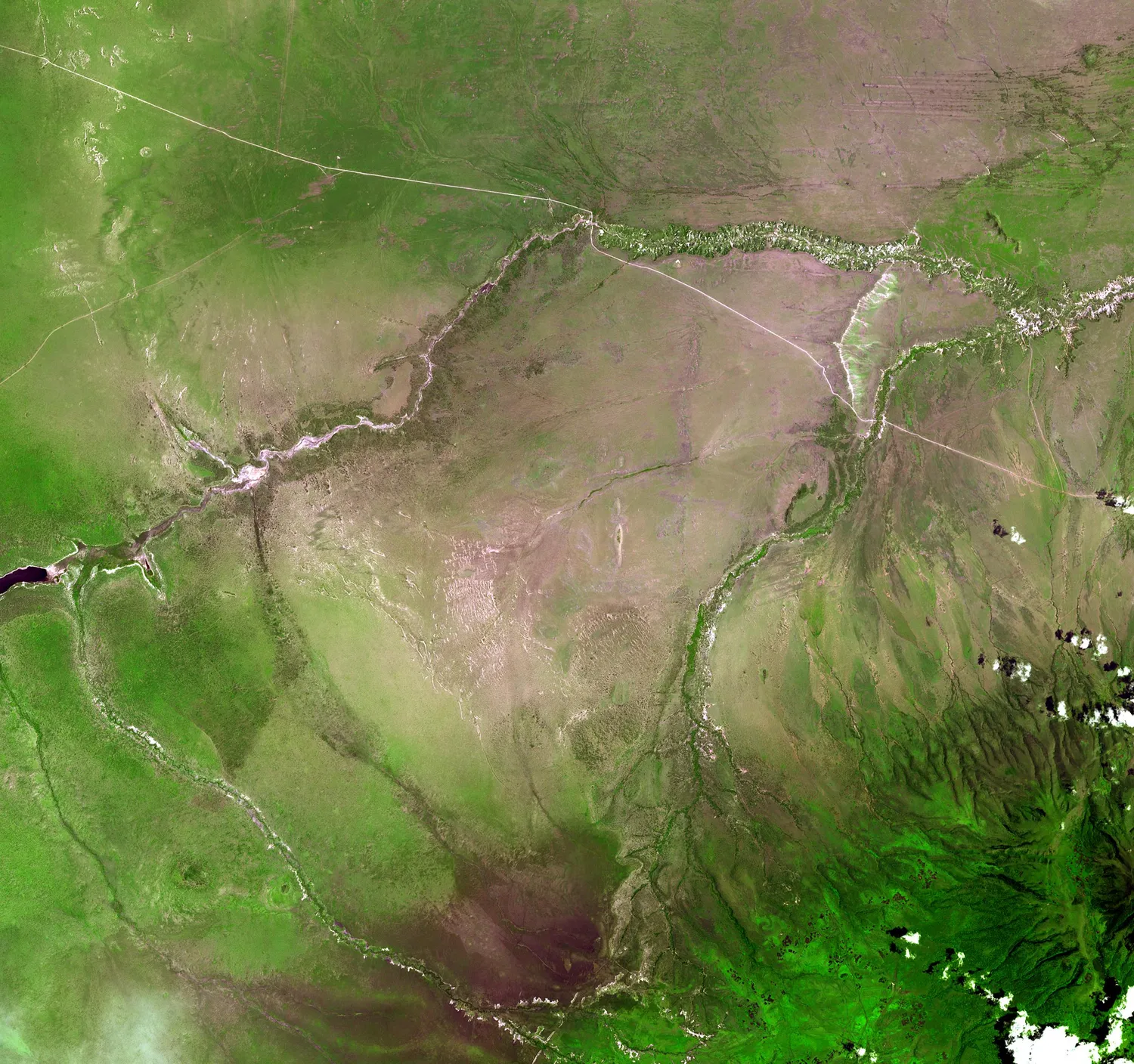
Olduvai Gorge, Tanzania from space / Wikimedia Commons
Archaeologists Mary and Louis Leakey made some of the world’s most important discoveries about early human evolution at Olduvai Gorge in Tanzania, Africa. Their work in the mid-20th century revealed new information about ancient ancestors and changed how scientists understand our past. Olduvai Gorge, a deep ravine in East Africa, contains layers of rocks and fossils that date back millions of years, providing a rich source of evidence about early hominids.
During the 1930s through the 1960s, the Leakeys led excavations in Olduvai Gorge. In 1959, Mary Leakey discovered the skull of an early hominid known as Australopithecus boisei. This find was significant because it was about 1.75 million years old, making it one of the oldest hominid fossils ever found at that time. The Leakeys also found stone tools, demonstrating that early humans used technology to survive. Their discoveries supported the idea that Africa was the birthplace of humanity.
In the 1970s, Mary Leakey made another groundbreaking discovery: the Laetoli footprints. These ancient footprints, preserved in volcanic ash, showed that early hominids walked upright over 3.6 million years ago. The footprints are considered primary sources of evidence for understanding early human behavior. The Leakeys’ careful methods of digging and recording helped set new standards for archaeological research. They showed how stratigraphy, or studying layers of earth, could reveal the relative ages of fossils and artifacts.
The Leakeys’ research had a huge impact on the field of paleoanthropology, which studies ancient human ancestors. Their work inspired future scientists and led to more discoveries in Africa. Today, Olduvai Gorge is recognized worldwide as a key site for understanding human origins. The Leakeys also helped train local Tanzanian scientists, supporting the growth of archaeology in Africa. Their discoveries connected geography, science, and history, showing how humans adapted to their environment over time.
The significance of Mary and Louis Leakey’s discoveries is still felt today. By uncovering fossils and footprints, they provided direct evidence of our evolutionary past. Their work showed that understanding early technology, movement, and adaptation is essential to learning about human history. The story of the Leakeys links to broader themes of migration, innovation, and the importance of evidence in reconstructing the past.
Interesting Fact: The Laetoli footprints are so well-preserved that scientists can see the toes and arches of the hominids’ feet, giving clues about how they walked upright.
Comprehension quiz (8 questions)
1. Where did the Leakeys work?
2. What year did Mary Leakey find the hominid skull?
3. What did the Laetoli footprints show?
4. Why were the Leakeys' discoveries important?
5. How did stratigraphy help the Leakeys?
6. What was a result of the Leakeys' work?
7. Mary Leakey found the Laetoli footprints.
8. What does 'excavation' mean?
Perfect for the way you teach
- Build comprehension skills
- Auto-graded quiz
- Differentiated reading
- Read together at home
- Improve fluency
- Quiet reading time
- Reading curriculum support
- Independent practice
- Track Lexile growth