Mechanical Advantage
Interactive passage with audio narration, comprehension questions, and printable PDF.
By completing this purchase you agree to our Terms of Use and Privacy Policy. Your subscription renews automatically until you cancel. You can cancel anytime from your account settings. All sales are final and non-refundable. Digital content is available for download in your account immediately upon purchase.
What's included
Mechanical Advantage preview and details
About this printable Mechanical Advantage science reading passage, NGSS-aligned (Grades 5-8)
Sample passage and quiz from Mechanical Advantage
Reading passage and comprehension quiz preview
Mechanical Advantage
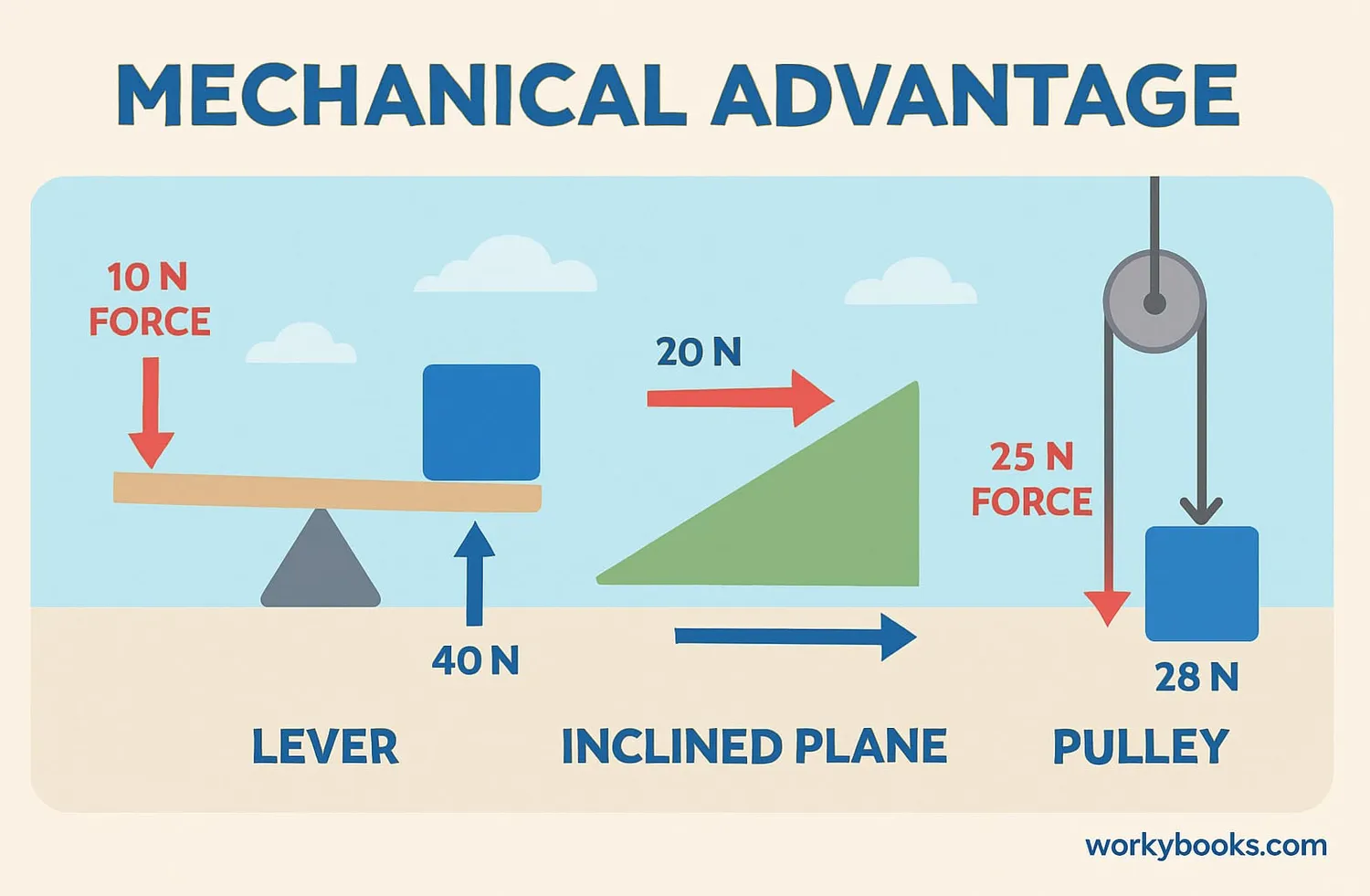
Mechanical advantage plays a central role in making work easier through the use of machines. In construction, tools like levers and pulleys allow workers to lift heavy materials with less effort. The science of mechanical advantage explains how machines can multiply force, change direction, or increase speed and distance. Understanding this concept helps engineers and inventors design more effective machines for everyday use.
How Mechanical Advantage Works
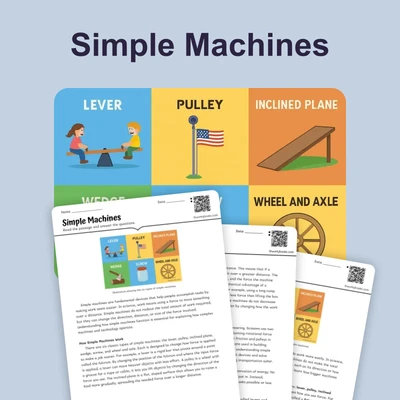
Mechanical advantage (MA) is defined as the ratio of the output force a machine produces to the input force applied to it. Mathematically, MA = Output Force / Input Force. A machine with an MA greater than 1 multiplies force, meaning it lets you move a heavy load with a smaller effort. For example, a lever can lift a boulder using much less force than would be needed by hand. Each type of simple machine—such as levers, pulleys, inclined planes, and wheel and axles—has its own method to calculate MA, often based on measurements like length or number of supporting ropes. However, in real machines, friction reduces the output force, so the actual MA is always less than the ideal mechanical advantage (IMA) calculated without friction. This difference is measured by a machine’s efficiency, which is the percentage of useful work output compared to the input.
Types and Applications of Mechanical Advantage
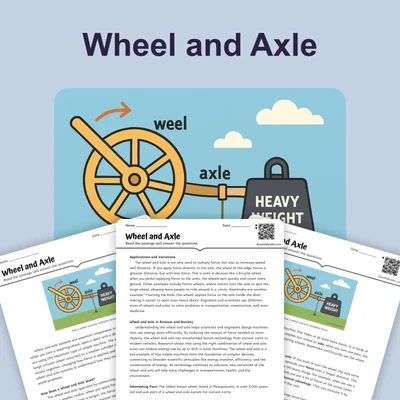
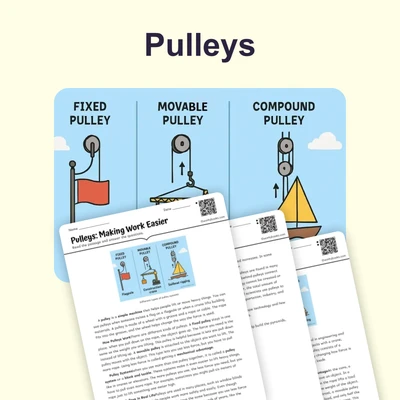
Machines with MA greater than 1 are called force multipliers because they increase the force you apply, like a car jack lifting a vehicle. Machines with MA less than 1, such as some types of wheel and axles, do not increase force. Instead, they increase speed or the distance over which the force is applied, making tasks like spinning wheels or fans more efficient. When MA equals 1, the machine changes only the direction of the force, such as a fixed pulley that lets someone pull down to lift an object up. Calculating MA helps scientists and engineers choose the right machine for a job and predict how much effort will be needed.
Efficiency and Real-World Implications
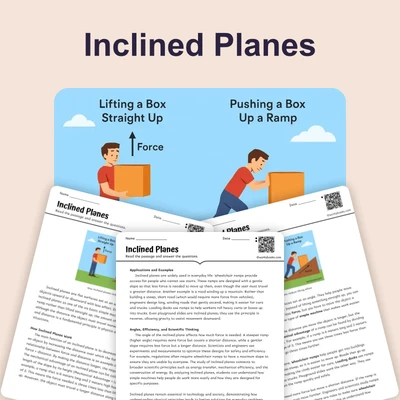
No real machine is perfectly efficient. Friction and other factors always reduce the actual output compared to the ideal. For example, a ramp (inclined plane) that should have an IMA of 5 might provide an actual MA of only 4 because of friction between the object and the surface. High efficiency means less energy is wasted, which is important in designing environmentally friendly machines and saving energy in manufacturing, transportation, and daily life. Mechanical advantage connects directly to the law of conservation of energy: although machines make tasks easier, they cannot create energy—they only help us use force more effectively.
Understanding mechanical advantage allows us to analyze and improve technology, from ancient tools to modern engineering marvels.
Interesting Fact:
Some ancient pyramids were built using ramps and levers to create huge mechanical advantages, letting workers move stones weighing several tons!
Comprehension quiz (10 questions)
1. What is mechanical advantage (MA)?
2. Which of the following is a simple machine?
3. What does efficiency measure in a machine?
4. If a machine has mechanical advantage less than 1, what does it increase?
5. What is the main effect of friction on mechanical advantage?
6. What is the mechanical advantage of a fixed pulley?
7. What is the relationship between actual MA and ideal MA?
8. Which statement is true?
9. A ramp designed to have an ideal mechanical advantage of 5 provides an actual MA of 4. True or False: Friction is the reason for this difference.
10. True or False: All real machines are perfectly efficient.
Perfect for the way you teach
- Build comprehension skills
- Auto-graded quiz
- Differentiated reading
- Read together at home
- Improve fluency
- Quiet reading time
- Reading curriculum support
- Independent practice
- Track Lexile growth