Compound Machines
Interactive passage with audio narration, comprehension questions, and printable PDF.
By completing this purchase you agree to our Terms of Use and Privacy Policy. Your subscription renews automatically until you cancel. You can cancel anytime from your account settings. All sales are final and non-refundable. Digital content is available for download in your account immediately upon purchase.
What's included
Compound Machines preview and details
About this printable Compound Machines science reading passage, NGSS-aligned (Grades 5-8)
Sample passage and quiz from Compound Machines
Reading passage and comprehension quiz preview
Compound Machines
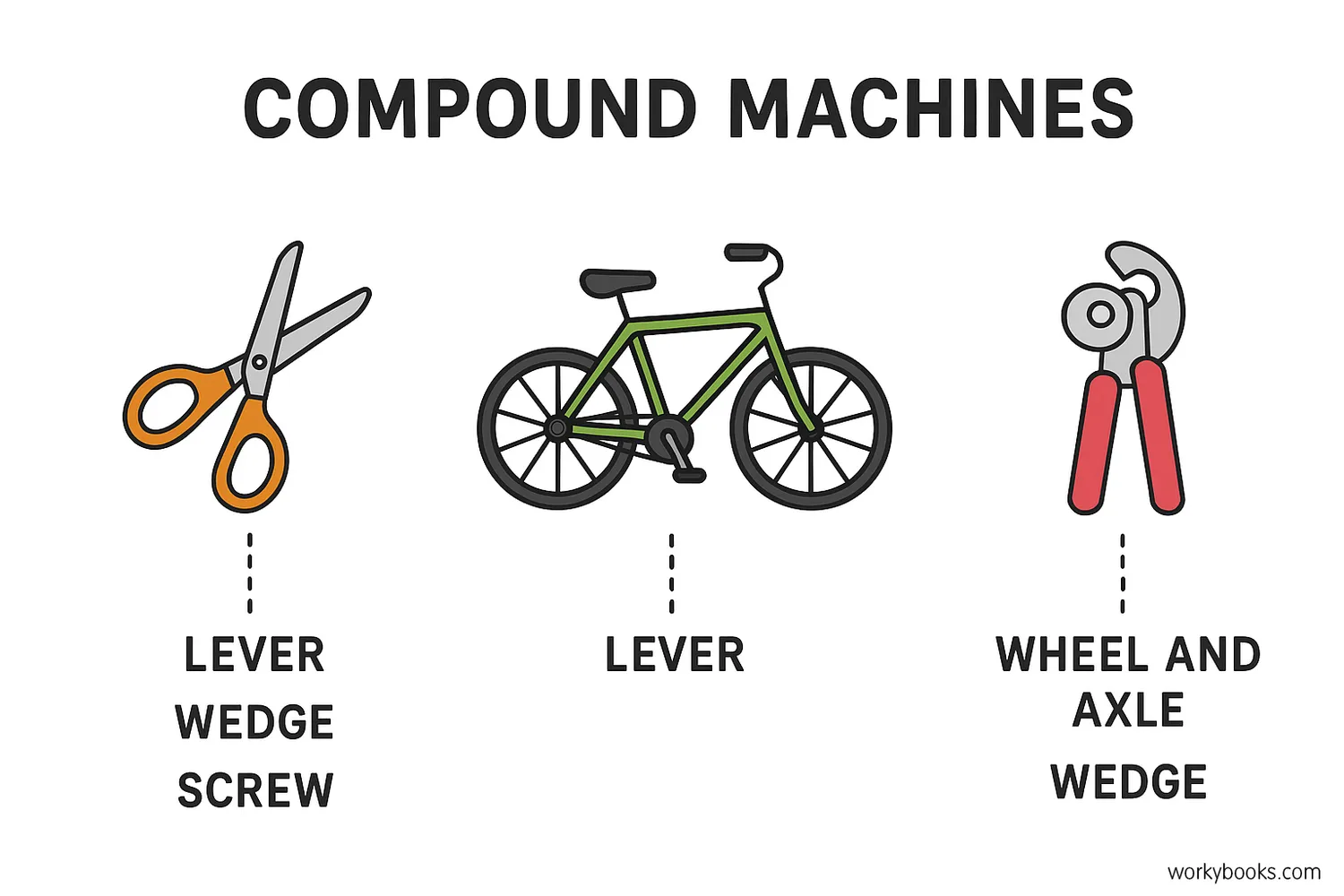
Compound machines are essential tools in our daily lives, enabling people to accomplish challenging tasks with less effort. In factories, on roads, and even in kitchens, these devices are present wherever work needs to be done efficiently. A compound machine is created when two or more simple machines are combined into one device, allowing multiple forces to interact. Understanding how compound machines work helps scientists and engineers design better tools that improve productivity and safety.
How Compound Machines Work
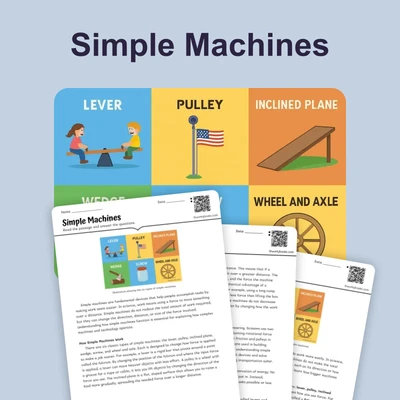
Each simple machine—a lever, wedge, screw, pulley, inclined plane, or wheel and axle—contributes a specific function to a compound machine. When combined, these parts form a system that multiplies force or changes its direction. For example, a pair of scissors is a compound machine made up of two levers (the handles) and two wedges (the blades). When you squeeze the handles, the levers increase your input force, while the sharp blades (wedges) split the material. Similarly, a bicycle uses levers (pedals), wheels and axles (tires), and pulleys (chains and gears) to propel a rider forward. By combining different simple machines, compound machines can perform complex tasks that would be difficult or impossible for a single simple machine alone.
Analyzing and Calculating Mechanical Advantage
One of the key benefits of compound machines is their mechanical advantage. Mechanical advantage (MA) is a measure of how much a machine multiplies your input force. For compound machines, the overall MA is calculated by multiplying the MA of each simple machine component. For instance, if a can opener’s lever gives a MA of 2 and its wedge provides a MA of 3, the total MA is 2 x 3 = 6. This means the user’s force is multiplied six times, making it much easier to open a can. Engineers use these calculations to optimize machine design for safety and efficiency.
Real-World Applications and Broader Implications
Compound machines are found in many devices, from car jacks to wheelbarrows. A car jack combines a screw and a lever to lift heavy vehicles safely. The screw converts rotational force into upward motion, while the lever reduces the effort needed. In can openers, wheels and axles work with levers and wedges to cut and lift lids. These machines are not only practical but also demonstrate important scientific principles, such as energy transfer and conservation of work. By analyzing the systems within compound machines, scientists gain insights into how forces interact, which guides future technology and innovation.
Compound machines illustrate the importance of systems thinking in science. They show how multiple components can work together to achieve a goal, highlighting the relationships between force, energy, and motion. Understanding these connections helps us build safer, more efficient machines that benefit society and the environment.
Interesting Fact: The bicycle is one of the most efficient compound machines ever invented. Up to 98% of the energy a rider puts into the pedals is transferred to the wheels!
Comprehension quiz (10 questions)
1. What is a compound machine?
2. Which of the following is NOT a simple machine found in a bicycle?
3. What simple machines make up a pair of scissors?
4. What does mechanical advantage measure?
5. Which statement best describes how a car jack works?
6. In the passage, what does the word 'system' most likely mean?
7. If a can opener’s lever has a MA of 2 and its wedge has a MA of 3, what is the total mechanical advantage?
8. True or False: Compound machines only use one type of simple machine.
9. True or False: Energy transfer is an important principle in how compound machines work.
10. Why do engineers calculate the mechanical advantage of compound machines?
Perfect for the way you teach
- Build comprehension skills
- Auto-graded quiz
- Differentiated reading
- Read together at home
- Improve fluency
- Quiet reading time
- Reading curriculum support
- Independent practice
- Track Lexile growth