Work and Power
Interactive passage with audio narration, comprehension questions, and printable PDF.
By completing this purchase you agree to our Terms of Use and Privacy Policy. Your subscription renews automatically until you cancel. You can cancel anytime from your account settings. All sales are final and non-refundable. Digital content is available for download in your account immediately upon purchase.
What's included
Work and Power preview and details
About this printable Work and Power science reading passage, NGSS-aligned (Grades 5-8)
Sample passage and quiz from Work and Power
Reading passage and comprehension quiz preview
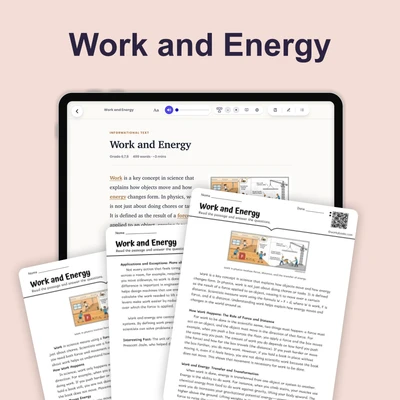
Work and Power
Work and power are key ideas in physical science that help us understand how energy moves and changes in our world. Lifting a book from the floor to a table requires effort, but what does it mean to do work in science? The scientific definition of work is different from everyday use. In science, work is only done when a force causes an object to move in the direction of that force. This passage explores how work is measured, when work is or isn’t done, and how power describes the rate of doing work.
How Work Happens: Force, Distance, and Direction
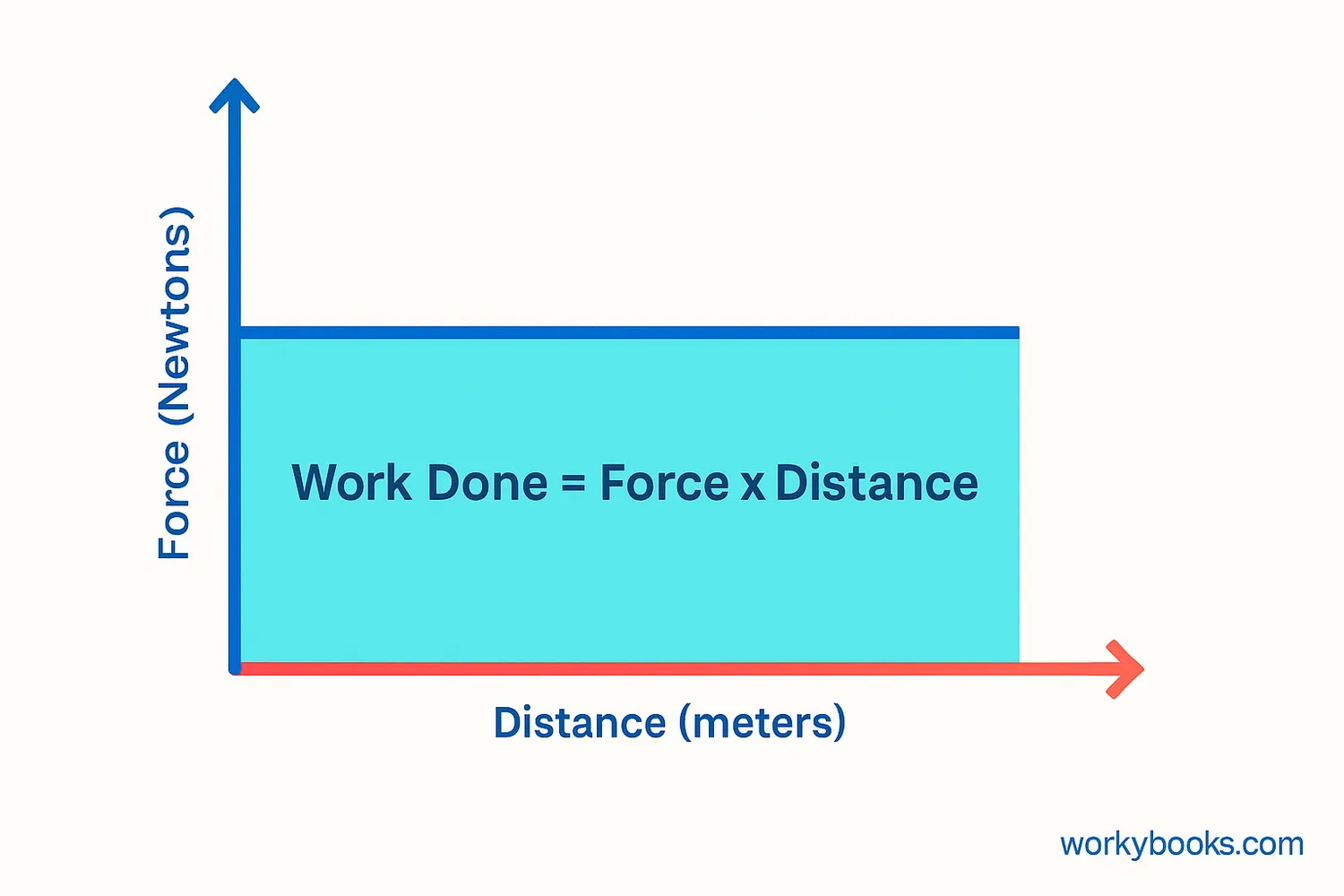
Scientists define work with a clear formula: Work equals force multiplied by distance (W = F × d). Force is a push or pull, measured in newtons (N), and distance is how far the object moves in the direction of the force, measured in meters (m). For example, if you lift a 10-newton book up 2 meters, you do 20 joules of work (10 N × 2 m). However, if you simply hold the book in place, even if you feel tired, you are not doing scientific work because the book isn’t moving. Work only happens when the force you apply causes movement in the same direction as the force.
Power: The Rate of Doing Work
While work tells us how much energy is transferred, power measures how quickly this work is done. The formula for power is power equals work divided by time (P = W ÷ t). Power is measured in watts (W), where one watt equals one joule of work per second. Climbing a set of stairs involves the same amount of work whether you walk slowly or run quickly, but running requires more power because you complete the work in less time. Engines and machines are often compared by their power ratings, such as a car engine measured in horsepower. More powerful engines can do the same amount of work faster.
Real-World Applications and Broader Connections
Understanding work and power helps engineers design safer buildings, faster vehicles, and more efficient machines. For example, elevators must be designed to provide enough power to lift people quickly and safely to higher floors. In daily life, using a ramp instead of stairs spreads the work over a longer distance, making it feel easier, even though the total work done might be the same. These concepts connect to the larger scientific idea of energy transfer, showing how energy moves from one system to another, such as from muscles to objects or from engines to vehicles. The scientific study of work and power allows us to improve technology, conserve energy, and solve real-world problems.
In summary, work in science is done only when a force moves an object in the direction of the force, and power tells us how fast this work is accomplished. These principles reveal the relationships between force, motion, energy, and time, forming the foundation for understanding machines and energy use in our world.
Interesting Fact:
One horsepower is equal to about 746 watts, which means a strong horse can do 746 joules of work every second!
Comprehension quiz (10 questions)
1. According to science, when is work done?
2. What is the correct formula for calculating work?
3. If a 10-newton force lifts a book 2 meters, how much work is done?
4. What unit is used to measure power?
5. What does power measure in science?
6. In the passage, what is an example of doing work?
7. What does it mean if two people climb the same stairs, but one does it faster?
8. Which of the following is true about holding a heavy box still?
9. True or False: Using a ramp instead of stairs can make work feel easier, even if the total work done is the same.
10. True or False: Power is measured in joules.
Perfect for the way you teach
- Build comprehension skills
- Auto-graded quiz
- Differentiated reading
- Read together at home
- Improve fluency
- Quiet reading time
- Reading curriculum support
- Independent practice
- Track Lexile growth