Efficiency of Machines
Interactive passage with audio narration, comprehension questions, and printable PDF.
By completing this purchase you agree to our Terms of Use and Privacy Policy. Your subscription renews automatically until you cancel. You can cancel anytime from your account settings. All sales are final and non-refundable. Digital content is available for download in your account immediately upon purchase.
What's included
Efficiency of Machines preview and details
About this printable Efficiency of Machines science reading passage, NGSS-aligned (Grades 5-8)
Sample passage and quiz from Efficiency of Machines
Reading passage and comprehension quiz preview
Efficiency of Machines
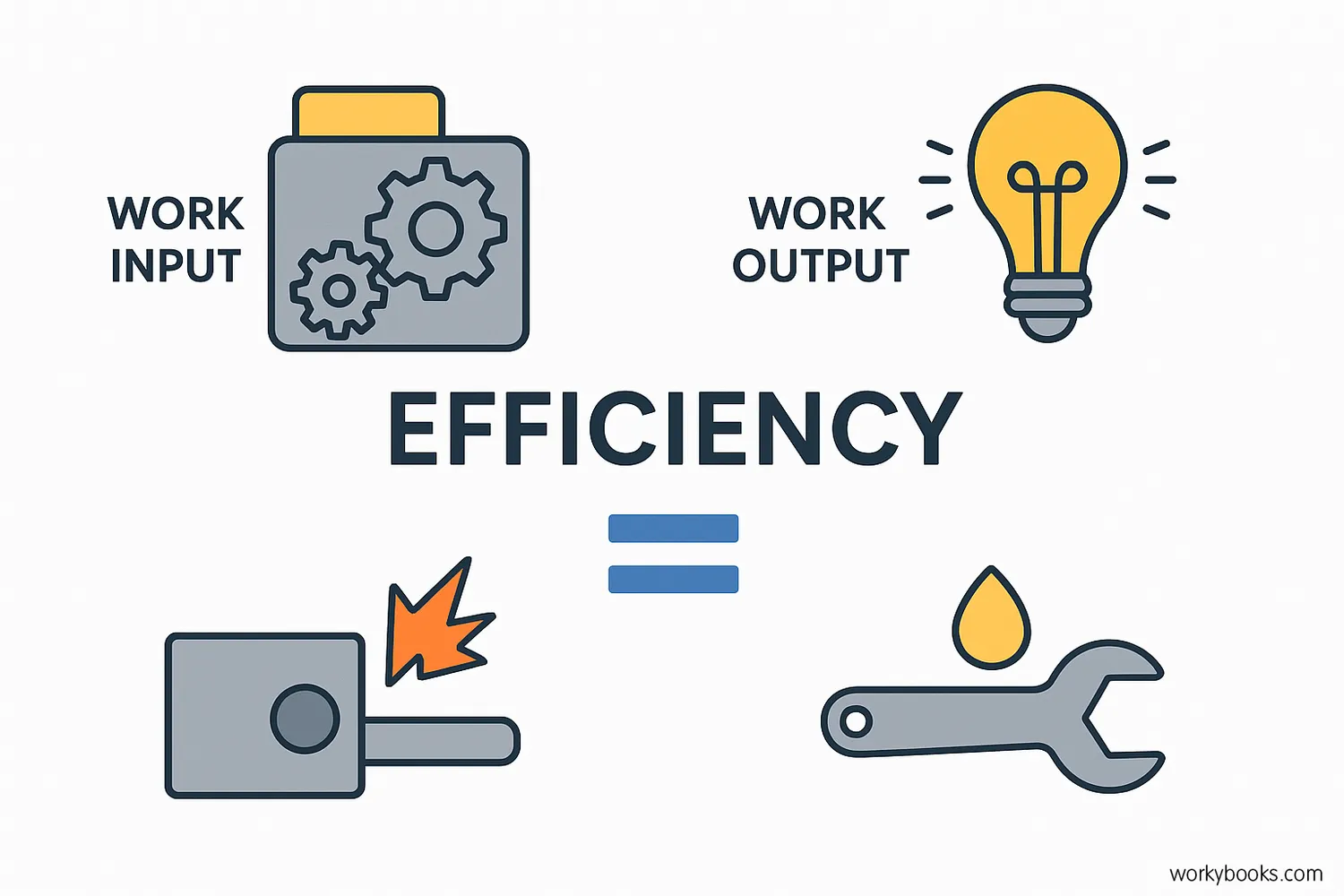
Efficiency is a key concept in science and engineering that explains how well a machine or system converts the energy it receives into useful work. When a person uses a bicycle, for example, not all of the energy from their legs is transferred to moving the bike forward. Some energy is lost to friction, such as the rubbing of the tires on the road and the moving parts within the gears. This means that the bicycle is not perfectly efficient.
Scientists define efficiency as the ratio of useful work output to total work input, expressed as a percentage. The formula for efficiency is:
Efficiency = (Work output ÷ Work input) × 100
This number is always less than 100% because some energy is always lost, usually as heat due to friction or other factors. For example, if a machine receives 200 joules of energy, but only produces 150 joules of useful work, its efficiency is (150 ÷ 200) × 100 = 75%. The remaining 25% of energy is lost, often as heat or sound.
How Do Machines Lose Efficiency?
Most machines lose efficiency because of friction, which is a force that resists motion between surfaces that touch. Friction causes some of the input energy to be converted into heat, rather than useful work. For example, in a car engine, moving parts rub against each other, generating heat that escapes into the environment. Even in simple machines like pulleys or levers, friction in the moving parts reduces how much output work you get compared to the input.
Another factor is energy transformation. When energy is converted from one form to another, such as electrical to mechanical energy in a fan, some of the original energy is lost as heat. No real machine can avoid these losses entirely. That is why scientists have never created a perpetual motion machine—a machine that can run forever without any energy input. Such a machine would require 100% efficiency, which is impossible according to the law of conservation of energy.
Improving Efficiency: Solutions and Innovations
Engineers work to make machines as efficient as possible. They use lubrication (like oil or grease) to reduce friction between moving parts. Smoother surfaces and better design also help minimize energy losses. For example, modern wind turbines have aerodynamic blades shaped to reduce air resistance, which increases the amount of wind energy converted into electricity. Electric cars use advanced materials and designs to reduce friction in their motors and wheels, making them more efficient than traditional gasoline vehicles.
Increasing efficiency is important for saving energy, reducing pollution, and lowering costs. In factories, more efficient machines can do the same work while using less electricity. In homes, efficient appliances like refrigerators and washing machines help families use less energy and save money. Even small improvements in efficiency can have a big impact on the environment by reducing the demand for fossil fuels.
Why Perpetual Motion Machines Are Impossible
Despite many attempts throughout history, perpetual motion machines have never worked because they would violate fundamental scientific laws. The law of conservation of energy states that energy cannot be created or destroyed, only transformed. Every real machine loses some energy to friction or other forms of waste, making 100% efficiency—and thus perpetual motion—impossible.
Understanding machine efficiency helps scientists and engineers design better technologies for the future. As society works toward cleaner energy and less pollution, improving efficiency remains a critical goal in science and engineering.
Interesting Fact: Some of the most efficient electric motors used today can reach about 95% efficiency, but no machine is truly 100% efficient.
Comprehension quiz (10 questions)
1. What is the formula for calculating the efficiency of a machine?
2. Why can no real machine be 100% efficient?
3. What happens to the energy lost by a machine?
4. Which force causes moving parts in machines to lose energy?
5. According to the passage, what does lubrication do?
6. What does the law of conservation of energy state?
7. Why are perpetual motion machines impossible?
8. Which of the following is NOT a way to improve machine efficiency?
9. True or False: All machines can eventually be made 100% efficient if designed perfectly.
10. True or False: Electric motors can reach up to about 95% efficiency, but never 100%.
Perfect for the way you teach
- Build comprehension skills
- Auto-graded quiz
- Differentiated reading
- Read together at home
- Improve fluency
- Quiet reading time
- Reading curriculum support
- Independent practice
- Track Lexile growth