This learning resource is available in interactive and printable formats. The interactive worksheet can be played online and assigned to students. The Printable PDF version can be downloaded and printed for completion by hand.
This comprehensive passage introduces middle school students to the concept of simple machines, aligning with NGSS standards MS-PS3-1 and MS-PS3-2. Students will learn about the six classic types of simple machines—lever, pulley, inclined plane, wedge, screw, and wheel and axle—and how each changes the direction, distance, or amount of force applied to perform work. The passage emphasizes the underlying physics of input force, output force, and the trade-off between force and distance, reinforcing the idea that simple machines do not reduce the total amount of work required. Real-world examples and applications help students connect these concepts to everyday life, technology, and engineering. The passage is supported by a glossary, differentiated and Spanish versions, a multiple-choice quiz, writing prompts, and graphic organizers. Audio integration supports diverse learning styles and accessibility. This resource is ideal for classroom instruction, homework, or independent science exploration.
CONTENT PREVIEW
Expand content preview
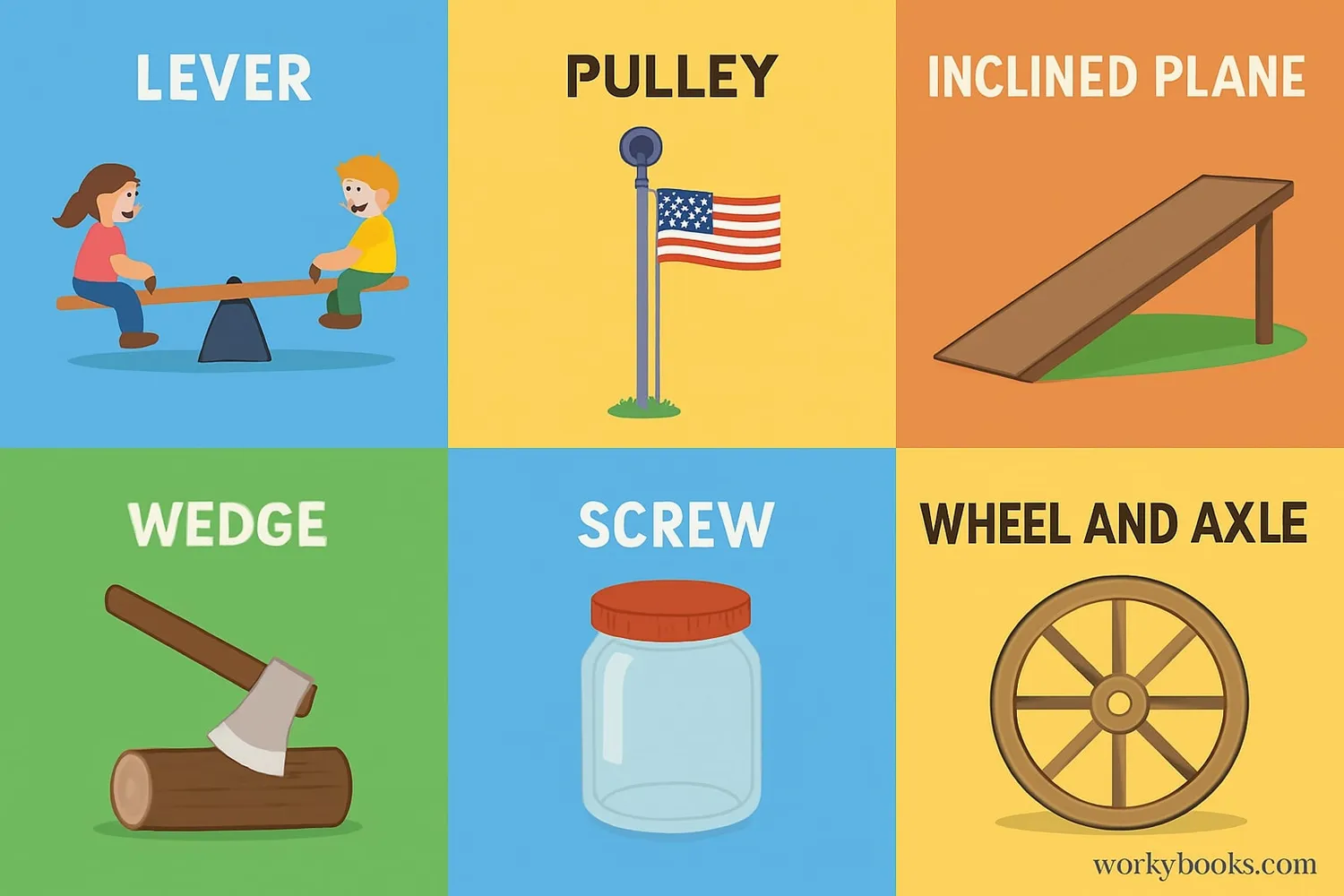
Illustration showing the six types of simple machines
Simple machines are fundamental devices that help people accomplish tasks by making work seem easier. In science, work means using a force to move something over a distance. Simple machines do not reduce the total amount of work required, but they can change the direction, distance, or size of the force involved. Understanding how simple machines function is essential for explaining how complex machines and technology operate.
How Simple Machines Work
There are six classic types of simple machines: the lever, pulley, inclined plane, wedge, screw, and wheel and axle. Each is designed to change how force is applied to make a job easier. For example, a lever is a rigid bar that pivots around a point called the fulcrum. By changing the position of the fulcrum and where the input force is applied, a lever can move heavier objects with less effort. A pulley is a wheel with a groove for a rope or cable; it lets you lift objects by changing the direction of the force you use. The inclined plane is a flat, sloped surface that allows you to raise a load more gradually, spreading the needed force over a longer distance.
Force, Distance, and Mechanical Advantage
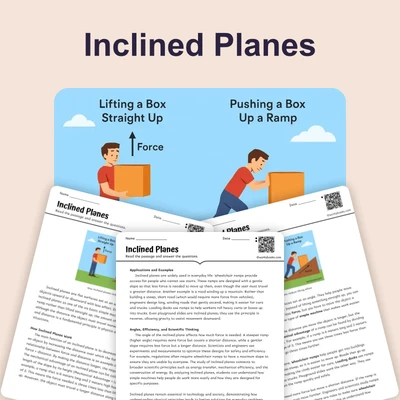
All simple machines work by trading force for distance. This means that if a machine allows you to use less force, you must apply it over a greater distance. The force you put into a machine is called the input force, and the force the machine applies to the load is called the output force. The mechanical advantage of a machine is the ratio of output force to input force. For example, using a long ramp (an inclined plane) to move a box into a truck requires less force than lifting the box straight up, but you have to push it a longer way. Simple machines do not decrease the amount of work done; instead, they make tasks easier by changing how the work is done.
Applications and Real-World Connections
Simple machines are everywhere in daily life and engineering. Scissors use two levers and two wedges. A screw holds things together by turning rotational force into linear motion. Bicycles use wheels and axles to reduce friction and pulleys in their gear systems. The principles behind simple machines are used in building bridges, designing tools, and creating new technologies. By understanding simple machines, scientists and engineers can invent more efficient devices and solve practical problems, such as lifting heavy materials or making transportation safer.
Simple machines are also a key example of the law of conservation of energy. No machine can create energy or do more work than the energy put in. Instead, machines help people use energy more effectively by making tasks possible or less tiring.
Interesting Fact: Archimedes, an ancient Greek scientist, studied levers and famously said, "Give me a place to stand and I will move the Earth."
What is the main purpose of a simple machine?
To make work easier by changing forceTo create more energyTo use electricityTo reduce speed
Which of the following is NOT one of the six classic simple machines?
GearScrewPulleyWheel and axle
What does the term 'input force' mean in the context of simple machines?
The force you put into a machineThe weight being liftedThe speed of the wheelThe length of the ramp
What is a fulcrum?
The fixed point on which a lever pivotsA type of wedgeA tool used to measure forceThe output force
Which simple machine is described as a flat, sloped surface?
Inclined planeWheel and axlePulleyLever
What does 'mechanical advantage' measure?
How much a machine multiplies forceThe speed of a machineThe cost of a machineHow many simple machines are used
Which statement best describes the relationship between force and distance in simple machines?
Less force means more distance is neededMore force always means less distanceForce and distance are not relatedSimple machines reduce both force and distance
Why are simple machines important in engineering and technology?
They help invent more efficient devices and solve problemsThey increase the total amount of work neededThey create energyThey replace all manual labor
True or False: Simple machines can decrease the total amount of work required to move an object.
TrueFalse
True or False: The law of conservation of energy states that machines can create energy.
TrueFalse
Perfect For:
👩🏫 Teachers
• Reading comprehension practice
• Auto-graded assessments
• Literacy skill development
👨👩👧👦 Parents
• Reading practice at home
• Comprehension improvement
• Educational reading time
🏠 Homeschoolers
• Reading curriculum support
• Independent reading practice
• Progress monitoring
Reading Features:
📖
Reading Passage
Engaging fiction or nonfiction text
❓
Comprehension Quiz
Auto-graded questions
📊
Instant Feedback
Immediate results and scoring
📄
Printable Version
Download for offline reading
🔊
Read Aloud
Voice-over with word highlighting
Reviews & Ratings
No reviews yet. Be the first to share your experience!
Related Content
Work and Energy
This science reading passage for grades 6-8 introduces students to the concepts of work and energy, aligned with NGSS st...
MS-PS3-1
Energy Transformations
This engaging middle school science passage explores the concept of energy transformations, aligning with NGSS standards...
MS-PS3-1MS-PS3-2MS-PS3-5
Conservation of Energy
This comprehensive science passage introduces middle school students to the fundamental principle of the law of conserva...
MS-PS3-1MS-PS3-2MS-PS3-5
Mechanical Energy
This comprehensive passage introduces middle school students to the concept of mechanical energy, defined as the sum of ...
MS-PS3-1MS-PS3-2
Work and Power
This comprehensive passage introduces middle school students to the scientific definitions of work and power, aligning w...
MS-PS3-1
Inclined Planes
This passage provides middle school students with a deep exploration of inclined planes, a fundamental type of simple ma...
MS-PS3-1MS-PS3-2
Wedges and Screws
This passage for grades 6-8 provides an in-depth exploration of wedges and screws as examples of simple machines. Studen...
MS-PS3-1MS-PS3-2
Wheel and Axle
This comprehensive middle school science passage explores the wheel and axle, a fundamental simple machine found in coun...
MS-PS3-1MS-PS3-2
Mechanical Advantage
This grade 6-8 science passage introduces students to the concept of mechanical advantage (MA) and its crucial role in u...
MS-PS3-1MS-PS3-2
Pulleys
This passage for grades 6-8 explores the science of pulleys, a fundamental simple machine that makes lifting objects eas...
MS-PS3-1MS-PS3-2
Electric Power and Energy
This middle school science reading passage, aligned to NGSS standard MS-PS3-1, explores the concepts of electric power a...
MS-PS3-1
Compound Machines
This middle school science passage explores the concept of compound machines, which are devices formed by combining two ...
MS-PS3-1MS-PS3-2
Efficiency of Machines
This comprehensive passage for grades 6-8 explores the concept of efficiency in machines, aligning with NGSS standards M...