Wheel and Axle
Interactive passage with audio narration, comprehension questions, and printable PDF.
By completing this purchase you agree to our Terms of Use and Privacy Policy. Your subscription renews automatically until you cancel. You can cancel anytime from your account settings. All sales are final and non-refundable. Digital content is available for download in your account immediately upon purchase.
What's included
Wheel and Axle preview and details
About this printable Wheel and Axle science reading passage, NGSS-aligned (Grades 5-8)
Sample passage and quiz from Wheel and Axle
Reading passage and comprehension quiz preview
Wheel and Axle
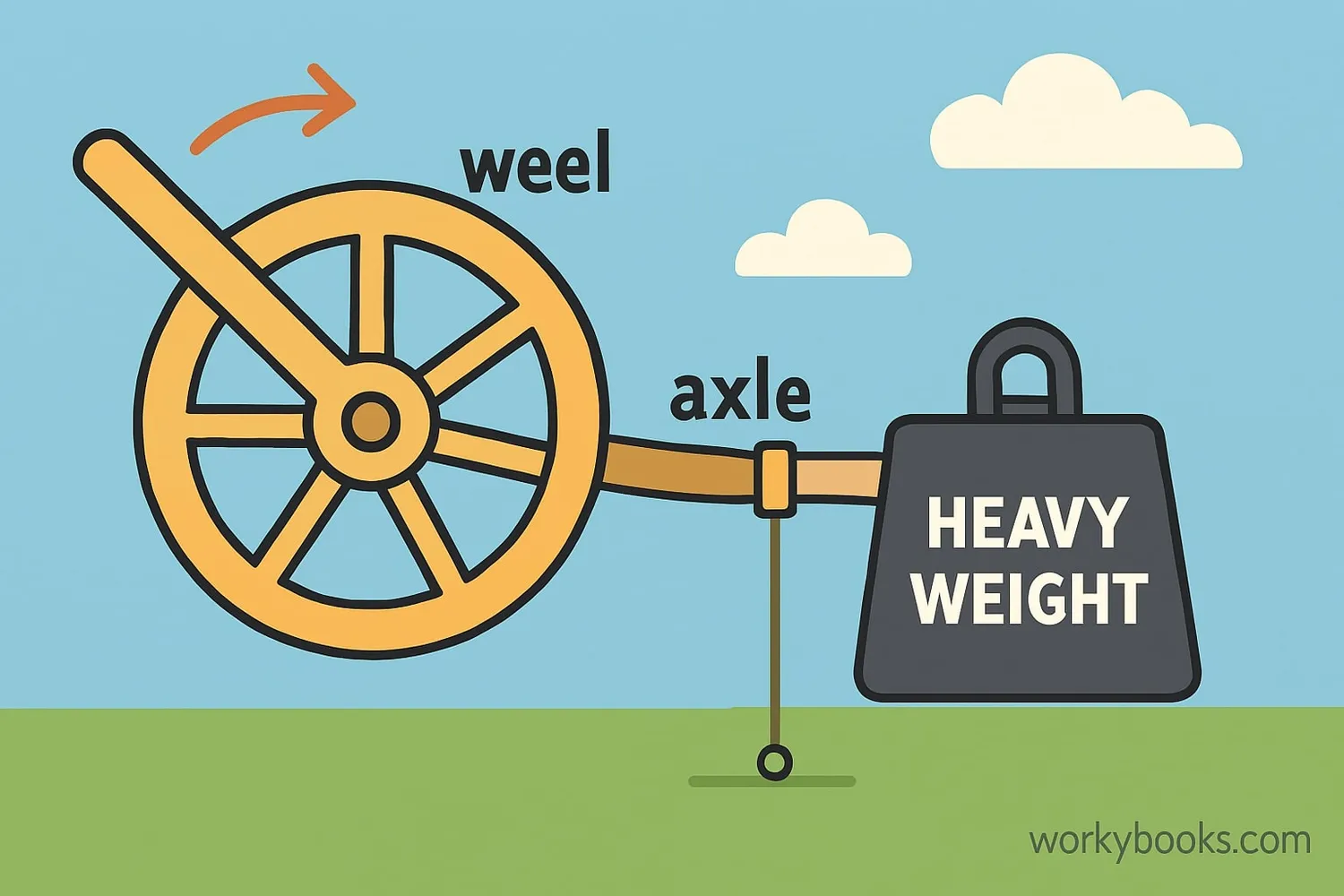
Wheel and axle systems are essential components in many machines and devices. When you turn a steering wheel, open a door with a doorknob, or ride a bicycle, you are using this important type of simple machine. The wheel and axle consists of a large circular wheel attached to a smaller cylinder called an axle. These two parts rotate together, changing how force is applied and transferred. Scientists study wheel and axle systems to understand how they make work easier and help solve real-world problems.
How Does a Wheel and Axle Work?
The wheel and axle operates by connecting a wheel with a larger radius to an axle with a smaller radius. When you apply force to the edge of the wheel, the axle turns. Because the wheel is larger, the force you use is spread out over a greater distance, but the axle turns with greater mechanical advantage. This means you can move heavy objects more easily, or generate more force at the axle than you could with your hands alone. For example, using a screwdriver (a type of wheel and axle), a small force applied to the handle turns the screw with much greater force at the tip. The relationship between the size of the wheel and the axle determines how much the force is increased or the distance is changed. Scientists measure this increase using the formula for mechanical advantage: Mechanical Advantage = Radius of Wheel / Radius of Axle.
Applications and Variations
The wheel and axle is not only used to multiply force, but also to increase speed and distance. If you apply force directly to the axle, the wheel at the edge moves a greater distance, but with less force. This is seen in devices like a bicycle wheel: when you pedal (applying force to the axle), the wheels spin quickly and cover more ground. Other examples include Ferris wheels, where motors turn the axle to spin the large wheel, allowing many people to ride around in a circle. Doorknobs are another example—turning the knob (the wheel) applies force to the axle inside the door, making it easier to open even heavy doors. Engineers and scientists use different sizes of wheels and axles to solve problems in transportation, construction, and even medicine.
Wheel and Axle in Science and Society
Understanding the wheel and axle helps scientists and engineers design machines that use energy more efficiently. By reducing the amount of force needed to move objects, the wheel and axle has transformed human technology from ancient carts to modern vehicles. Research shows that using the right combination of wheel and axle sizes can reduce energy use by up to 50% in some machines. The wheel and axle is a key example of how simple machines form the foundation of complex devices, connecting to broader scientific principles like energy transfer, efficiency, and the conservation of energy. As technology continues to advance, new variations of the wheel and axle will help solve challenges in transportation, health, and the environment.
Interesting Fact: The oldest known wheel, found in Mesopotamia, is over 5,000 years old and was part of a wheel and axle system for ancient carts.
Comprehension quiz (10 questions)
1. What is a wheel and axle?
2. Which of these is NOT an example of a wheel and axle?
3. According to the passage, what happens when you apply force to the wheel?
4. What is mechanical advantage?
5. How does the size of the wheel compared to the axle affect force?
6. What does the term 'efficiency' mean in the context of machines?
7. If you apply force to the axle instead of the wheel, what happens?
8. Why is the wheel and axle important in society?
9. True or False: The mechanical advantage of a wheel and axle can be measured by dividing the radius of the wheel by the radius of the axle.
10. True or False: Using the right combination of wheel and axle sizes can reduce energy use by up to 50% in some machines.
Perfect for the way you teach
- Build comprehension skills
- Auto-graded quiz
- Differentiated reading
- Read together at home
- Improve fluency
- Quiet reading time
- Reading curriculum support
- Independent practice
- Track Lexile growth