Wedges and Screws
Interactive passage with audio narration, comprehension questions, and printable PDF.
By completing this purchase you agree to our Terms of Use and Privacy Policy. Your subscription renews automatically until you cancel. You can cancel anytime from your account settings. All sales are final and non-refundable. Digital content is available for download in your account immediately upon purchase.
What's included
Wedges and Screws preview and details
About this printable Wedges and Screws science reading passage, NGSS-aligned (Grades 5-8)
Sample passage and quiz from Wedges and Screws
Reading passage and comprehension quiz preview
Wedges and Screws
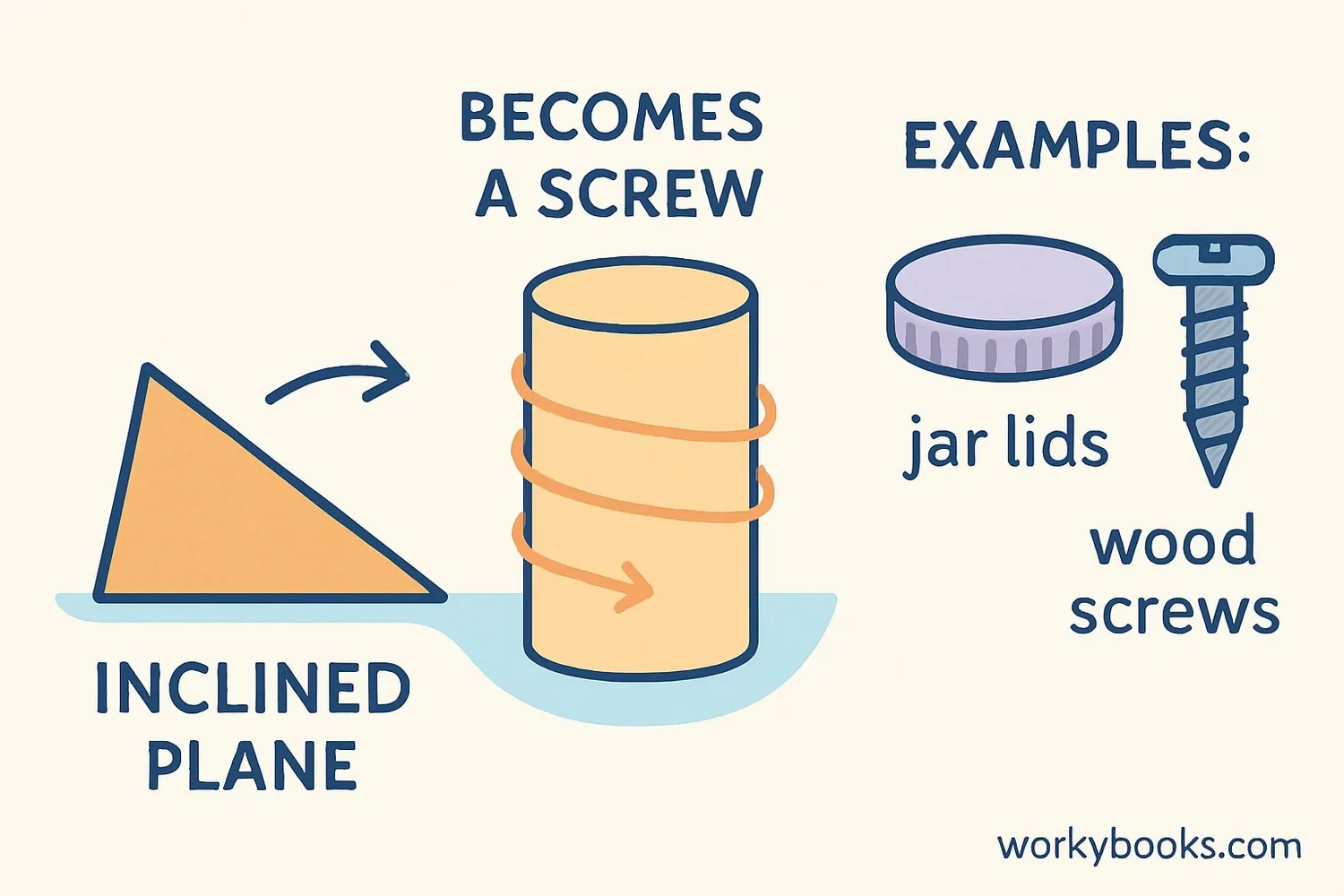
Wedges and screws are essential simple machines that have played a major role in shaping human technology. In everyday life, tools like axes, knives, and jar lids help us split, cut, or fasten materials. These devices may look different, but they are both based on the principle of the inclined plane. By understanding how wedges and screws work, we can see how simple machines allow us to multiply force, making difficult tasks much easier.
How Wedges Multiply Force
A wedge is formed by joining two inclined planes back-to-back. This shape allows a small input force to be transformed into a much larger output force, which can split or separate materials. For example, when you use an axe to split wood, the thin edge of the wedge enters the log first. As you push down, the shape of the wedge redirects your force sideways, forcing the wood fibers apart. A sharp knife works in a similar way, but is optimized for slicing rather than splitting. Other examples include chisels for carving and doorstops that hold doors open by wedging underneath. Even the tiny teeth of a zipper act as miniature wedges, separating and rejoining fabric with each pull. The mechanical advantage of a wedge depends on its length and width: a longer, thinner wedge requires less force but moves farther, while a shorter, thicker wedge needs more force but moves a shorter distance.
Screws: Turning Inclined Planes into Rotating Force
A screw is actually an inclined plane wrapped around a central cylinder. When a screw is turned, the threads push it forward or backward, depending on the direction of rotation. This design allows a small rotational force (called torque) to be converted into a large force that moves objects or holds them together tightly. Common examples are wood screws and bolts, which fasten objects, and even jar lids that twist on and off using the same principle. Spiral staircases are another example of large screws, where each step is part of an inclined plane spiraling upward. The closer together the threads are, the greater the mechanical advantage—the force is spread over a longer distance, but less effort is needed to move the screw. Screws are used in many machines to lift heavy objects, press materials together, or adjust precise positions in scientific equipment.
Wedges and Screws in Real-World Systems
Wedges and screws are more than individual tools; they are components of complex systems. For example, construction workers use wedges to split stone or wood, while surgeons rely on screws to hold bones together during healing. In technology, screws are essential in everything from electronics assembly to spacecraft construction, where secure fastening is critical. Both wedges and screws illustrate the conservation of energy: the work you put in is equal to the work you get out, but the force and distance can be traded off. Exploring these simple machines helps us understand fundamental physical laws—like how mechanical advantage allows us to do more with less effort. Innovations in wedge and screw design continue to improve safety, efficiency, and precision in many fields.
In summary, wedges and screws show how the concept of the inclined plane can be adapted for many purposes. By multiplying force and redirecting energy, these simple machines have transformed the way humans work with materials. Their principles remain at the core of modern engineering, design, and everyday problem-solving.
Interesting Fact:
The ancient Egyptians used giant wooden wedges, soaked in water, to split huge stone blocks for building pyramids—a technique that still amazes scientists today!
Comprehension quiz (10 questions)
1. What is a wedge in terms of simple machines?
2. Which of the following is an example of a screw?
3. What is the main function of a wedge?
4. In the passage, what does 'mechanical advantage' mean?
5. How does wrapping an inclined plane around a cylinder make a screw?
6. Why do surgeons use screws during healing?
7. What is the effect of having closer threads on a screw?
8. True or False: A wedge can only be used for splitting wood.
9. True or False: The principle of conservation of energy means energy can be created when using a wedge or screw.
10. Which scientific principle is illustrated by both wedges and screws?
Perfect for the way you teach
- Build comprehension skills
- Auto-graded quiz
- Differentiated reading
- Read together at home
- Improve fluency
- Quiet reading time
- Reading curriculum support
- Independent practice
- Track Lexile growth