Pulleys
Interactive passage with audio narration, comprehension questions, and printable PDF.
What's included
Pulleys preview and details
About this printable Pulleys science reading passage, NGSS-aligned (Grades 5-8)
Sample passage and quiz from Pulleys
Reading passage and comprehension quiz preview
Pulleys: Making Work Easier
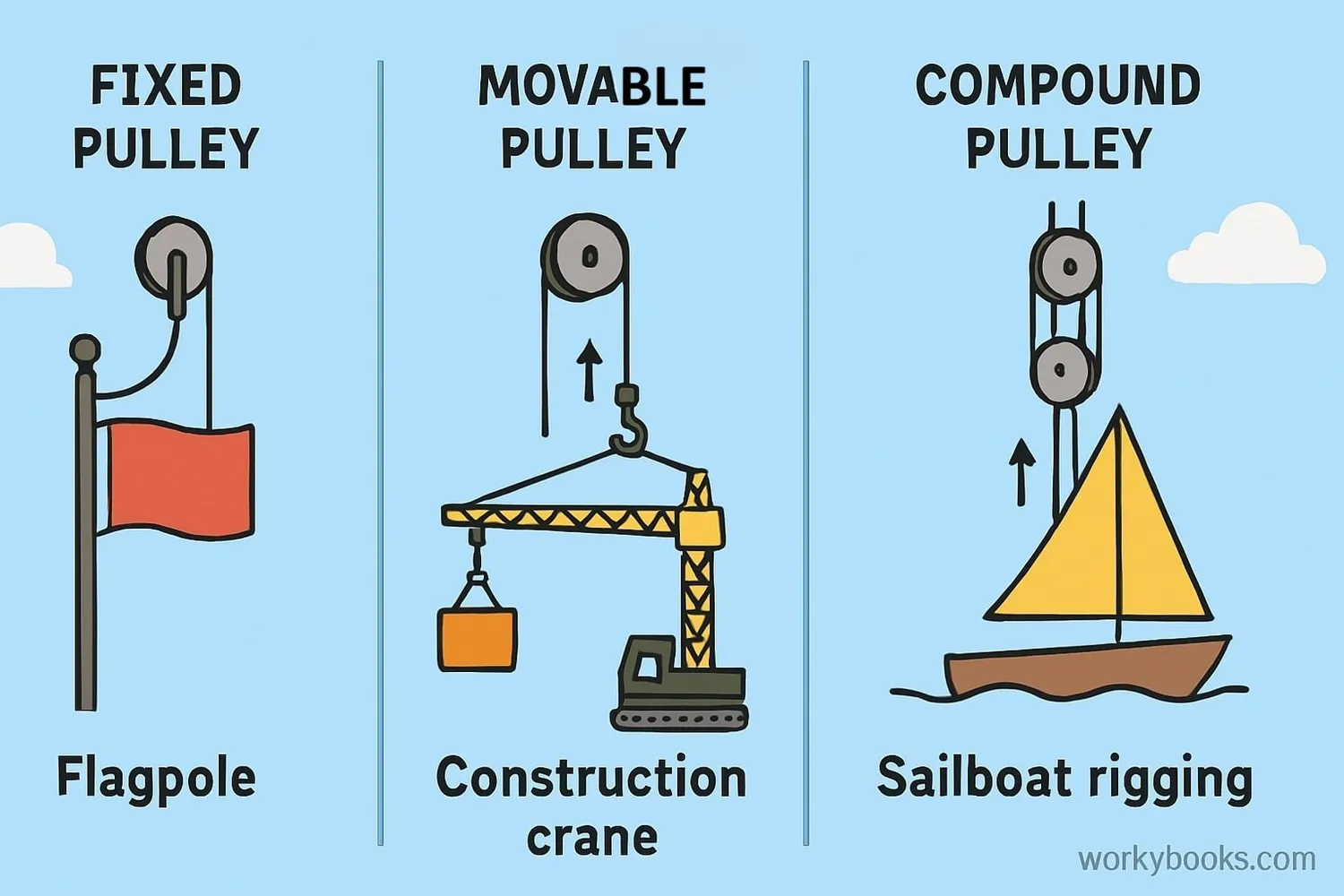
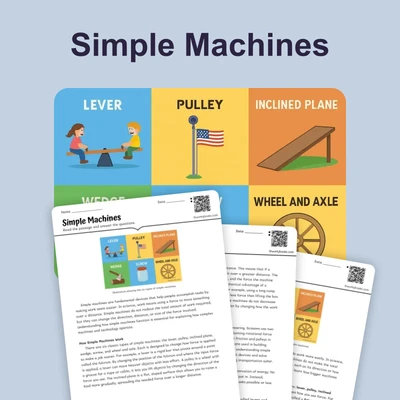
Pulleys are one of the most important simple machines used in engineering and daily life. When raising a flag on a flagpole or lifting heavy objects with a crane, pulleys play a critical role in reducing the effort needed. A pulley consists of a grooved wheel with a rope or cable running along its edge. By changing how force is applied, pulleys help solve problems involving lifting or moving loads.
How Pulleys Work: Force, Direction, and Mechanical Advantage
At the core, a pulley changes the direction or size of the force needed to move an object. In a fixed pulley, the wheel is attached to one spot. Pulling down on the rope lifts a load upward, but the amount of force needed stays the same as the weight of the object. The key benefit is changing the direction of the force. In contrast, a movable pulley is attached to the load itself. Here, the pulley moves with the load, and only half the force is required to lift the object, although you must pull twice as much rope. This decrease in required force is called mechanical advantage. For example, in construction, movable pulleys are used to lift building materials more easily.
Pulley Systems: Combining Pulleys for Greater Effect
When several pulleys are combined, they create a pulley system or a block and tackle. These systems use both fixed and movable pulleys to multiply the mechanical advantage. For instance, cranes lifting tons of material use complex pulley systems to reduce the force required by operators. Elevator systems also rely on pulley systems to raise and lower cars smoothly and safely. The main trade-off is that as you add more pulleys, the force required decreases, but the length of rope that must be pulled increases. In some cases, pulling six meters of rope will only lift a load one meter.
Real-Life Examples and Broader Scientific Connections
Pulleys are found in many places, from window blinds to gym equipment. The principles behind pulleys connect to the law of conservation of energy, which states that energy cannot be created or destroyed, only transformed. While pulleys make lifting easier, the total amount of work (force times distance) remains the same. Engineers and scientists use pulleys to design machines that maximize efficiency and safety in transportation, industry, and everyday life.
Understanding pulleys demonstrates how simple machines shape technology and how humans apply scientific principles to solve practical problems.
Interesting Fact:
Ancient Egyptians used pulley systems to help build the pyramids, moving massive stones with surprisingly little force!
Comprehension quiz (10 questions)
1. What is the main function of a pulley?
2. Which type of pulley only changes the direction of the force applied?
3. What happens to the required force when a movable pulley is used?
4. What is the main trade-off when using more pulleys in a system?
5. In the context of the passage, what is 'mechanical advantage'?
6. Which of the following best describes a block and tackle?
7. According to the passage, what is a real-world example where pulleys are used?
8. True or False: The total amount of work changes when pulleys are used.
9. True or False: Using more pulleys in a system always means you need less rope.
10. What scientific law is related to how pulleys work, as mentioned in the passage?
Perfect for the way you teach
- Build comprehension skills
- Auto-graded quiz
- Differentiated reading
- Read together at home
- Improve fluency
- Quiet reading time
- Reading curriculum support
- Independent practice
- Track Lexile growth