Work and Energy
Interactive passage with audio narration, comprehension questions, and printable PDF.
By completing this purchase you agree to our Terms of Use and Privacy Policy. Your subscription renews automatically until you cancel. You can cancel anytime from your account settings. All sales are final and non-refundable. Digital content is available for download in your account immediately upon purchase.
What's included
Work and Energy preview and details
About this printable Work and Energy science reading passage, NGSS-aligned (Grades 5-8)
Sample passage and quiz from Work and Energy
Reading passage and comprehension quiz preview
Work and Energy
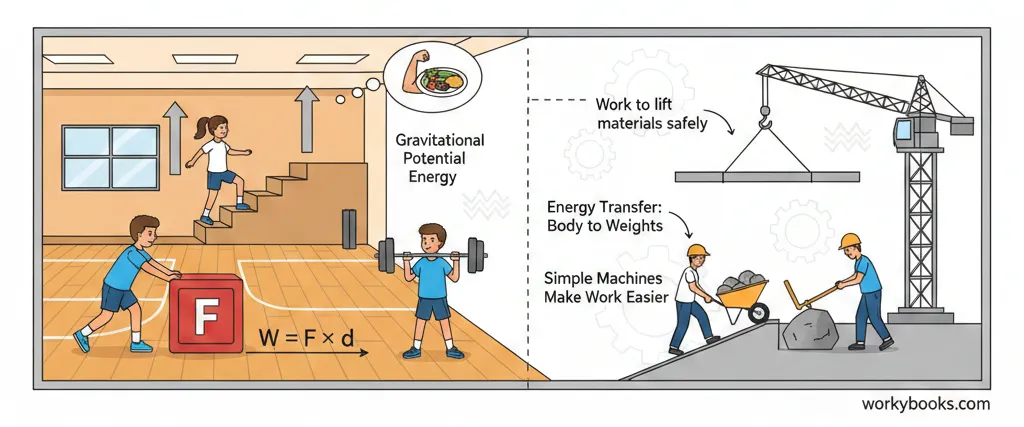
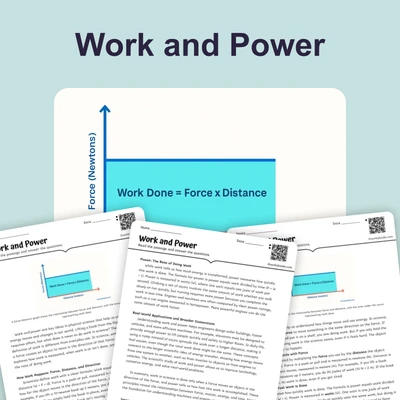
Work is a key concept in science that explains how objects move and how energy changes form. In physics, work is not just about doing chores or tasks. It is defined as the result of a force applied to an object, causing it to move over a certain distance. Scientists measure work using the formula W = F × d, where W is work, F is force, and d is distance. Understanding work helps explain how energy moves and changes in the world around us.
How Work Happens: The Role of Force and Distance
For work to be done in the scientific sense, two things must happen: a force must act on an object, and the object must move in the direction of that force. For example, when you push a box across the floor, you apply a force and the box moves the same way you push. The amount of work you do depends on how hard you push (the force) and how far the box travels (the distance). If you push harder or move the box farther, you do more work. However, if you hold a book in place without moving it, even if it feels heavy, you are not doing scientific work because the book does not move. This shows that movement is necessary for work to be done.
Work and Energy: Transfer and Transformation
When work is done, energy is transferred from one object or system to another. Energy is the ability to do work. For instance, when you climb stairs, your muscles use chemical energy from food to do work against gravity, lifting your body upward. The work you do increases your gravitational potential energy—energy stored by being higher above the ground. Lifting weights in the gym is another example: you apply force to raise the weights, transferring energy from your body to the weights. This process demonstrates how work connects force, motion, and energy change.
Applications and Exceptions: More about Work
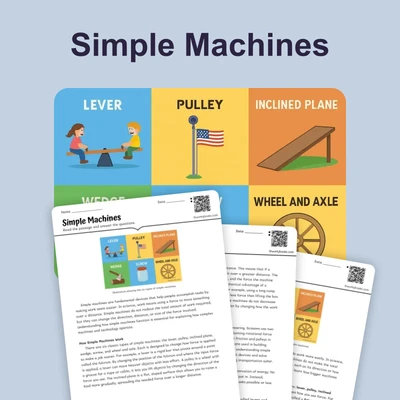
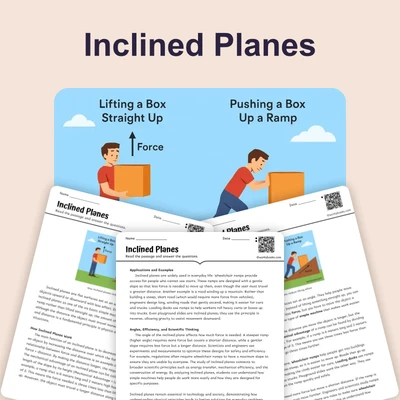
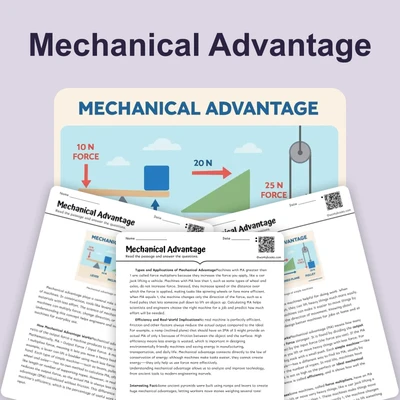
Not every action that feels tiring counts as work in science. Carrying a heavy bag across a room, for example, requires effort, but if the force you exert is upward and you move sideways, no work is done on the bag in the direction of the force. This difference is important in engineering and technology, where understanding work helps design machines that use energy more efficiently. In construction, engineers calculate the work needed to lift materials safely. Everyday tools like ramps and levers make work easier by reducing the force needed or increasing the distance over which the force is applied.
Work and energy are central to understanding motion, machines, and living systems. By defining work precisely and exploring how energy is transferred, scientists can solve problems and create new technologies that improve our lives.
Interesting Fact: The unit of work is called the joule (J), named after physicist James Prescott Joule, who helped discover how work and energy are related.
Comprehension quiz (10 questions)
1. What must happen for work to be done in the scientific sense?
2. Which formula do scientists use to measure work?
3. What kind of energy increases as you climb stairs?
4. If you hold a heavy book without moving, are you doing scientific work?
5. What does the word 'transfer' mean in the context of energy?
6. What is the meaning of 'system' as used in the passage?
7. Why is carrying a bag sideways not considered work in science?
8. How do ramps and levers help with work?
9. Work is measured in units called joules. (True/False)
10. If an object moves in the direction of the force, work is being done. (True/False)
Perfect for the way you teach
- Build comprehension skills
- Auto-graded quiz
- Differentiated reading
- Read together at home
- Improve fluency
- Quiet reading time
- Reading curriculum support
- Independent practice
- Track Lexile growth