This learning resource is available in interactive and printable formats. The interactive worksheet can be played online and assigned to students. The Printable PDF version can be downloaded and printed for completion by hand.
This engaging history reading passage explores the Minoans, one of the earliest civilizations of the Bronze Age located on the island of Crete in Ancient Greece. Students will learn about the Minoans’ achievements in trade, art, and technology, their advanced palace at Knossos, and the impact of geography on their development. The passage addresses social hierarchy, daily life, and important archaeological discoveries like Linear A and vibrant frescoes. Students will analyze cause and effect, continuity and change, and the Minoans’ influence on later Greek civilization. Activities include a glossary, reading comprehension quiz, writing prompts, Spanish translation, and graphic organizers, all aligned to CA HSS 6.1 and CCSS RH.6-8.1, RH.6-8.4. Read aloud audio and a differentiated version support accessibility, making this resource ideal for history learners.
CONTENT PREVIEW
Expand content preview
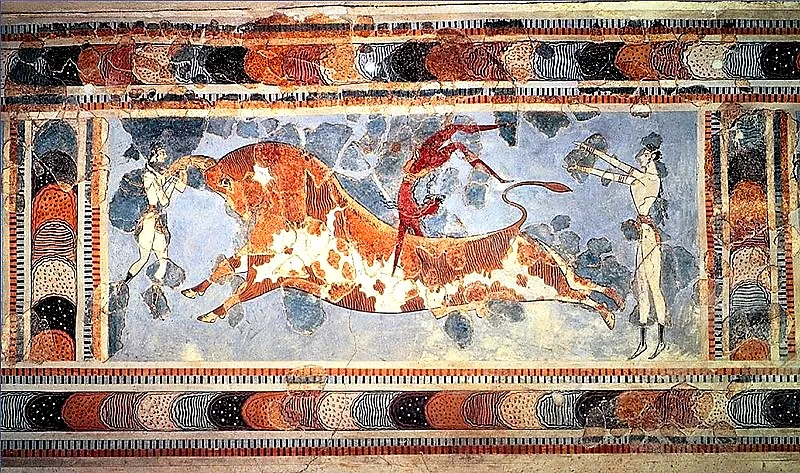
Colorful frescoes on the palace walls show scenes of daily life, festivals, and mysterious rituals. unknown ancient artist. Wikimedia Commons -
The Minoans were an ancient civilization that flourished on the island of Crete from around 2000 to 1450 BCE. Centered at the grand palace of Knossos, the Minoans are recognized as some of the earliest and most influential people of the Bronze Age in the Aegean Sea region. Their society was shaped by the geography of Crete, a large, fertile island with access to important sea routes. The Minoans took advantage of their location by becoming skilled sailors and traders, exchanging goods like pottery, olive oil, and metalwork with Egypt, Mesopotamia, and mainland Greece.
The heart of Minoan civilization was the Palace of Knossos, which covered over six acres and included hundreds of rooms, intricate frescoes, and advanced features such as indoor plumbing. Archaeologists believe that the palace was not just a royal residence, but also a religious and economic center. Colorful frescoes on the palace walls show scenes of daily life, festivals, and mysterious rituals, providing primary evidence about Minoan society. For example, the famous 'Bull-Leaping' fresco possibly depicts a ceremonial sport or religious rite, highlighting the importance of religion and public events.
Unlike many ancient societies, the Minoans seem to have had a relatively peaceful existence with few signs of war or fortifications. Their economy was based on trade, skilled craftspeople, and agriculture. Minoan society had different social classes, including a ruling elite, priests or priestesses, and artisans. Women appeared to have had a significant role in religious life, as suggested by statues of female deities and priestesses found at Knossos. The Minoans developed their own system of writing called Linear A, though it has not yet been fully deciphered. Clay tablets and seals with Linear A have been discovered, offering tantalizing clues into their administration and culture.
The decline of the Minoan civilization is still debated by historians. Around 1450 BCE, many of their palaces were destroyed, possibly due to natural disasters such as the eruption of the volcano on the island of Thera (modern Santorini), or invasions by Mycenaeans from mainland Greece. While the exact cause is unclear, the end of the Minoan civilization marked a turning point in Aegean history, as their art, architecture, and religious ideas influenced later Greek cultures, especially the Mycenaeans.
The Minoans’ achievements in trade, art, and technology demonstrate how geography, innovation, and cross-cultural contact shaped one of the earliest European civilizations. Their legacy reminds us that ancient peoples were connected and influenced by the world around them, a key theme throughout ancient history.
Interesting Fact: The myth of the Minotaur and the labyrinth is believed to have originated from stories about the complex Palace of Knossos and Minoan bull-leaping rituals.
Where did the Minoans live?
CreteAthensRomeEgypt
What was the main Minoan palace?
KnossosSpartaTroyBabylon
Which writing did the Minoans invent?
Linear ACuneiformHieroglyphicsPhoenician
Why was Crete important for trade?
Its sea locationGold minesTall mountainsLarge forests
How did Minoan art show daily life?
In frescoesOn coinsIn booksThrough statues only
What shows women’s role in Minoan religion?
Statues of priestessesGold coinsMetal weaponsShips
The Minoans had many wars. True or false?
TrueFalse
What is a fresco?
Wall paintingShipPalaceWriting
Perfect For:
👩🏫 Teachers
• Reading comprehension practice
• Auto-graded assessments
• Literacy skill development
👨👩👧👦 Parents
• Reading practice at home
• Comprehension improvement
• Educational reading time
🏠 Homeschoolers
• Reading curriculum support
• Independent reading practice
• Progress monitoring
Reading Features:
📖
Reading Passage
Engaging fiction or nonfiction text
❓
Comprehension Quiz
Auto-graded questions
📊
Instant Feedback
Immediate results and scoring
📄
Printable Version
Download for offline reading
🔊
Read Aloud
Voice-over with word highlighting
Reviews & Ratings
No reviews yet. Be the first to share your experience!
Related Content
Geography of Ancient Greece
This rigorous history reading passage explores 'The Geography of Ancient Greece,' examining how the region’s mountains, ...
Homer: Epic Poet of Ancient Greece
This history reading passage explores the life and historical significance of Homer, the legendary epic poet of Ancient ...
Ancient Sparta
This reading passage explores the unique military society of Sparta, an influential city-state in Ancient Greece. Studen...
Greek Polis
This in-depth history reading passage explores the rise and development of the Greek polis, or city-state, a foundationa...
Ancient Greek City-States
This history reading passage explores the development and significance of city-states in ancient civilizations, focusing...
Greece's Lasting Legacy
This engaging history reading passage explores the enduring legacy of Ancient Greece and its profound influence on the m...
Evidence in Ancient History
This engaging history reading passage investigates how archaeologists and historians discover clues about how ancient pe...
Ancient Philosophy
This reading passage takes students on a journey through the philosophical traditions of ancient Greece, India, and Chin...
Euripides and Greek Drama
This engaging passage introduces students to Euripides, one of the greatest ancient Greek playwrights, known for his exp...
Women in Ancient Societies
This reading passage explores the complex roles of women in the ancient world, focusing on civilizations such as Mesopot...
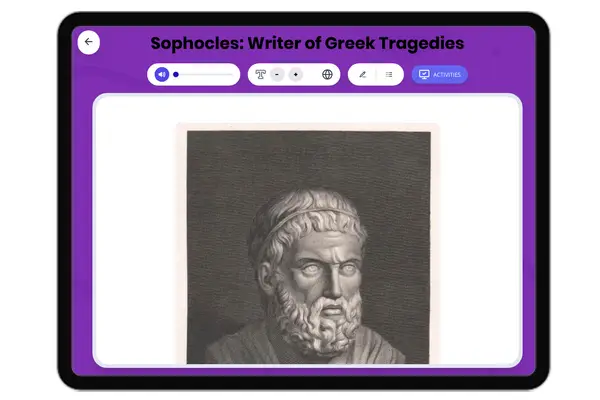
Sophocles and Greek Tragedy
This passage explores the life and legacy of Sophocles, one of the most influential playwrights of ancient Greece, whose...
Ancient Literature
This passage explores the importance of ancient stories and poems from civilizations such as Greece, India, and Israel. ...
Ancient Science and Medicine
This comprehensive reading passage explores the development of science and medicine in ancient civilizations, including ...
Slavery in Ancient World
This passage explores the complex history of slavery in the ancient world, examining its presence in societies such as M...
Ancient Theocracy
This engaging history reading passage explores the concept of theocracy in ancient civilizations, where priests and reli...
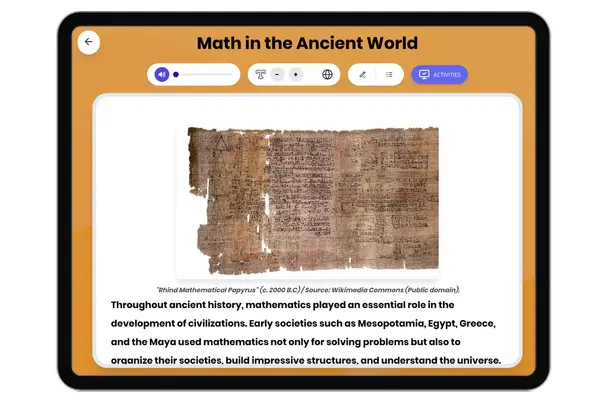
Ancient Mathematics
This passage explores the essential role of mathematics in ancient civilizations, including Mesopotamia, Egypt, Greece, ...
Ancient Canaan
This educational passage explores the land of Canaan, the historical homeland of the ancient Israelites. Students will l...
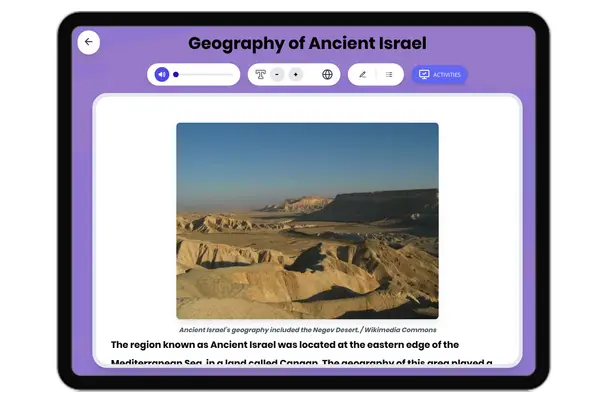
Geography of Ancient Israel
This passage explores the rich geography of Ancient Israel, focusing on how landforms, climate, and natural resources sh...
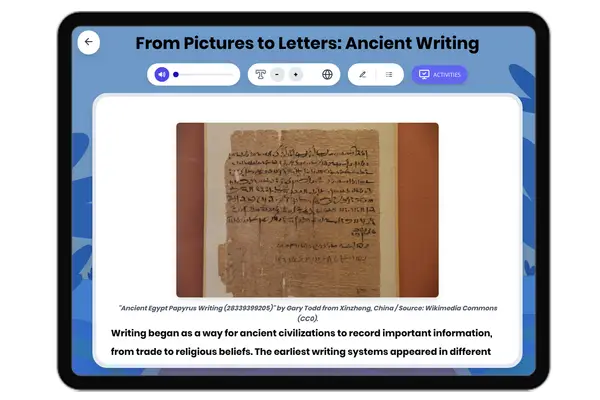
Ancient Writing Systems
This engaging history reading passage explores the origins and evolution of ancient writing systems, including cuneiform...
Ancient Agriculture Farming
This passage explores the transformative impact of farming on ancient societies, examining how the Neolithic Revolution ...