New Immigrant Communities
Interactive passage with audio narration, comprehension questions, and printable PDF.
By completing this purchase you agree to our Terms of Use and Privacy Policy. Your subscription renews automatically until you cancel. You can cancel anytime from your account settings. All sales are final and non-refundable. Digital content is available for download in your account immediately upon purchase.
What's included
New Immigrant Communities preview and details
About this printable New Immigrant Communities reading passage (Grades 6-8)
Sample passage and quiz from New Immigrant Communities
Reading passage and comprehension quiz preview
New Immigrant Communities
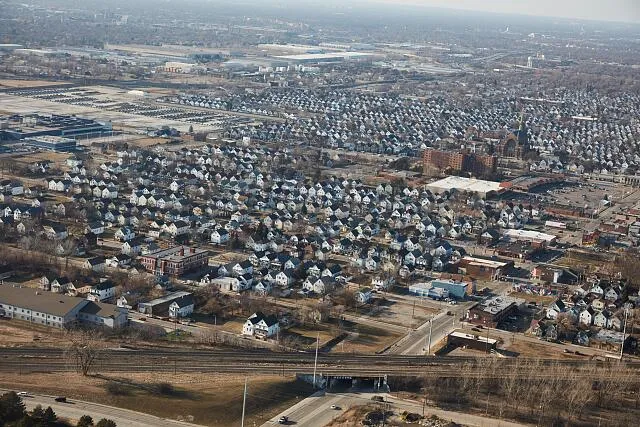
"Aerial view of a large neighborhood of nearly identical houses in Hamtramck, Michigan, next to Detroit " once the homes of waves of European (largely Polish) immigrants who arrived to work in Detroit's then-thriving auto plants. The Polish influence remains, but the city is now a multi-ethnic community" by Highsmith, Carol M., 1946- / Library of Congress.
During the Progressive Era, millions of immigrants arrived in American cities seeking new opportunities and a better life. Many newcomers settled in urban areas, where jobs in factories and businesses were available. These immigrants often faced significant challenges, including language barriers, unfamiliar customs, and limited financial resources. To address these difficulties, immigrants frequently gathered in ethnic enclaves, or neighborhoods where people from the same country or region lived close to each other.
Ethnic enclaves provided a sense of community and support. In these neighborhoods, immigrants could speak their native language, enjoy familiar foods, and practice shared traditions. Local institutions such as churches, synagogues, and clubs helped maintain cultural ties. For example, Little Italy in New York City became a center for Italian immigrants, while Chinese immigrants formed a vibrant Chinatown in San Francisco. These neighborhoods helped newcomers adjust to life in the United States while preserving their unique identities.
However, living in ethnic enclaves was not without problems. Crowded housing and poor sanitation were common because cities grew quickly and lacked adequate infrastructure. Many immigrant families lived in cramped tenements with limited access to clean water and fresh air. In addition, some Americans viewed immigrant communities with suspicion or prejudice, believing that newcomers would not assimilate into American society. This sometimes led to discrimination, making it harder for immigrants to find jobs and participate fully in civic life.
Despite these obstacles, immigrant communities created important solutions. Mutual aid societies, which were organizations formed by immigrants to help one another, provided financial assistance, health care, and job connections. Children often attended public schools, where they learned English and American customs. Over time, many immigrants and their descendants became active citizens, contributing to the economic and cultural growth of their cities. The blending of traditions led to a rich, diverse urban culture.
The story of new immigrant communities is one of both struggle and resilience. While they faced significant hardships, these groups developed creative ways to overcome adversity and build supportive environments. Their experiences highlight the complex relationship between preserving cultural heritage and adapting to a new country. Today, the legacy of these communities is visible in the diverse neighborhoods, foods, festivals, and traditions found throughout American cities.
Interesting Fact: Ellis Island, opened in 1892, processed over 12 million immigrants entering the United States, many of whom went on to form new communities in cities across the nation.
Comprehension quiz (8 questions)
1. When did Ellis Island open?
2. What is an ethnic enclave?
3. Which city is Little Italy located in?
4. Why did immigrants form mutual aid societies?
5. What problem did many immigrant families face?
6. How did public schools help immigrant children?
7. Immigrants always had easy lives in cities. True or false?
8. What does 'assimilate' mean?
Perfect for the way you teach
- Build comprehension skills
- Auto-graded quiz
- Differentiated reading
- Read together at home
- Improve fluency
- Quiet reading time
- Reading curriculum support
- Independent practice
- Track Lexile growth