This learning resource is available in interactive and printable formats. The interactive worksheet can be played online and assigned to students. The Printable PDF version can be downloaded and printed for completion by hand.
This U.S. History reading passage focuses on the role of Muckrakers in exposing corruption during the Progressive Era, a transformative period in American society. Students will analyze the motivations, methods, and impact of investigative journalists such as Upton Sinclair and Ida Tarbell, using historical evidence and primary source excerpts. The passage encourages critical thinking by comparing different perspectives, addressing the complexities of reform, and examining the consequences of exposing corruption. Activities include a reading comprehension quiz, writing prompts, a T-Chart graphic organizer, and a timeline of key events. Glossary terms help students master academic vocabulary, while a Spanish translation and read aloud audio support diverse learners. The lesson aligns with standards D2.His.2.3-5, D2.His.3.3-5, RI.4.3, RI.4.4, and W.4.2, making this a rigorous and engaging resource for history classrooms.
CONTENT PREVIEW
Expand content preview
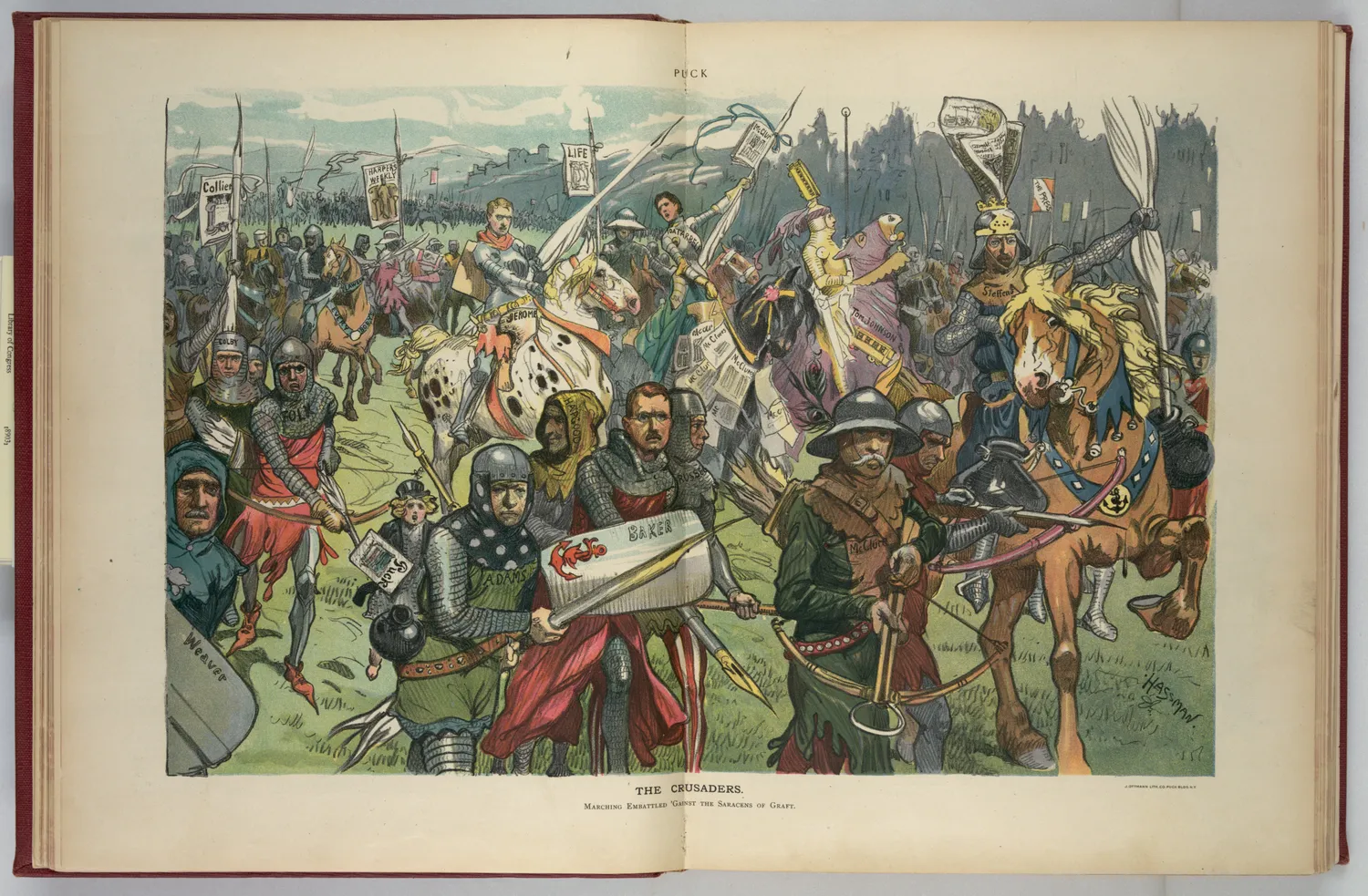
"The crusaders - C. Hassman. LCCN2011645818" by Hassmann, Carl, 1869-1933, artist. Source: Wikimedia Commons (Public domain).
During the Progressive Era of the early 1900s, a group of journalists known as muckrakers played a vital role in American society. These journalists used their skills in writing and reporting to reveal problems such as government corruption, unsafe working conditions, and social injustices. Through careful investigation, muckrakers brought hidden issues to light, sparking public outrage and inspiring real reforms that changed the country.
The United States at the turn of the twentieth century was rapidly industrializing. Cities grew larger, factories multiplied, and many immigrants arrived seeking better lives. However, this rapid growth led to serious problems. Factories often ignored safety rules, politicians sometimes accepted bribes, and powerful business owners formed monopolies that limited competition. Many Americans did not know about these issues because those in power tried to keep them secret. Muckrakers saw these problems and decided to act by using exposure through newspapers and magazines.
One famous muckraker was Ida Tarbell, who investigated the Standard Oil Company. Her detailed articles revealed unfair business practices and helped lead to the company’s breakup by the government under antitrust laws. Another influential muckraker, Upton Sinclair, wrote the novel "The Jungle" in 1906. Sinclair’s investigation of Chicago meatpacking plants exposed unsanitary conditions and mistreatment of workers. His work shocked the public and directly influenced the passage of the Pure Food and Drug Act and the Meat Inspection Act, which set new safety standards for food.
Not all muckrakers focused on business. Lincoln Steffens published reports about political corruption in city governments, while Jacob Riis used photography to document the harsh lives of poor immigrants in crowded tenements. Muckrakers used a variety of tools—writing, photography, statistics, and interviews—to build their cases. Their commitment to evidence and truth helped convince ordinary people and lawmakers that reform was necessary.
Despite their contributions, muckrakers sometimes faced criticism. Some business leaders and politicians accused them of exaggerating problems or causing unnecessary panic. However, most historians agree that muckrakers used objective methods to report facts. Their work demonstrated the importance of a free press in a democracy and showed how journalism can serve as a check on power and protect public interests.
The legacy of the muckrakers is still felt today. Modern investigative journalists continue to expose wrongdoing and hold leaders accountable. Muckrakers proved that well-researched journalism could make a difference by informing citizens and promoting positive change in society.
Interesting Fact: President Theodore Roosevelt gave muckrakers their name, comparing them to someone who rakes up dirt to reveal what lies beneath.
Who was Ida Tarbell?
A muckraker journalistA meatpacking ownerA city mayorA factory worker
What did Upton Sinclair write?
The JungleTenementsStandard OilThe Pure Food Act
Which law was passed after Sinclair’s work?
Meat Inspection ActSherman ActVoting Rights ActCivil Rights Act
How did muckrakers expose problems?
Through reporting and writingBy running for officeBy closing factoriesThrough protests
Why were monopolies a problem?
They limited competitionThey helped workersThey built schoolsThey improved cities
What was a result of muckraker reporting?
Reforms and new lawsFewer newspapersMore monopoliesLess immigration
Muckrakers only wrote about food safety. True or false?
TrueFalse
What does 'corruption' mean?
Dishonest behavior by people in powerSafe working conditionsA new lawHelping immigrants
Perfect For:
👩🏫 Teachers
• Reading comprehension practice
• Auto-graded assessments
• Literacy skill development
👨👩👧👦 Parents
• Reading practice at home
• Comprehension improvement
• Educational reading time
🏠 Homeschoolers
• Reading curriculum support
• Independent reading practice
• Progress monitoring
Reading Features:
📖
Reading Passage
Engaging fiction or nonfiction text
❓
Comprehension Quiz
Auto-graded questions
📊
Instant Feedback
Immediate results and scoring
📄
Printable Version
Download for offline reading
🔊
Read Aloud
Voice-over with word highlighting
Reviews & Ratings
No reviews yet. Be the first to share your experience!
Related Content
Native American Tribes Across America
This engaging history reading passage introduces students to Native American tribes across America, focusing on their da...
D2.HIS.1.3-5D2.HIS.2.3-5RI.4.1RI.4.2
Teepees: Homes on the Great Plains
This engaging history reading passage introduces students to teepees, the unique homes of Native American tribes on the ...
D2.HIS.2.3-5D2.HIS.14.3-5RI.4.1RI.4.2RI.4.4
Traditional Native American Clothing
This engaging history passage explores traditional Native American clothing and how it reflected the environment, values...
D2.HIS.2.3-5D2.HIS.3.3-5RI.4.3RI.4.4
The Iroquois Confederacy: A System of Peace
This engaging U.S. History reading passage introduces students to the Iroquois Confederacy, a powerful alliance of Nativ...
D2.HIS.2.3-5D2.HIS.3.3-5RI.4.3RI.4.4
The Cherokee Nation: History and Culture
This reading passage explores the rich history and culture of the Cherokee Nation, one of the largest Native American tr...
D2.HIS.2.3-5D2.HIS.14.3-5RI.4.3RI.4.4RI.4.10
The Sioux: Warriors and Tribal Leaders
This history reading passage explores the Sioux Nation, focusing on their roles as warriors and tribal leaders. Students...
D2.HIS.1.3-5D2.HIS.2.3-5RI.4.1RI.4.3
Native American Respect for Nature
This engaging history reading passage explores Native American respect for nature, emphasizing the close relationship be...
D2.HIS.2.3-5D2.HIS.3.3-5RI.4.3RI.4.4
Jamestown: The First Permanent English Colony
This engaging history passage explores the founding of Jamestown, the first permanent English colony in America. Aligned...
D2.HIS.1.3-5D2.HIS.2.3-5RI.4.3RI.4.4
Pocahontas and the Powhatan People
This engaging reading passage explores the life of Pocahontas and the Powhatan people and their important role in early ...
D2.HIS.1.3-5D2.HIS.2.3-5RI.4.1RI.4.3
Colonial Children: School and Chores
This reading passage explores the daily lives of colonial children, focusing on their experiences at school and their ma...
D2.HIS.2.3-5D2.HIS.3.3-5RI.4.1RI.4.2RI.4.4
Colonial Clothing and Homemade Goods
This engaging U.S. history passage explores the daily life of early American colonists with a focus on colonial clothing...
D2.HIS.2.3-5RI.4.3RI.4.4
Colonial Jobs: Blacksmiths, Bakers, and Craftsmen
This engaging history reading passage explores the vital roles of blacksmiths, bakers, and craftsmen in colonial America...
D2.HIS.2.3-5D2.HIS.3.3-5RI.4.3RI.4.4
Colonial Towns and Village Life
This engaging history reading passage explores the daily life, work, and unity found in colonial towns and villages. Ali...
D2.HIS.1.3-5D2.HIS.2.3-5RI.4.3RI.4.4
Colonial Trade with England and Africa
This history reading passage explores colonial trade between the American colonies, England, and Africa, focusing on the...
D2.HIS.2.3-5D2.HIS.14.3-5RI.4.3RI.4.4
Benjamin Franklin: Printer, Inventor, and Leader
This history reading passage explores the life and achievements of Benjamin Franklin, one of America's most important ea...
D2.HIS.2.3-5D2.HIS.3.3-5RI.4.1RI.4.3
George Washington Leads the Army
This engaging history reading passage explores how George Washington bravely led the Continental Army during the America...
D2.HIS.1.3-5D2.HIS.2.3-5RI.4.3RI.4.4
Women and Children During the Revolutionary War
This reading passage explores the important roles women and children played during the Revolutionary War. Students will ...
D2.HIS.2.3-5RI.4.3RI.5.3
African Americans Fight for Freedom
This educational passage explores the brave and inspiring story of how African Americans fought for freedom in the Unite...
D2.HIS.2.3-5D2.HIS.3.3-5RI.4.3RI.4.4
The Battle of Yorktown Ends War
This engaging U.S. history reading passage explores the Battle of Yorktown, a key event that ended the American Revoluti...
D2.HIS.1.3-5D2.HIS.2.3-5RI.4.1RI.4.3
Loyalists vs. Patriots: Divided Families
This engaging U.S. history reading passage explores the division between Loyalists and Patriots during the American Revo...