This learning resource is available in interactive and printable formats. The interactive worksheet can be played online and assigned to students. The Printable PDF version can be downloaded and printed for completion by hand.
This informational reading passage for grades 6-8 provides a comprehensive look at osmosis and its critical role in cell function. Aligned with NGSS standard MS-LS1-2, the content explains how water moves across selectively permeable membranes, defines hypertonic, hypotonic, and isotonic solutions, and details their effects on animal and plant cells. The passage illustrates scientific mechanisms, presents real-world scenarios (like why slugs die from salt or why plants wilt), and connects to broader scientific principles of systems and interactions. Glossary terms are highlighted for vocabulary development. The resource includes a Spanish translation, a differentiated version for struggling readers, quizzes, writing activities, and graphic organizers. Audio integration supports diverse learners, making it ideal for classroom or independent study.
CONTENT PREVIEW
Expand content preview
Osmosis is a critical process in biology that controls how water moves in and out of cells. In living organisms, the balance of water inside and outside each cell affects its shape, health, and ability to function. When this balance is disturbed, cells can swell, shrink, or even burst. Understanding osmosis explains why plants wilt, why drinking salt water is dangerous, and why salt kills slugs.
Mechanism of Osmosis: Moving Water Across Membranes
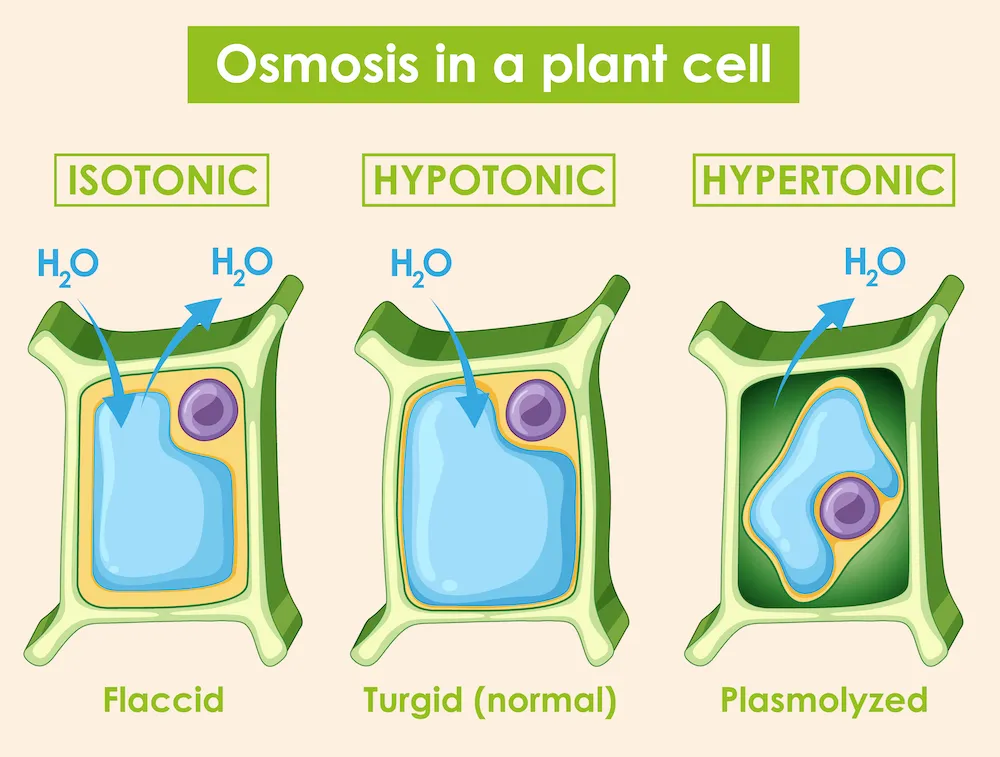
Osmosis occurs when water molecules move across a selectively permeable membrane from an area of higher water concentration to an area of lower water concentration. The membrane allows water to pass, but not most dissolved substances. Solutions outside the cell can be hypertonic, hypotonic, or isotonic. In a hypertonic solution (higher solute concentration outside), water leaves the cell, causing it to shrink. In a hypotonic solution (lower solute outside), water enters the cell, causing it to swell. In an isotonic solution, water moves equally in both directions, and the cell stays the same size.
For example, if an animal cell is placed in pure water (a hypotonic solution), water rushes in, and the cell may burst. In salty water (hypertonic), the cell loses water and shrivels. Plant cells behave differently: in a hypotonic solution, water entering the cell increases turgor pressure, making the plant firm. In hypertonic solutions, plant cells lose water, and the cell membrane pulls away from the wall—a process called plasmolysis.
Real-World Effects and Applications
Osmosis has important consequences for living things. When gardeners sprinkle salt on slugs, water leaves their bodies by osmosis, causing them to dehydrate and die. Plants wilt when the soil becomes too salty, drawing water out of their roots. Drinking salt water can be dangerous for humans because it makes blood hypertonic, pulling water out of cells and causing dehydration. In medicine, saline solutions are used in IV fluids to match the body's isotonic conditions and avoid harming cells.
Scientists study osmosis using experiments with plant cells and artificial membranes. Data shows that water can cross membranes quickly—sometimes at rates of thousands of water molecules per second per channel protein. The principles of osmosis also guide food preservation (like salting meat or pickling) and environmental management.
Interactions and Broader Implications
Osmosis demonstrates how cells interact with their environments and maintain homeostasis. The balance of water is part of a larger system that includes nutrient transport, waste removal, and cell communication. Disrupting osmosis can lead to disease, stress, or death in cells. Understanding osmosis helps scientists develop better treatments, improve agriculture, and protect ecosystems.
Osmosis is a key concept in understanding how life maintains stability in changing environments. It connects to larger scientific ideas about systems, energy, and equilibrium in living things.
Interesting Fact: Some desert plants have adapted cell membranes that control osmosis so well they can survive in extremely salty soils!
What is osmosis?
The movement of water across a selectively permeable membraneThe movement of oxygen into cellsThe movement of solutes through a cell membraneThe process of photosynthesis
What happens to an animal cell placed in a hypertonic solution?
It swells and burstsIt shrivels as water leavesIt stays the same sizeIt becomes more flexible
Why do plant cells become firm in a hypotonic solution?
Water leaves the cellTurgor pressure increases as water entersThe cell wall dissolvesPlasmolysis occurs
What is the main function of a selectively permeable membrane?
It allows all substances to pass freelyIt blocks all moleculesIt lets some substances, like water, pass while blocking othersIt produces energy for the cell
What does isotonic mean in relation to cell solutions?
More water outside the cellLess water outside the cellEqual water and solute concentration inside and outside the cellNo water present
What happens to plant cells in a hypertonic solution?
They gain water and become turgidThey lose water and plasmolysis occursThey burst openThey begin photosynthesis
Which real-world example is caused by osmosis?
Slugs dying when salt is sprinkled on themBirds migrating in winterFrogs croaking at nightLeaves changing color in autumn
Why is drinking salt water dangerous for humans?
It provides no nutrientsIt makes blood hypertonic, pulling water out of cellsIt causes plants to wiltIt increases turgor pressure
T/F: In an isotonic solution, water moves only into the cell.
TrueFalse
T/F: Plasmolysis happens when a plant cell loses water in a hypertonic environment.
TrueFalse
Perfect For:
👩🏫 Teachers
• Reading comprehension practice
• Auto-graded assessments
• Literacy skill development
👨👩👧👦 Parents
• Reading practice at home
• Comprehension improvement
• Educational reading time
🏠 Homeschoolers
• Reading curriculum support
• Independent reading practice
• Progress monitoring
Reading Features:
📖
Reading Passage
Engaging fiction or nonfiction text
❓
Comprehension Quiz
Auto-graded questions
📊
Instant Feedback
Immediate results and scoring
📄
Printable Version
Download for offline reading
🔊
Read Aloud
Voice-over with word highlighting
Reviews & Ratings
No reviews yet. Be the first to share your experience!
Related Content
Antonie van Leeuwenhoek and the Discovery of Animalcules
This NGSS-aligned science passage explores the groundbreaking work of Antonie van Leeuwenhoek, a pioneer in microscopic ...
MS-LS1-1MS-LS1-2
Robert Hooke and the Naming of 'Cells'
This NGSS-aligned reading passage introduces middle school students to Robert Hooke's discovery and naming of 'cells' in...
MS-LS1-1MS-LS1-2
Rudolf Virchow and His Contribution to Cell Theory
This NGSS-aligned science reading passage introduces students to Rudolf Virchow, a key historical figure in cell biology...
MS-LS1-1MS-LS1-2
Matthias Schleiden and the Discovery That Plants Are Made of Cells
This NGSS-aligned science passage explains how Matthias Schleiden, a German scientist in the 1830s, discovered that all ...
MS-LS1-1MS-LS1-2
When Was the Microscope Invented?
This NGSS-aligned reading passage introduces students to the invention of the microscope, an essential scientific tool. ...
MS-LS1-1MS-LS1-2
What are Prokaryotic Cells?
This NGSS-aligned science reading passage explains prokaryotic cells, the simplest type of cells found in single-celled ...
MS-LS1-1MS-LS1-2
What are Eukaryotic Cells?
This NGSS-aligned reading passage introduces middle school students to eukaryotic cells, which are complex cells found i...
MS-LS1-1MS-LS1-2
Prokaryotic vs. Eukaryotic Cells
This NGSS-aligned reading passage helps middle school students compare prokaryotic and eukaryotic cells. Supporting stan...
MS-LS1-1MS-LS1-2
What is an Organelle?
This NGSS-aligned reading passage introduces middle school students to the concept of organelles. Supporting MS-LS1-
MS-LS1-1MS-LS1-2
Chromoplast: Nature's Color Palette
This passage details chromoplast functions in pigment production, ecological signaling, and nutrition. Aligned with NGSS...
MS-LS1-1MS-LS1-2MS-LS1-6LS1.C
Parts of the Cell
This informational science passage, aligned with NGSS standard MS-LS1-1, introduces students to the parts of the cell an...
MS-LS1-1MS-LS1-2
The Nucleolus and Its Function
This NGSS-aligned reading passage focuses on the nucleolus, a key structure inside the cell’s nucleus responsible for ma...
MS-LS1-1MS-LS1-2
What Is Vapor Pressure?
This NGSS-aligned science passage explains the concept of vapor pressure in an age-appropriate, engaging way for middle ...
MS-PS1-4MS-LS1-2
Cell Membrane Transport
This middle school science reading passage explores how cell membranes regulate the movement of substances in and out of...
MS-LS1-2
Cell Structure and Function
This middle school science passage introduces the fundamental concept that cells are the basic unit of life, aligned wit...
MS-LS1-1MS-LS1-2
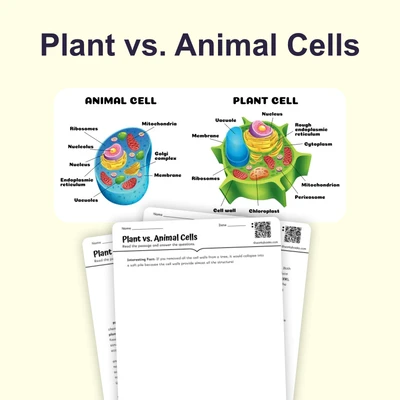
Plant vs. Animal Cells
This comprehensive science passage introduces students in grades 6-8 to the similarities and differences between plant a...
MS-LS1-2
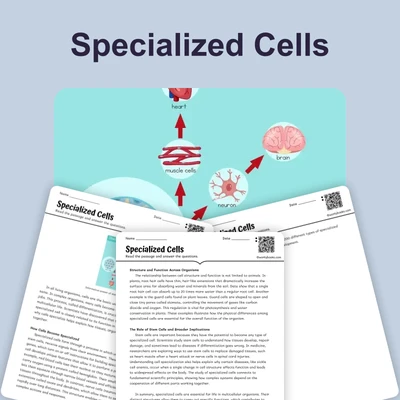
Specialized Cells
This passage introduces middle school students to the concept of specialized cells and explains how their unique structu...
MS-LS1-1MS-LS1-2
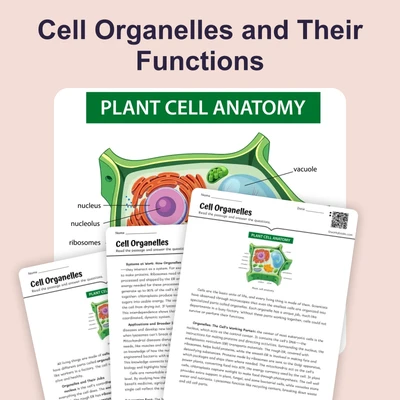
Cell Organelles
This comprehensive science passage for grades 6-8 explores the structure and function of major cell organelles within eu...
MS-LS1-2
Cell Membrane Structure
This comprehensive passage explores the structure and function of the cell membrane, aligning with NGSS standard MS-LS1-...