This learning resource is available in interactive and printable formats. The interactive worksheet can be played online and assigned to students. The Printable PDF version can be downloaded and printed for completion by hand.
This passage introduces middle school students to the concept of specialized cells and explains how their unique structures determine their functions within multicellular organisms. Aligned to NGSS standards MS-LS1-1 and MS-LS1-2, it begins with observable phenomena and then explores the mechanisms of cell differentiation, providing detailed examples such as red blood cells, nerve cells, muscle cells, plant root hair cells, and guard cells. The text also connects these ideas to stem cells and discusses the broader significance for human health, technology, and society. Designed for grades 6-8, the resource includes an accessible, differentiated version, Spanish translations, quizzes, writing prompts, and graphic organizers. Audio integration supports various learners. Ideal for classrooms seeking a standards-based, cross-disciplinary approach to life science, this resource helps students build a foundational understanding of how structure and function are connected at the cellular level.
CONTENT PREVIEW
Expand content preview
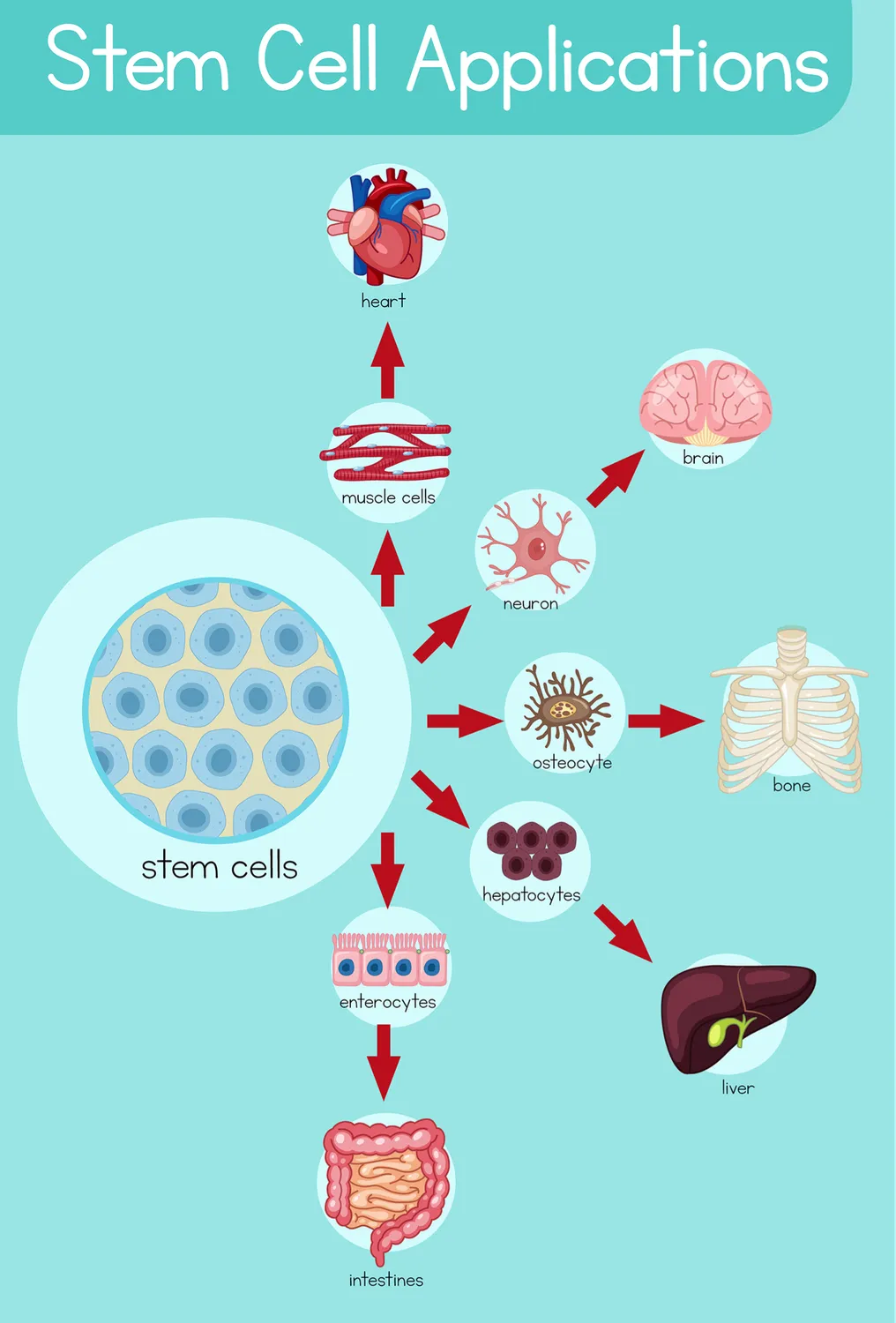
Informative poster of stem cell applications
In all living organisms, cells are the basic units of life. But not all cells are the same. In complex organisms, many cells become specialized to perform particular jobs. This process, called differentiation, is crucial for the survival and health of multicellular life. Scientists have discovered that the unique structure of each specialized cell is closely related to its function in the body. Understanding how and why cells specialize helps explain how tissues, organs, and entire systems work together.
How Cells Become Specialized
Specialized cells form through a process in which undifferentiated cells, known as stem cells, receive signals from their environment. These signals activate certain genes, which turn on or off instructions for building specific proteins. As a result, the cell develops unique features that allow it to perform a particular function. For example, red blood cells lose their nucleus as they mature, making more room to carry oxygen using a protein called hemoglobin. Their small, flexible, disc-like shape lets them squeeze through narrow blood vessels and efficiently deliver oxygen to tissues throughout the body. In contrast, nerve cells (neurons) develop long extensions called axons and dendrites, which allow them to send electrical signals rapidly over long distances. This structure enables the nervous system to coordinate complex actions and responses.
Structure and Function Across Organisms
The relationship between cell structure and function is not limited to animals. In plants, root hair cells have thin, hair-like extensions that dramatically increase the surface area for absorbing water and minerals from the soil. Data show that a single root hair cell can absorb up to 20 times more water than a regular root cell. Another example is the guard cells found on plant leaves. Guard cells are shaped to open and close tiny pores called stomata, controlling the movement of gases like carbon dioxide and oxygen. This regulation is vital for photosynthesis and water conservation in plants. These examples illustrate how the physical differences among specialized cells are essential for the overall function of the organism.
The Role of Stem Cells and Broader Implications
Stem cells are important because they have the potential to become any type of specialized cell. Scientists study stem cells to understand how tissues develop, repair damage, and sometimes lead to diseases if differentiation goes wrong. In medicine, researchers are exploring ways to use stem cells to replace damaged tissues, such as heart muscle after a heart attack or nerve cells in spinal cord injuries. Understanding cell specialization also helps explain why certain diseases, like sickle cell anemia, occur when a single change in cell structure affects function and leads to widespread effects on the body. The study of specialized cells connects to fundamental scientific principles, showing how complex systems depend on the cooperation of different parts working together.
In summary, specialized cells are essential for life in multicellular organisms. Their distinct structures allow them to carry out specific functions, which contributes to the health and survival of the entire organism. From carrying oxygen to sending signals or absorbing water, each cell’s role is shaped by its unique form. As science advances, understanding the mechanisms of cell differentiation offers new possibilities for treating diseases and improving human health.
Interesting Fact: The human body contains over 200 different types of specialized cells, all originating from stem cells early in development.
What is the main reason cells become specialized in multicellular organisms?
To perform specific functions needed by the organismTo become larger and strongerTo move around the body freelyTo create more energy for the organism
What do red blood cells lose as they mature to help them carry more oxygen?
Their nucleusTheir cell wallTheir mitochondriaTheir membrane
Which plant cell increases water and mineral absorption from soil by having hair-like extensions?
Root hair cellGuard cellNerve cellRed blood cell
Why are guard cells important to plants?
They open and close stomata to control gas exchange.They transport food through the stem.They absorb sunlight for photosynthesis.They store water in roots.
What is the function of a nerve cell’s long extensions (axons and dendrites)?
To send electrical signals quickly over long distancesTo store nutrients for the cellTo absorb food from the bloodstreamTo provide protection to organs
In the passage, what does the word "differentiation" mean?
The process where a cell becomes specialized for a certain jobThe movement of cells in the bodyThe loss of a cell’s nucleusThe doubling of cell size
Based on the passage, what is a stem cell?
A cell that can become any type of specialized cellA cell that only forms plant rootsA cell found only in animalsA cell that cannot change its function
How does the structure of a cell relate to its function?
The shape and parts of a cell help it do a specific jobAll cells have the same structure and functionThe structure is not important for cell functionCells change function but not structure
True or False: Stem cells are already specialized to do a single job.
TrueFalse
True or False: A single change in a cell’s structure can cause diseases like sickle cell anemia.
TrueFalse
Perfect For:
👩🏫 Teachers
• Reading comprehension practice
• Auto-graded assessments
• Literacy skill development
👨👩👧👦 Parents
• Reading practice at home
• Comprehension improvement
• Educational reading time
🏠 Homeschoolers
• Reading curriculum support
• Independent reading practice
• Progress monitoring
Reading Features:
📖
Reading Passage
Engaging fiction or nonfiction text
❓
Comprehension Quiz
Auto-graded questions
📊
Instant Feedback
Immediate results and scoring
📄
Printable Version
Download for offline reading
🔊
Read Aloud
Voice-over with word highlighting
Reviews & Ratings
No reviews yet. Be the first to share your experience!
Related Content
Antonie van Leeuwenhoek and the Discovery of Animalcules
This NGSS-aligned science passage explores the groundbreaking work of Antonie van Leeuwenhoek, a pioneer in microscopic ...
MS-LS1-1MS-LS1-2
Robert Hooke and the Naming of 'Cells'
This NGSS-aligned reading passage introduces middle school students to Robert Hooke's discovery and naming of 'cells' in...
MS-LS1-1MS-LS1-2
Rudolf Virchow and His Contribution to Cell Theory
This NGSS-aligned science reading passage introduces students to Rudolf Virchow, a key historical figure in cell biology...
MS-LS1-1MS-LS1-2
Matthias Schleiden and the Discovery That Plants Are Made of Cells
This NGSS-aligned science passage explains how Matthias Schleiden, a German scientist in the 1830s, discovered that all ...
MS-LS1-1MS-LS1-2
When Was the Microscope Invented?
This NGSS-aligned reading passage introduces students to the invention of the microscope, an essential scientific tool. ...
MS-LS1-1MS-LS1-2
What are Prokaryotic Cells?
This NGSS-aligned science reading passage explains prokaryotic cells, the simplest type of cells found in single-celled ...
MS-LS1-1MS-LS1-2
What are Eukaryotic Cells?
This NGSS-aligned reading passage introduces middle school students to eukaryotic cells, which are complex cells found i...
MS-LS1-1MS-LS1-2
Prokaryotic vs. Eukaryotic Cells
This NGSS-aligned reading passage helps middle school students compare prokaryotic and eukaryotic cells. Supporting stan...
MS-LS1-1MS-LS1-2
What is an Organelle?
This NGSS-aligned reading passage introduces middle school students to the concept of organelles. Supporting MS-LS1-
MS-LS1-1MS-LS1-2
Chromoplast: Nature's Color Palette
This passage details chromoplast functions in pigment production, ecological signaling, and nutrition. Aligned with NGSS...
MS-LS1-1MS-LS1-2MS-LS1-6LS1.C
Parts of the Cell
This informational science passage, aligned with NGSS standard MS-LS1-1, introduces students to the parts of the cell an...
MS-LS1-1MS-LS1-2
The Nucleolus and Its Function
This NGSS-aligned reading passage focuses on the nucleolus, a key structure inside the cell’s nucleus responsible for ma...
MS-LS1-1MS-LS1-2
Golgi Apparatus and Its Function
This NGSS-aligned reading passage introduces middle school students to the structure and function of the Golgi apparatus...
MS-LS1-1
Is a Platypus a Mammal?
This interactive science reading passage, titled "Is a Platypus a Mammal? The Monotreme Mystery!", delves into the uniqu...
MS-LS1-1
Where Do Platypus Live?
This engaging science reading passage, titled "Where Do Platypus Live? Finding Australia's Elusive Swimmer," explores th...
MS-LS1-1
The Amazing Red Panda
This engaging science reading passage, titled "The Amazing Red Panda: A Fluffy Tree Dweller," introduces students to one...
MS-LS1-1MS-LS4-D
Where Do Red Pandas Live?
This science reading passage, titled "Where Do Red Pandas Live? In the Mountain Forests," explores the specific habitat ...
MS-LS1-1
Przewalski's Horse
This engaging science reading passage, titled "Przewalski's Horse: A Wild Comeback Story," introduces students to the tr...
MS-LS4-DMS-LS1-1
The Quokka
This engaging science reading passage, titled "The Quokka: The Happiest Animal on Earth?", introduces students to one of...
MS-LS4-DMS-LS1-1
The Proboscis Monkey
This interactive science reading passage, titled "The Proboscis Monkey: A Monkey with a Mighty Nose!", introduces studen...