Plato and the Academy of Athens — Reading Comprehension
Rate this
Premium Resource
Present
Present in classroom. No work saved
Assign
Classroom with student accounts, Track progress
Quick Play
No student accounts, assign with a link
Grades
6
7
8
PRINT+DIGITAL RESOURCE
This learning resource is available in interactive and printable formats. The interactive worksheet can be played online and assigned to students. The Printable PDF version can be downloaded and printed for completion by hand.
This history reading passage explores the life and legacy of Plato, the great philosopher of Ancient Greece and founder of the Academy in Athens. Students will learn about Plato's connection to Socrates, his groundbreaking contributions to philosophy, and the lasting impact of the Academy—the first known institution of higher learning in the Western world. The passage includes primary source references, a glossary, and activities designed to deepen understanding of cause-and-effect, chronology, and significance. Aligned with CA HSS 6.4.1 and CCSS RI.6.3, this resource supports historical thinking and analysis. Spanish translation and read aloud audio are available to make the content accessible to diverse learners. Students will analyze historical change, social structure, and the enduring influence of Plato's ideas on education and Western thought.
CONTENT PREVIEW
Expand content preview
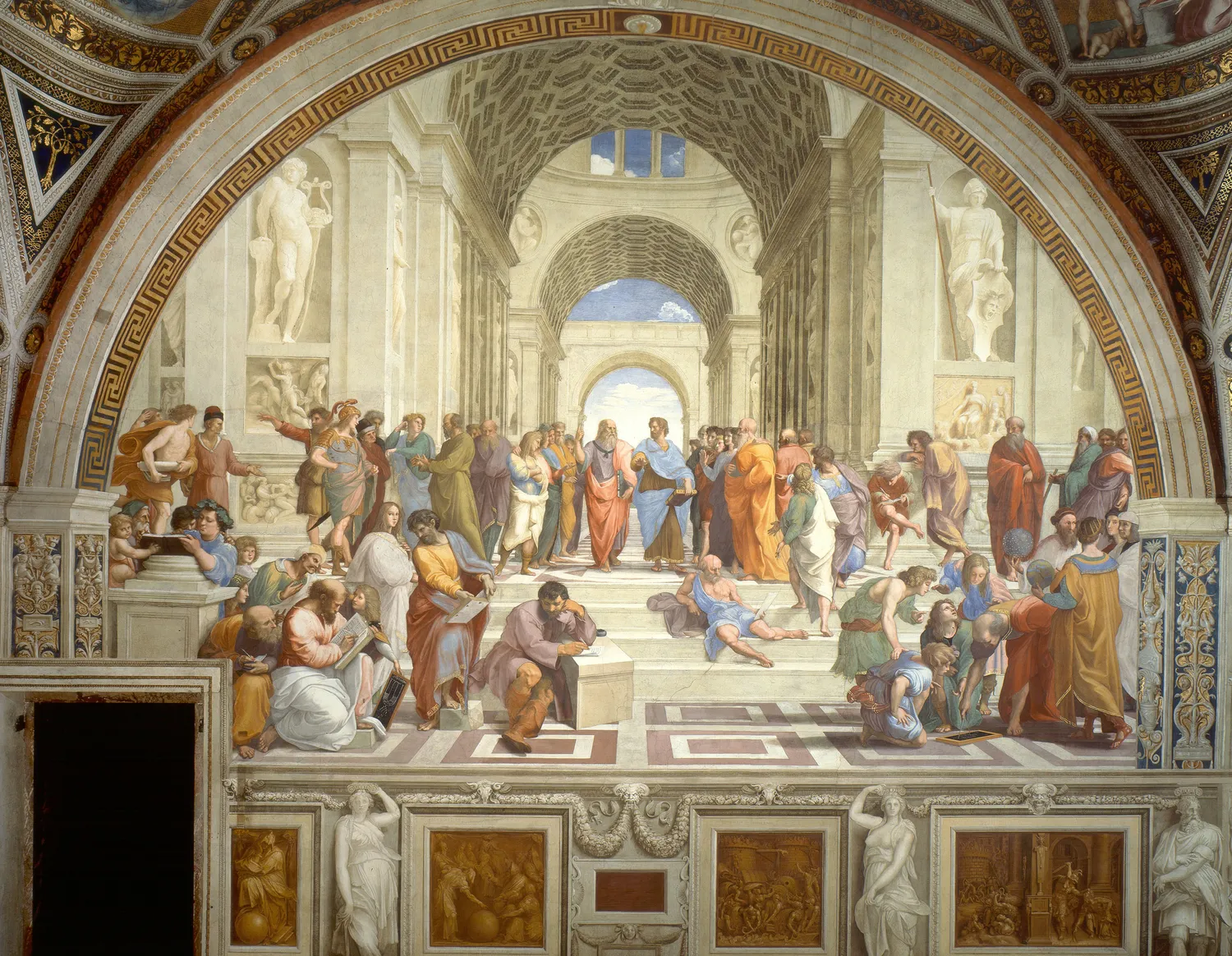
""The School of Athens" by Raffaello Sanzio da Urbino" by Raphael / Wikimedia Commons
Plato was a leading philosopher in Ancient Greece who founded the Academy, the first known school of higher learning in the Western world. Born around 427 BCE in Athens, Plato grew up during a time of political conflict and change. He became a student of Socrates, a teacher known for asking challenging questions about truth and justice. Socrates deeply influenced Plato, who later wrote about his teacher’s ideas in many dialogues.
After Socrates was executed in 399 BCE, Plato traveled to places like Italy and Egypt, seeking knowledge from other cultures. When he returned to Athens, he established the Academy around 387 BCE, in a grove sacred to the hero Academus. The Academy was not just a school, but a place where scholars gathered to discuss philosophy, mathematics, astronomy, and politics. Unlike earlier forms of education that focused mainly on rhetoric or public speaking, Plato’s Academy encouraged students to think critically and use reason. Students studied by engaging in debates, reading, and writing, rather than memorizing facts. This approach helped shape future methods of education.
Plato’s most famous student was Aristotle, who later became a philosopher and teacher himself. The Academy welcomed people from across the Greek world, including some women, which was unusual for the time. The main subject at the Academy was philosophy, but Plato also believed in the importance of mathematics and the study of nature. In one of his best-known works, The Republic, Plato described his ideas about government and justice. He used a method called dialogue, where ideas are explored through conversations between characters. Archaeological remains of the Academy’s site still exist near Athens today, showing the impact of Plato’s school on Greek society.
The Academy lasted for nearly 900 years, until it was closed by the Roman emperor Justinian I in 529 CE. Plato’s influence continued through his writings and his students. His ideas about education, ethics, and the search for truth became a foundation for Western philosophy. The word “academy” is still used today for schools and learned societies, a sign of the lasting legacy of Plato’s vision.
Plato’s Academy demonstrates the power of education to shape societies and encourage critical thinking. His work connects to the broader story of how ancient Greek culture spread knowledge, developed new forms of government, and influenced later civilizations.
Interesting Fact: The phrase “Let no one ignorant of geometry enter” was said to be inscribed at the entrance of Plato’s Academy, showing the importance of mathematics in his school.
Who was Plato’s teacher?
SocratesAristotleJustinianPythagoras
Where was the Academy founded?
RomeSpartaAthensAlexandria
What did students do at the Academy?
Memorize factsEngage in debatesBuild statuesTrade goods
Why was the Academy important for education?
It taught only mathIt was for soldiersIt encouraged critical thinkingIt had no teachers
What effect did Plato’s Academy have on society?
Spread philosophy ideasStarted warsBuilt templesStopped all trade
Who was Plato’s most famous student?
PericlesAristotleAlexanderHomer
The Academy lasted almost 900 years. True or false?
TrueFalse
What is a 'dialogue' in Plato’s work?
A kind of buildingA written conversationA set of lawsA musical instrument
Perfect For:
👩🏫 Teachers
• Reading comprehension practice
• Auto-graded assessments
• Literacy skill development
👨👩👧👦 Parents
• Reading practice at home
• Comprehension improvement
• Educational reading time
🏠 Homeschoolers
• Reading curriculum support
• Independent reading practice
• Progress monitoring
Reading Features:
📖
Reading Passage
Engaging fiction or nonfiction text
❓
Comprehension Quiz
Auto-graded questions
📊
Instant Feedback
Immediate results and scoring
📄
Printable Version
Download for offline reading
🔊
Read Aloud
Voice-over with word highlighting
Reviews & Ratings
No reviews yet. Be the first to share your experience!
Related Content
Geography of Ancient Greece
This rigorous history reading passage explores 'The Geography of Ancient Greece,' examining how the region’s mountains, ...
Homer: Epic Poet of Ancient Greece
This history reading passage explores the life and historical significance of Homer, the legendary epic poet of Ancient ...
Ancient Sparta
This reading passage explores the unique military society of Sparta, an influential city-state in Ancient Greece. Studen...
Greek Polis
This in-depth history reading passage explores the rise and development of the Greek polis, or city-state, a foundationa...
Ancient Greek City-States
This history reading passage explores the development and significance of city-states in ancient civilizations, focusing...
Greece's Lasting Legacy
This engaging history reading passage explores the enduring legacy of Ancient Greece and its profound influence on the m...
Evidence in Ancient History
This engaging history reading passage investigates how archaeologists and historians discover clues about how ancient pe...
Ancient Philosophy
This reading passage takes students on a journey through the philosophical traditions of ancient Greece, India, and Chin...
Euripides and Greek Drama
This engaging passage introduces students to Euripides, one of the greatest ancient Greek playwrights, known for his exp...
Women in Ancient Societies
This reading passage explores the complex roles of women in the ancient world, focusing on civilizations such as Mesopot...
Sophocles and Greek Tragedy
This passage explores the life and legacy of Sophocles, one of the most influential playwrights of ancient Greece, whose...
Ancient Literature
This passage explores the importance of ancient stories and poems from civilizations such as Greece, India, and Israel. ...
Ancient Science and Medicine
This comprehensive reading passage explores the development of science and medicine in ancient civilizations, including ...
Slavery in Ancient World
This passage explores the complex history of slavery in the ancient world, examining its presence in societies such as M...
Ancient Theocracy
This engaging history reading passage explores the concept of theocracy in ancient civilizations, where priests and reli...
Ancient Mathematics
This passage explores the essential role of mathematics in ancient civilizations, including Mesopotamia, Egypt, Greece, ...
Ancient Canaan
This educational passage explores the land of Canaan, the historical homeland of the ancient Israelites. Students will l...
Geography of Ancient Israel
This passage explores the rich geography of Ancient Israel, focusing on how landforms, climate, and natural resources sh...
Ancient Writing Systems
This engaging history reading passage explores the origins and evolution of ancient writing systems, including cuneiform...
Ancient Agriculture Farming
This passage explores the transformative impact of farming on ancient societies, examining how the Neolithic Revolution ...