This learning resource is available in interactive and printable formats. The interactive worksheet can be played online and assigned to students. The Printable PDF version can be downloaded and printed for completion by hand.
This engaging ancient history reading passage introduces students to the discovery of the world's oldest decorative shells, found in Morocco and South Africa, dating back over 142,000 years. The text explores how early humans used shells for symbolic and social purposes, the archaeological evidence supporting these findings, and the significance for understanding the development of art and communication. The passage is aligned with CA HSS 6.1 and CCSS RH.6-8.1 standards, and is accompanied by multiple-choice questions, writing prompts, graphic organizers, and a timeline. Spanish translation and read aloud audio are provided to support diverse learners. Key vocabulary terms are highlighted and defined in an accessible glossary. Students will analyze evidence, explore cause and effect, and connect these discoveries to broader themes in world history and the development of human societies.
CONTENT PREVIEW
Expand content preview
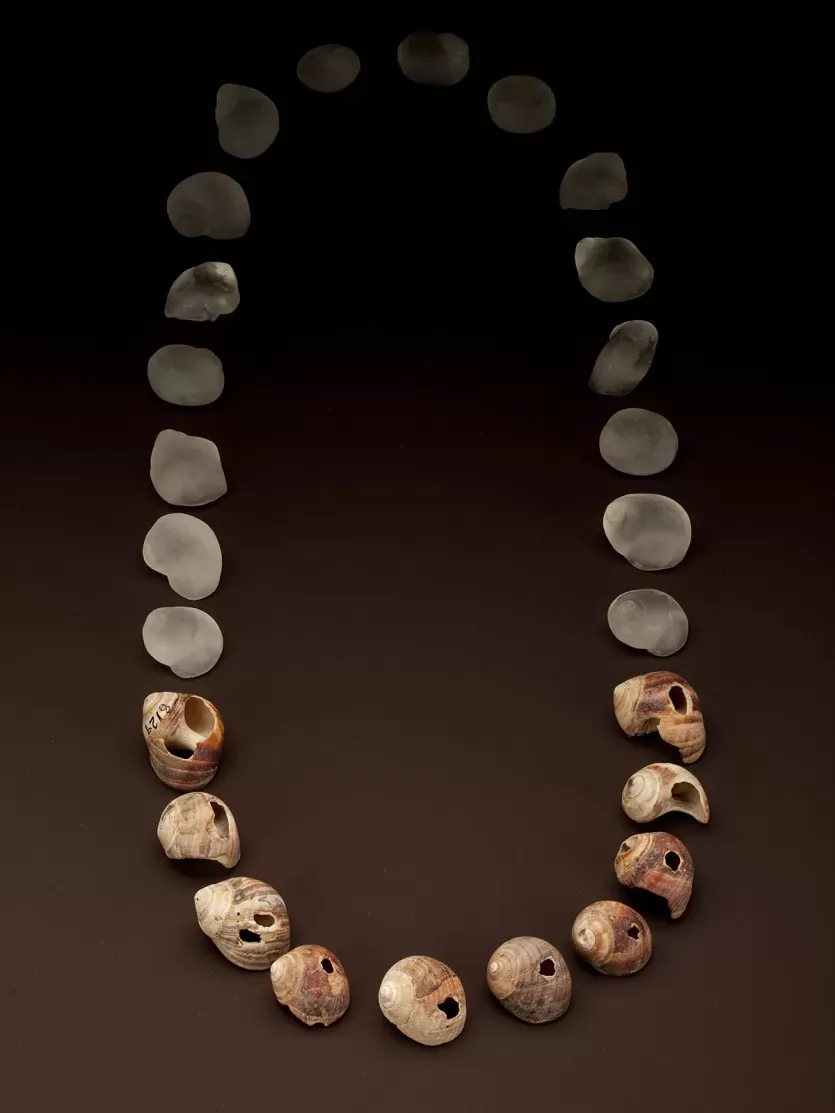
"Shell bead necklace" / Wikimedia Commons
Archaeologists have discovered the earliest known decorative shells made by humans, dating back more than 142,000 years. These small beads, found in Morocco and South Africa, provide evidence that ancient humans engaged in symbolic activities much earlier than previously thought. The discovery challenges earlier beliefs about when humans first began to use objects for personal expression and social communication.
The oldest of these shells were unearthed at Bizmoune Cave in Morocco. Scientists used advanced dating techniques to confirm their age at about 142,000 years old. The shells, from the Nassarius genus, were pierced with small holes and show traces of red ochre, a natural pigment. This suggests the shells were likely strung together as necklaces or worn as ornaments. Similar shell beads were also found at Blombos Cave in South Africa, dating to about 75,000 years ago. These sites are nearly 5,000 miles apart, showing that different groups of early humans across Africa developed similar cultural practices.
Archaeological evidence suggests these beads were more than just decoration. Researchers believe that wearing shell ornaments was a way for early humans to communicate identity, group membership, or status within their community. The use of red ochre, a symbolic color, may have carried specific meanings or represented important rituals. The careful selection, preparation, and transport of shells from the coast, sometimes over long distances, shows planning and cooperation among individuals.
The discovery of such ancient decorative shells provides insight into the cognitive and social abilities of early Homo sapiens. It marks a significant development in the history of human creativity, symbolism, and shared meaning. These artifacts demonstrate that even in the prehistoric past, people valued more than just survival—they sought ways to express themselves and connect with others. The continuity of shell bead use over tens of thousands of years shows how traditions and symbolic behaviors were passed down through generations, shaping human culture.
This evidence connects to larger themes in ancient history, such as the development of art, technology, and society. By studying decorative artifacts, historians and archaeologists gain a better understanding of how early humans adapted to their environment and built complex social structures.
Interesting Fact: Some shell beads from Blombos Cave still contain traces of red ochre, suggesting that people carefully selected and colored their jewelry for special meaning.
Where were the oldest shells found?
MoroccoEgyptFranceIndia
How old are the Bizmoune Cave beads?
142,000 years10,000 years1,000 years75,000 years
What color pigment was used on the shells?
Red ochreGreen paintBlue inkBlack charcoal
Why did early humans wear shell beads?
To show group membershipTo trade for foodTo hunt animalsFor building houses
What does the use of beads show?
Symbolic thinkingAbility to flyBuilding boatsWriting books
How are Bizmoune and Blombos sites connected?
Both have shell beadsBoth are in EuropeBoth used metal toolsBoth are underwater
Decorative shells were used just for food. True or False?
TrueFalse
What does 'cognitive' mean?
Thinking and understandingBuilding housesHunting animalsMaking fire
Perfect For:
👩🏫 Teachers
• Reading comprehension practice
• Auto-graded assessments
• Literacy skill development
👨👩👧👦 Parents
• Reading practice at home
• Comprehension improvement
• Educational reading time
🏠 Homeschoolers
• Reading curriculum support
• Independent reading practice
• Progress monitoring
Reading Features:
📖
Reading Passage
Engaging fiction or nonfiction text
❓
Comprehension Quiz
Auto-graded questions
📊
Instant Feedback
Immediate results and scoring
📄
Printable Version
Download for offline reading
🔊
Read Aloud
Voice-over with word highlighting
Reviews & Ratings
No reviews yet. Be the first to share your experience!
Related Content
Underwater Archaeology: Discovering Shipwrecks
This engaging passage explores the field of underwater archaeology, focusing on the discovery and study of ancient shipw...
What is Archaeology?
This engaging passage introduces students to the science of archaeology and how it helps us understand early humans and ...
Evidence in Ancient History
This engaging history reading passage investigates how archaeologists and historians discover clues about how ancient pe...
Protecting and Restoring Ancient Artifacts
This engaging passage explores how scientists, especially archaeologists and conservators, protect and restore artifacts...
Dating Ancient Artifacts
This passage explores the scientific methods used by archaeologists to determine the age of artifacts, such as radiocarb...
Terracotta Army China
This passage examines the remarkable discovery of China’s Terracotta Army, one of the world’s most famous archaeological...
Dead Sea Scrolls: Hidden Texts
This passage explores the remarkable discovery of the Dead Sea Scrolls, one of history’s most significant archaeological...
Paying Taxes in Ancient Times
This reading passage explores the origins and practices of taxation in ancient civilizations, focusing on how early gove...
Stratigraphy: Reading Earth's Layers
This passage introduces students to the science of stratigraphy, a key archaeological method for studying the layers of ...
Ancient Theocracy
This engaging history reading passage explores the concept of theocracy in ancient civilizations, where priests and reli...
Discovery of Rosetta stone
This engaging history reading passage explores the remarkable discovery of the Rosetta Stone and its impact on the study...
Social structures in Ancient World
This passage explores the organization and significance of family life in ancient societies, focusing on how extended fa...
Pompeii: A City Frozen in Time
This engaging passage explores the ancient Roman city of Pompeii, which was buried by the eruption of Mount Vesuvius in ...
Trade in the Ancient World
This reading passage delves into the dynamic world of trade among ancient civilizations, focusing on the Silk Road, Medi...
Ancient Canaan
This educational passage explores the land of Canaan, the historical homeland of the ancient Israelites. Students will l...
Ancient Literature
This passage explores the importance of ancient stories and poems from civilizations such as Greece, India, and Israel. ...
Terracotta Army
This passage explores the fascinating discovery of the Terra-Cotta Army near Xi’an, China, and its significance in ancie...
Howard Carter and the Tomb of King Tut
This detailed history reading passage explores the remarkable discovery of King Tutankhamun's tomb by Howard Carter in 1...
Geography of Ancient Israel
This passage explores the rich geography of Ancient Israel, focusing on how landforms, climate, and natural resources sh...
Ancient Writing Systems
This engaging history reading passage explores the origins and evolution of ancient writing systems, including cuneiform...