This learning resource is available in interactive and printable formats. The interactive worksheet can be played online and assigned to students. The Printable PDF version can be downloaded and printed for completion by hand.
This ancient history reading passage introduces students to the remarkable discovery of the world's oldest known musical instruments, dating back 43,000 to 35,000 years. Students will learn how archaeologists unearthed bone and ivory flutes in caves of southern Germany, providing insight into early human creativity, symbolic thinking, and cultural development during the Upper Paleolithic period. The passage explores archaeological evidence, artifact analysis, and the broader significance of music in early human societies. Activities include a multiple-choice quiz, writing prompts, graphic organizers, and a timeline, all designed to meet CA HSS 6.2 and CCSS RI.6-8 standards. Read aloud audio and a full Spanish translation are provided to support diverse learners. This resource is ideal for building historical thinking skills and understanding the role of music and art in human history.
CONTENT PREVIEW
Expand content preview
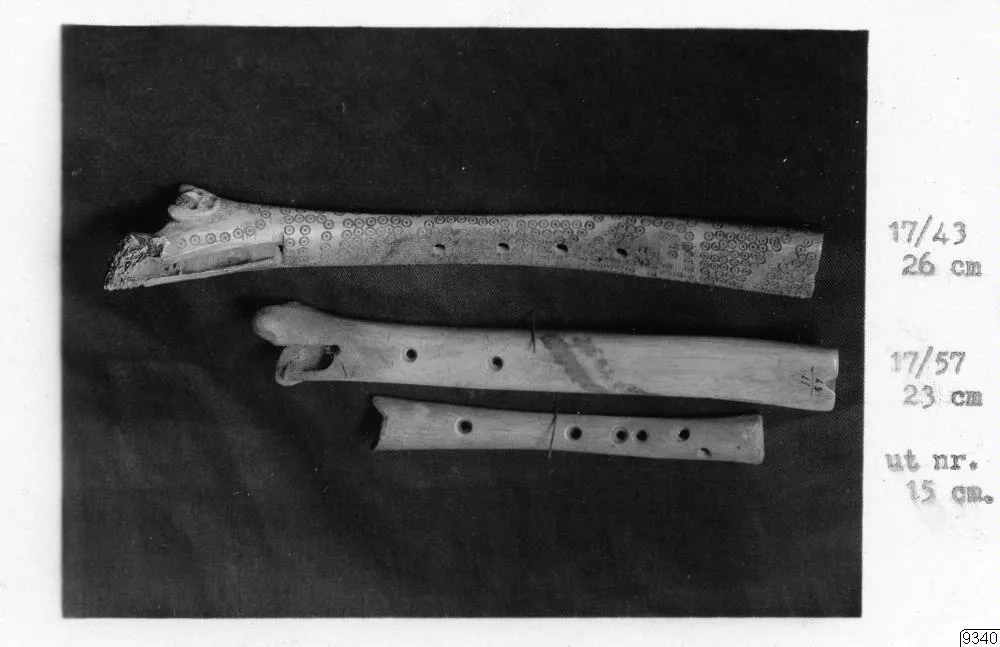
"Musical Instrument -Bone flute" by Ljungh, Gösta / Europeana
Archaeologists have uncovered some of the earliest known musical instruments, dating from 43,000 to 35,000 years ago, during excavations in caves in southern Germany. These discoveries show that the creation of music was an important part of early human culture in the Paleolithic era. The instruments include flutes made from the bones of birds and mammoths, as well as ivory. These ancient artifacts reveal not only technical skill but also the beginnings of symbolic and artistic expression among early Homo sapiens.
The most famous finds come from the Hohle Fels and Geissenklösterle caves in the Swabian Jura region. In 2008, scientists led by Dr. Nicholas Conard discovered a flute made from a griffon vulture’s wing bone. Radiocarbon dating shows this instrument is about 40,000 years old. Other flutes, carved from mammoth ivory, have also been found at nearby sites. Archaeologists carefully document the locations and layers where these artifacts are found, which helps them build a chronology of human activities over thousands of years.
The presence of these instruments suggests that music played a role in social gatherings and possibly in rituals or ceremonies. The craftsmanship required to make a flute from bone or ivory shows advanced knowledge of materials and tool use. Scientists believe these flutes were made by anatomically modern humans, not Neanderthals. The geographic context is also important: southern Germany was a meeting place for different human groups, which may have led to the sharing of ideas and traditions, including music-making. Some scholars debate whether music helped early humans develop stronger communities or communicate complex ideas.
Analysis of the flutes reveals that they can produce a scale of notes, allowing for simple melodies. This suggests an early form of artistic creativity and perhaps even emotional expression. Over time, the tradition of making musical instruments has continued and evolved, but these ancient flutes represent a key moment in human cultural history. The artifacts also connect us to the daily lives of our ancestors, showing that music has been part of social life for tens of thousands of years.
The discovery of the world’s oldest musical instruments highlights the ingenuity of ancient people and provides direct evidence of their symbolic thinking. By studying these artifacts, historians and archaeologists gain insight into how early societies developed complex cultures. The study of ancient music links to broader historical themes such as innovation, the development of art, and the ways humans adapt to their environments.
Interesting Fact: One of the flutes found at Hohle Fels Cave is made from the hollow bone of a griffon vulture, showing that early humans used resources from their environment in creative ways.
Where were the oldest flutes found?
Southern GermanyNorthern FranceEastern AsiaNorthern Africa
What are the flutes mainly made from?
Bone and ivoryClay and stoneMetal and woodGlass and marble
Who led the team that found the Hohle Fels flute?
Dr. Nicholas ConardLouis LeakeyMary AnningHoward Carter
Why are the flutes significant?
They show early symbolic thinkingThey were used for huntingThey were made by NeanderthalsThey are made of gold
How do archaeologists date the flutes?
Radiocarbon datingCounting layers of paintExamining tree ringsChecking for handwriting
What effect did music have on groups?
Helped build communitiesCaused warsDestroyed settlementsLed to farming
The flutes were made by Neanderthals. True or false?
TrueFalse
What does the word "chronology" mean?
A timeline of eventsA kind of boneA type of fluteA group of people
Perfect For:
👩🏫 Teachers
• Reading comprehension practice
• Auto-graded assessments
• Literacy skill development
👨👩👧👦 Parents
• Reading practice at home
• Comprehension improvement
• Educational reading time
🏠 Homeschoolers
• Reading curriculum support
• Independent reading practice
• Progress monitoring
Reading Features:
📖
Reading Passage
Engaging fiction or nonfiction text
❓
Comprehension Quiz
Auto-graded questions
📊
Instant Feedback
Immediate results and scoring
📄
Printable Version
Download for offline reading
🔊
Read Aloud
Voice-over with word highlighting
Reviews & Ratings
No reviews yet. Be the first to share your experience!
Related Content
Underwater Archaeology: Discovering Shipwrecks
This engaging passage explores the field of underwater archaeology, focusing on the discovery and study of ancient shipw...
What is Archaeology?
This engaging passage introduces students to the science of archaeology and how it helps us understand early humans and ...
Evidence in Ancient History
This engaging history reading passage investigates how archaeologists and historians discover clues about how ancient pe...
Protecting and Restoring Ancient Artifacts
This engaging passage explores how scientists, especially archaeologists and conservators, protect and restore artifacts...
Dating Ancient Artifacts
This passage explores the scientific methods used by archaeologists to determine the age of artifacts, such as radiocarb...
Terracotta Army China
This passage examines the remarkable discovery of China’s Terracotta Army, one of the world’s most famous archaeological...
Dead Sea Scrolls: Hidden Texts
This passage explores the remarkable discovery of the Dead Sea Scrolls, one of history’s most significant archaeological...
Paying Taxes in Ancient Times
This reading passage explores the origins and practices of taxation in ancient civilizations, focusing on how early gove...
Stratigraphy: Reading Earth's Layers
This passage introduces students to the science of stratigraphy, a key archaeological method for studying the layers of ...
Ancient Theocracy
This engaging history reading passage explores the concept of theocracy in ancient civilizations, where priests and reli...
Discovery of Rosetta stone
This engaging history reading passage explores the remarkable discovery of the Rosetta Stone and its impact on the study...
Social structures in Ancient World
This passage explores the organization and significance of family life in ancient societies, focusing on how extended fa...
Pompeii: A City Frozen in Time
This engaging passage explores the ancient Roman city of Pompeii, which was buried by the eruption of Mount Vesuvius in ...
Trade in the Ancient World
This reading passage delves into the dynamic world of trade among ancient civilizations, focusing on the Silk Road, Medi...
Ancient Canaan
This educational passage explores the land of Canaan, the historical homeland of the ancient Israelites. Students will l...
Ancient Literature
This passage explores the importance of ancient stories and poems from civilizations such as Greece, India, and Israel. ...
Terracotta Army
This passage explores the fascinating discovery of the Terra-Cotta Army near Xi’an, China, and its significance in ancie...
Howard Carter and the Tomb of King Tut
This detailed history reading passage explores the remarkable discovery of King Tutankhamun's tomb by Howard Carter in 1...
Geography of Ancient Israel
This passage explores the rich geography of Ancient Israel, focusing on how landforms, climate, and natural resources sh...
Ancient Writing Systems
This engaging history reading passage explores the origins and evolution of ancient writing systems, including cuneiform...