This learning resource is available in interactive and printable formats. The interactive worksheet can be played online and assigned to students. The Printable PDF version can be downloaded and printed for completion by hand.
This engaging middle school science passage explores the Siberian Taiga, the world’s largest forest ecosystem, stretching across northern Russia. Students will learn about the taiga’s extreme continental climate, the role of permafrost, and its diverse wildlife, including the Siberian tiger and reindeer. The passage explains complex interactions between climate, soil, plants, and animals, as well as the importance of the taiga in carbon storage and global climate regulation. It also discusses the risks posed by climate change, such as increased wildfires and thawing permafrost, and how these changes could affect ecosystems worldwide. Designed to meet NGSS MS-LS2-1 and MS-ESS3-5 standards, the resource includes vocabulary support, differentiated reading levels, Spanish translations, and a variety of comprehension and writing activities. Integrated audio options are available, making this an accessible and comprehensive resource for science classrooms.
CONTENT PREVIEW
Expand content preview
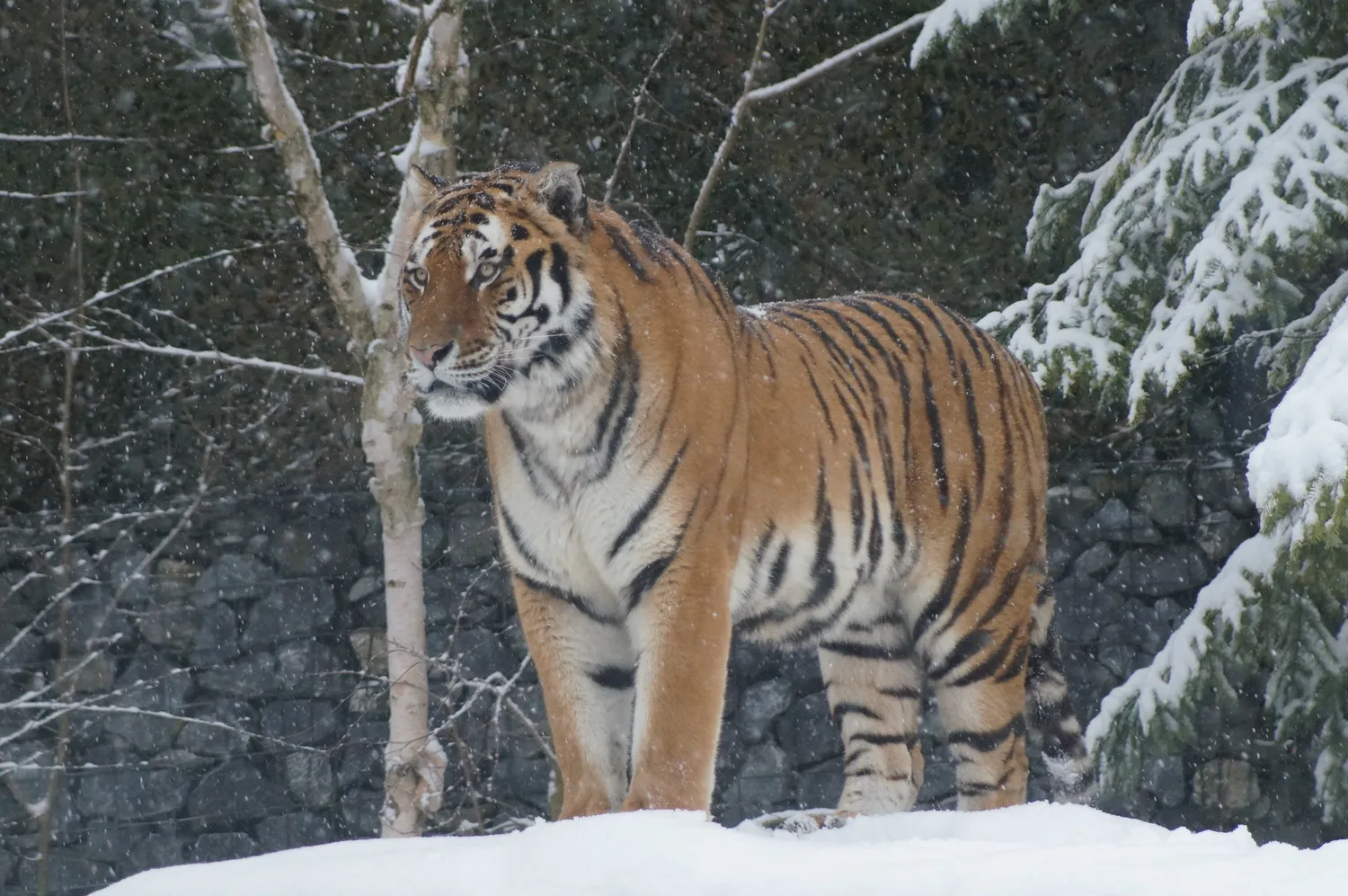
The Siberian tiger, the largest wild cat, roams the forests, preying on deer and boar. Image by Albinfo / Wikimedia Commons (CC0).
The Siberian Taiga spans over 13 million square kilometers across northern Russia, making it the largest forest on Earth—larger even than the Amazon rainforest. This vast region is known as a boreal forest, characterized by its endless stretches of coniferous trees like pine, spruce, and larch. Scientists study the taiga to understand its role in Earth's climate system and how it is changing due to global warming. The Siberian Taiga is not only home to unique wildlife but also stores huge amounts of carbon, making it vital for the planet's health.
Extreme Climate and Permafrost
The Siberian Taiga experiences an extreme continental climate, with long, harsh winters where temperatures can drop below -40°C and short, warm summers. This climate is caused by the region’s distance from oceans, which means there is little moisture and little moderation of temperature. Beneath much of the taiga lies permafrost, a thick layer of soil that remains frozen year-round. Permafrost affects everything from plant growth to animal habitats. In summer, only the uppermost layer thaws, allowing shallow-rooted plants to grow. The presence of permafrost also influences how water moves through the soil, creating wetlands and bogs that support unique ecosystems.
Wildlife and Ecosystem Interactions
The taiga supports a variety of adapted species. The Siberian tiger, the largest wild cat, roams the forests, preying on deer and boar. Brown bears hibernate to survive the severe winters, while wolves and reindeer form important parts of the food web. Many of these animals have thick fur and behaviors suited to extreme cold. The trees, especially conifers, have needle-like leaves that minimize water loss and withstand heavy snow. These plant and animal adaptations are crucial for survival in such a demanding environment. Scientists observe these adaptations to understand how life responds to environmental stress.
Carbon Storage and Climate Change Impacts
The Siberian Taiga acts as a massive carbon sink, storing about one-third of the world’s terrestrial carbon, mainly in its soils and permafrost. This storage is vital because it helps slow the buildup of carbon dioxide in the atmosphere, which contributes to global warming. However, the taiga is now threatened by climate change. Rising temperatures are causing permafrost to thaw and increasing the frequency of forest fires. In 2021, wildfires in Siberia burned an area larger than the size of Greece. When permafrost thaws, it releases greenhouse gases, which can accelerate climate change in a feedback loop. These changes can harm local ecosystems and have global effects by releasing more carbon into the atmosphere.
Understanding the Siberian Taiga helps scientists predict how ecosystems worldwide might respond to climate change. The taiga’s interactions between climate, soil, plants, and animals illustrate the complexity of Earth’s systems and the importance of protecting major forests.
Interesting Fact: The Siberian Taiga is so vast that it produces enough oxygen for billions of people every year.
What makes the Siberian Taiga unique compared to other forests?
It is the largest forest on Earth, larger than the Amazon.It has more rainfall than any other forest.It is located near the equator.It only has one type of tree.
What type of climate does the Siberian Taiga have?
Which of these animals is NOT mentioned as living in the Siberian Taiga?
Siberian tigerBrown bearElephantReindeer
What is permafrost?
Frozen rain that falls in winterSoil that remains frozen all yearA type of tree in the taigaA large animal in the region
What does the term 'carbon sink' mean in the passage?
A place where carbon is used up quicklyA place that stores and absorbs carbon dioxideA place where carbon is madeA place that turns carbon into water
Why is the Siberian Taiga important for Earth's climate?
It produces most of the world's food.It stores large amounts of carbon, slowing climate change.It is the warmest place on Earth.It covers the South Pole.
What is one effect of permafrost thawing in the taiga?
It helps trees grow faster.It releases greenhouse gases, making climate change worse.It makes the soil dry and sandy.It causes more rain.
If the Siberian Taiga is harmed by climate change, what could happen?
More carbon dioxide could enter the atmosphere.More animals would move to the desert.The taiga would become a tropical forest.The taiga would sink underwater.
True or False: The Siberian Taiga stores about one-third of the world's terrestrial carbon.
TrueFalse
True or False: The Siberian Taiga only affects local weather and has no impact on the global climate.
TrueFalse
Perfect For:
👩🏫 Teachers
• Reading comprehension practice
• Auto-graded assessments
• Literacy skill development
👨👩👧👦 Parents
• Reading practice at home
• Comprehension improvement
• Educational reading time
🏠 Homeschoolers
• Reading curriculum support
• Independent reading practice
• Progress monitoring
Reading Features:
📖
Reading Passage
Engaging fiction or nonfiction text
❓
Comprehension Quiz
Auto-graded questions
📊
Instant Feedback
Immediate results and scoring
📄
Printable Version
Download for offline reading
🔊
Read Aloud
Voice-over with word highlighting
Reviews & Ratings
No reviews yet. Be the first to share your experience!
Related Content
Natural Disaster: Hurricanes
Hurricanes are massive storms with strong winds and rain. Tracking and preparing for them helps protect people in their ...
RI.3.1RI.4.4RI.4.2RI.5.2
The Narwhal: Arctic’s Unicorn of the Sea
This NGSS-aligned passage (MS-LS2-1) explores how narwhals survive in Arctic ecosystems. Students learn about specialize...
MS-LS2-1RI.6.3RI.7.3RI.8.8
The Blue-Ringed Octopus
This NGSS aligned passage explores how the tiny blue-ringed octopus impacts its ecosystem through predator-prey relation...
MS-LS2-1RI.6.3RI.7.3RI.8.8
Tardigrades: Microscopic Superheroes
Aligned to MS-LS1-1, this passage examines how tardigrade cell structures (TDP proteins, DNA-repair enzymes) allow survi...
MS-LS2-1RI.6.3RI.7.3RI.8.8
The Leafy Sea Dragon: Nature's Living Seaweed
This NGSS-aligned passage explores how leafy sea dragons (Phycodurus eques) demonstrate key life science concepts for mi...
MS-LS2-1RI.6.3RI.7.3RI.8.8
How Climate Change Affects Animal Migration
This NGSS-aligned science reading passage explains how climate change affects animal migration by altering seasonal cues...
MS-LS2-6MS-ESS3-5
What Is Global Warming?
This NGSS-aligned reading passage explains global warming, the greenhouse effect, and how human activities like burning ...
MS-ESS3-5
What Causes Global Warming?
This NGSS-aligned reading passage explains what causes global warming, focusing on how human activities like burning fos...
MS-ESS3-5
How to Stop Global Warming
This NGSS-aligned reading passage helps students understand how to stop global warming by reducing greenhouse gases. It ...
MS-ESS3-5
What Do Axolotls Eat?
This science reading passage, titled "What Do Axolotls Eat?", offers an engaging exploration into the feeding habits of ...
MS-LS2-1
Where Do Axolotls Live?
This science reading passage, titled "The Axolotl's Home," delves into the specific natural environment of the fascinati...
MS-LS4-DMS-LS2-1
The Blobfish
This science reading passage, titled "The Blobfish: A Deep-Sea Mystery," introduces students to one of Earth's most pecu...
MS-LS4-DMS-LS2-1
What Do Blobfish Eat?
This science reading passage, titled "What Do Blobfish Eat?", offers an engaging exploration into the feeding habits of ...
MS-LS2-1
Where Do Penguins Live?
This engaging science reading passage, titled "Where Do Penguins Live? A Cold and Coastal World," clarifies the diverse ...
MS-LS2-1
The Emperor Penguin
This science reading passage, titled "The Emperor Penguin: Antarctica's Royal Survivor," introduces students to one of t...
MS-LS2-1
The Adélie Penguin
This engaging science reading passage, titled "The Adélie Penguin: Antarctica's Little Explorer," introduces students to...
MS-LS2-1
How Does Global Warming Affect Adélie Penguins?
This comprehensive science passage, titled "How Does Global Warming Affect Adélie Penguins?", details the significant im...
MS-LS2-1
Human Impacts: Climate Change
This standards-aligned science reading passage for grades 6-8 explains the mechanisms and effects of human-driven climat...
MS-LS2-4MS-ESS3-5
Climate Change: Vulnerable Ecosystems
This middle school science passage, aligned with NGSS standards MS-ESS3-5 and MS-LS2-4, helps students understand how cl...
MS-ESS3-5MS-LS2-4
Climate Change: Solutions and Mitigation
This passage explores scientific solutions and mitigation strategies for climate change, designed for middle school scie...