How Climate Change Affects Oceans — Reading Comprehension
Rate this
Premium Resource
Present
Present in classroom. No work saved
Assign
Classroom with student accounts, Track progress
Quick Play
No student accounts, assign with a link
Grades
5
6
7
8
Standards
MS-ESS3-5
PRINT+DIGITAL RESOURCE
This learning resource is available in interactive and printable formats. The interactive worksheet can be played online and assigned to students. The Printable PDF version can be downloaded and printed for completion by hand.
This NGSS-aligned passage explores major changes occurring in Earth’s oceans, focusing on the mechanisms and impacts of ocean warming and acidification. Students will learn how the ocean absorbs excess heat and carbon dioxide from the atmosphere, leading to rising temperatures, lower pH levels, and significant consequences for marine life and global systems. The passage explains scientific evidence, processes like coral bleaching and the formation of carbonic acid, and the broader implications for food webs and climate. Activities include comprehension questions, writing prompts, and graphic organizers to deepen understanding. Designed for grades 6-8, this resource integrates academic vocabulary, systems thinking, and real-world connections. Audio integration supports diverse learners, and the included Spanish translations foster accessibility for bilingual students. This comprehensive package supports the development of scientific literacy and critical thinking, making it ideal for middle school science classrooms.
CONTENT PREVIEW
Expand content preview
The world’s oceans act as a massive carbon sink. Image by Sebastian Voortman / Pexels.
Earth’s oceans are undergoing significant changes that affect both marine life and global climate systems. Scientists have observed that the oceans are warming and becoming more acidic, raising questions about the future of the planet’s largest ecosystem. Understanding the mechanisms driving these changes is essential for predicting their impact on biodiversity, weather patterns, and human societies.
Warming Oceans: The Heat Sink Effect
The world’s oceans act as a massive heat sink, absorbing over 90% of the excess heat generated by human-caused greenhouse gases. As a result, ocean temperatures have risen steadily in recent decades. This warming leads to more frequent and intense marine heat waves, which can devastate ecosystems. For example, warmer water causes coral bleaching, where stressed corals lose their symbiotic algae and turn white, often leading to death. Fish populations are also shifting their ranges poleward in search of cooler waters, which disrupts food webs and fisheries. Additionally, warmer oceans provide more energy for stronger hurricanes and tropical storms, increasing risks for coastal communities.
Ocean Acidification: A Chemical Shift
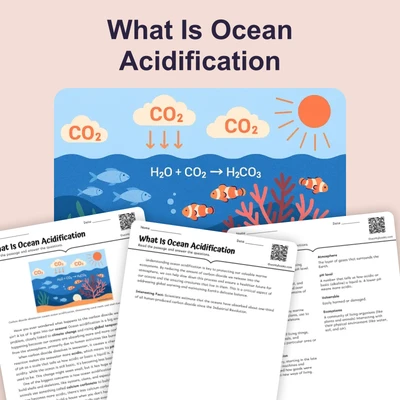
Another major change is ocean acidification. The ocean absorbs about 25% of human carbon dioxide emissions each year. When CO₂ mixes with seawater, it forms carbonic acid, lowering the water’s pH and making it more acidic. Since the pre-industrial era, the ocean has become about 30% more acidic. This chemical change makes it harder for shell-forming organisms—such as corals, oysters, and pteropods (tiny sea snails)—to build and maintain their shells. In some cases, existing shells can even dissolve in the more acidic water. These changes threaten the food web, as creatures like pteropods are a vital food source for many fish species.
Interactions and Broader Impacts
Warming water also holds less dissolved oxygen, leading to low-oxygen areas called "dead zones" where many marine organisms cannot survive. Scientists are also studying how warming and changes in salinity could slow down major ocean circulation patterns, which transport heat and nutrients around the globe. These disruptions could affect weather, climate, and food supplies far beyond the ocean itself. By monitoring ocean chemistry, temperature, and animal populations, scientists use data and models to predict future changes and inform conservation efforts.
Understanding ocean changes requires a systems approach, linking chemistry, biology, and climate. The health of the ocean is deeply connected to life on land, making it vital to protect and preserve this vast and dynamic system.
Interesting Fact: Some scientists call pteropods "the potato chips of the sea" because so many fish and whales depend on them for food!
What percentage of excess heat produced by greenhouse gases is absorbed by the ocean?
Over 90%About 50%Less than 25%Around 10%
What is coral bleaching?
A process where corals lose their algae and turn white due to stressCorals growing faster because of warm waterThe formation of new coral reefsWhen fish eat all the coral
How much more acidic is the ocean compared to pre-industrial times?
About 30% more acidicAbout 5% more acidicTwice as acidicNo change
What is a food web?
A network showing who eats whom in an ecosystemA kind of fishing netA group of ocean currentsA map of ocean temperatures
Which of the following best describes 'marine heat waves' as used in the passage?
Periods when ocean water is unusually warm for days to monthsGiant waves caused by hurricanesA pattern of strong winds over the oceanTimes when fish swim in groups
What is the function of pteropods in the ocean food web?
They are a vital food source for many fishThey provide oxygen to the waterThey filter out pollutionThey build coral reefs
Why does warmer water lead to 'dead zones'?
Because warmer water holds less dissolved oxygenBecause it creates more coral reefsBecause more fish swim thereBecause it increases the salt content
If ocean currents slow down due to warming and salinity changes, what might happen?
Weather, climate, and food supplies could change worldwideCoral reefs will grow fasterMore whales will appearOcean pH will rise
True or False: Ocean acidification makes it easier for shell-forming organisms to build their shells.
TrueFalse
True or False: Scientists use data and models to predict future changes in the ocean.
TrueFalse
Perfect For:
👩🏫 Teachers
• Reading comprehension practice
• Auto-graded assessments
• Literacy skill development
👨👩👧👦 Parents
• Reading practice at home
• Comprehension improvement
• Educational reading time
🏠 Homeschoolers
• Reading curriculum support
• Independent reading practice
• Progress monitoring
Reading Features:
📖
Reading Passage
Engaging fiction or nonfiction text
❓
Comprehension Quiz
Auto-graded questions
📊
Instant Feedback
Immediate results and scoring
📄
Printable Version
Download for offline reading
🔊
Read Aloud
Voice-over with word highlighting
Reviews & Ratings
No reviews yet. Be the first to share your experience!
Related Content
Natural Disaster: Hurricanes
Hurricanes are massive storms with strong winds and rain. Tracking and preparing for them helps protect people in their ...
RI.3.1RI.4.4RI.4.2RI.5.2
How Climate Change Affects Animal Migration
This NGSS-aligned science reading passage explains how climate change affects animal migration by altering seasonal cues...
MS-LS2-6MS-ESS3-5
What Is Global Warming?
This NGSS-aligned reading passage explains global warming, the greenhouse effect, and how human activities like burning ...
MS-ESS3-5
What Causes Global Warming?
This NGSS-aligned reading passage explains what causes global warming, focusing on how human activities like burning fos...
MS-ESS3-5
How to Stop Global Warming
This NGSS-aligned reading passage helps students understand how to stop global warming by reducing greenhouse gases. It ...
MS-ESS3-5
Human Impacts: Climate Change
This standards-aligned science reading passage for grades 6-8 explains the mechanisms and effects of human-driven climat...
MS-LS2-4MS-ESS3-5
Climate Change: Vulnerable Ecosystems
This middle school science passage, aligned with NGSS standards MS-ESS3-5 and MS-LS2-4, helps students understand how cl...
MS-ESS3-5MS-LS2-4
Climate Change: Solutions and Mitigation
This passage explores scientific solutions and mitigation strategies for climate change, designed for middle school scie...
MS-ESS3-4MS-ESS3-5
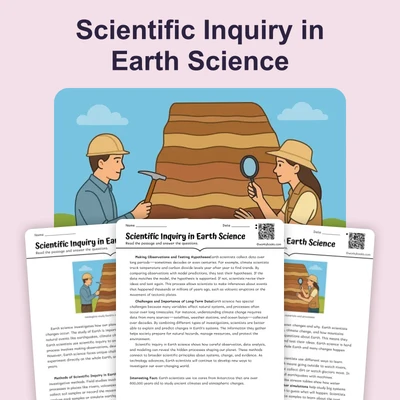
Scientific Inquiry in Earth Science
This passage explores scientific inquiry in Earth science for grades 6-8, aligned with NGSS standards MS-ESS1-4, MS-ESS2...
MS-ESS1-4MS-ESS2-1MS-ESS3-5SEP
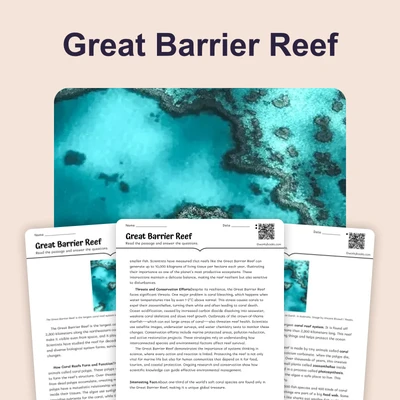
Great Barrier Reef
This passage introduces middle school students to the Great Barrier Reef, the world's largest coral reef system, located...
MS-LS2-1MS-LS2-4MS-ESS3-5
Siberian Taiga
This engaging middle school science passage explores the Siberian Taiga, the world’s largest forest ecosystem, stretchin...
MS-LS2-1MS-ESS3-5
The Greenhouse Effect
This comprehensive middle school science passage explores the greenhouse effect, a process essential to maintaining Eart...
MS-ESS2-6MS-ESS3-5
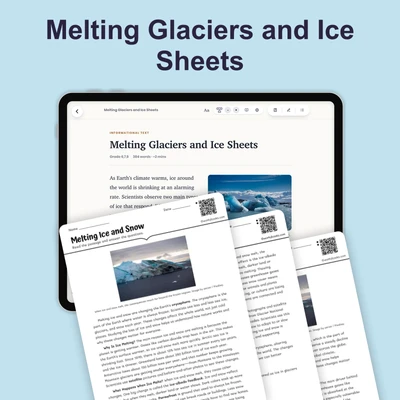
Melting Ice and Snow
This passage, designed for grades 6-8 and aligned with NGSS MS-ESS3-5, explores the mechanisms and impacts of melting ic...
MS-ESS3-5
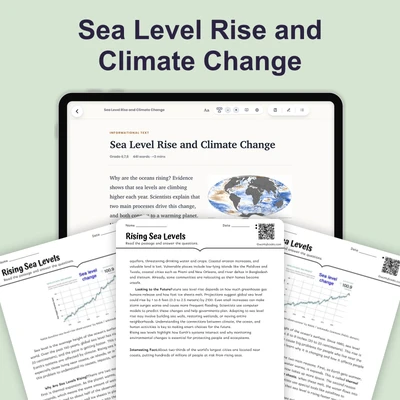
Rising Sea Levels
This science passage, written for grades 6-8, explores the phenomenon of rising sea levels, a key topic aligned with NGS...
MS-ESS3-5
Ice Cores
This passage, aligned with NGSS standards MS-ESS3-5 and MS-ESS1-4, explores the scientific process of extracting and ana...
MS-ESS3-5MS-ESS1-4
How Climate Change Affects Weather
This middle school science passage explores how and why weather patterns are changing globally. Students will learn abou...
MS-ESS3-5
Carbon Footprint
This NGSS-aligned passage for grades 6-8 explores the concept of a carbon footprint, focusing on how personal activities...
MS-ESS3-4MS-ESS3-5
El Niño
This middle school science passage provides an in-depth exploration of El Niño, the warm phase of the El Niño-Southern O...
MS-ESS2-6MS-ESS3-5
ENSO and Global Climate
This comprehensive passage explores the El Niño-Southern Oscillation (ENSO), a crucial driver of global climate variabil...