How Climate Change Affects Weather — Reading Comprehension
Rate this
Premium Resource
Present
Present in classroom. No work saved
Assign
Classroom with student accounts, Track progress
Quick Play
No student accounts, assign with a link
Grades
5
6
7
8
Standards
MS-ESS3-5
PRINT+DIGITAL RESOURCE
This learning resource is available in interactive and printable formats. The interactive worksheet can be played online and assigned to students. The Printable PDF version can be downloaded and printed for completion by hand.
This middle school science passage explores how and why weather patterns are changing globally. Students will learn about increased extreme precipitation events like 'rain bombs,' more frequent droughts, and shifting flood zones. The passage explains mechanisms such as warmer air holding more moisture, and how warmer oceans fuel stronger hurricanes. It introduces the concept of attribution science, which helps scientists determine whether climate change has made certain weather events more likely or severe. Real-world examples from the southwestern and southeastern US, South Asia, and other regions are used to illustrate these changes. The passage connects to NGSS standard MS-ESS3-5, providing key vocabulary and multiple activities to support deep understanding. Audio integration and graphic organizers make the content accessible for all learners. This resource is ideal for grades 6-8 and helps students analyze the causes and effects of global weather changes.
CONTENT PREVIEW
Expand content preview
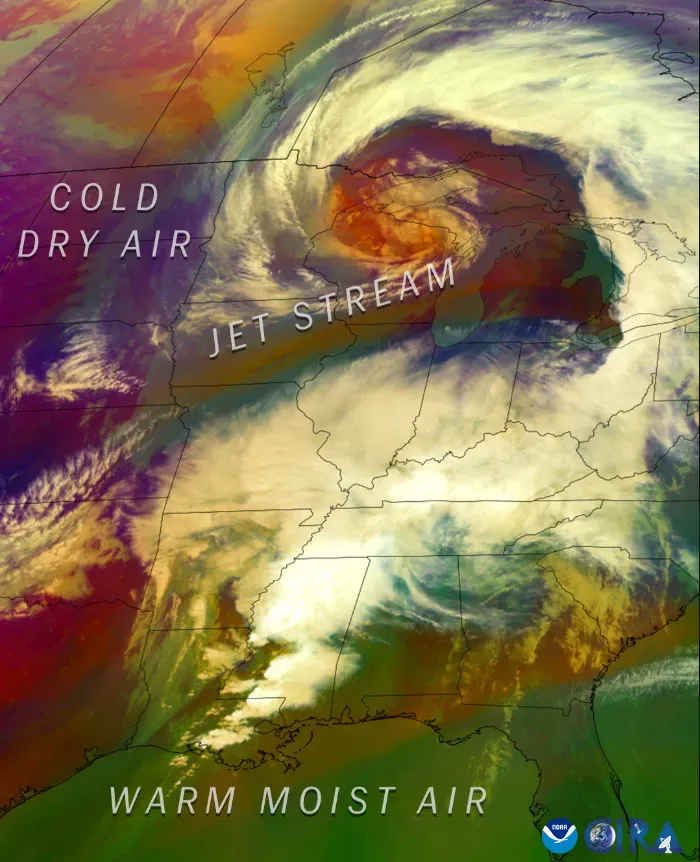
NOAA Satellites Monitor Severe Weather Outbreak by NOAA / Wikimedia Commons (Public domain).
Weather patterns are shifting worldwide, bringing new challenges to people and the environment. In recent years, scientists have observed more intense rainfall events, longer droughts, and stronger storms in many regions. These changes are not random; they are linked to rising global temperatures and increasing levels of greenhouse gases in the atmosphere. Understanding these shifts helps us prepare for and respond to changing conditions on Earth.
Changing Precipitation and Extreme Events Warmer air can hold more moisture, leading to heavier precipitation when storms occur. This results in more frequent and intense rainfall, sometimes called “rain bombs.” These are sudden, highly localized downpours that can cause severe flooding in a short time. For example, the southeastern United States and parts of South Asia are experiencing increased flooding as wet areas get wetter. In contrast, regions like the southwestern US, Mediterranean, and sub-Saharan Africa are seeing more severe and prolonged droughts, where rainfall is below normal for extended periods. This shift, sometimes called “weather whiplash,” can mean rapid swings between very wet and very dry conditions in the same place.
Storms, Snowfall, and Attribution Science Hurricanes are also changing. Warmer oceans provide more energy, making hurricanes likely to become stronger and carry more moisture. As a result, storms can drop more rain and move more slowly, leading to greater damage in areas they “stall” over. Snowfall patterns are shifting too. Warmer temperatures cause more precipitation to fall as rain instead of snow, and snow that does fall often melts earlier in the spring. Scientists use attribution science to study whether climate change has made specific events, like 100-year floods, more likely or severe. In fact, these so-called “100-year floods” are happening much more frequently than in the past.
Systems, Impacts, and Broader Connections These weather changes are part of larger Earth systems, where the atmosphere, oceans, and land all interact. For instance, more intense storms can damage crops, homes, and infrastructure, while extended droughts can reduce water supplies and harm food production. Understanding the mechanisms behind these changes allows scientists and communities to predict risks and develop better responses, such as improved flood control or drought-resistant crops. Studying weather pattern changes also reveals how human activities, like burning fossil fuels, play a role in shaping the planet’s climate system.
By recognizing these patterns and the science behind them, societies can better adapt to a changing world. Solutions may include building stronger infrastructure, improving early warning systems, and reducing greenhouse gas emissions to slow down future changes.
Interesting Fact: Some cities are now experiencing “100-year floods” every decade, showing how rapidly weather risks are increasing in some places.
What is one main reason why weather patterns are changing globally?
Rising global temperatures and more greenhouse gasesChanges in the Earth's gravityDecreased sunlight reaching the surfaceMovement of the continents
What is a 'rain bomb'?
A sudden, intense downpour causing local floodingA device used to make it rainA weather prediction modelA drought that lasts for years
Which areas are experiencing more frequent droughts?
Southwestern US, Mediterranean, sub-Saharan AfricaSoutheastern US and South AsiaThe Arctic OceanCentral Europe
What does 'weather whiplash' mean?
Rapid changes between wet and dry weather in one placeA type of hurricaneA very hot summerA flood caused by snowmelt
What is the main effect of warmer oceans on hurricanes?
They become stronger and wetterThey move much fasterThey become smallerThey cause less rain
In the context of the passage, what does 'attribution science' mean?
Studying if climate change made a specific event more likely or severeNaming hurricanesPredicting the weather for next weekMeasuring wind speed
Which of the following is a real-world impact of more extreme weather?
Damage to homes and cropsMore stars in the skyCooler summers everywhereFewer clouds
True or False: Snowfall is increasing in most places because temperatures are rising.
TrueFalse
True or False: '100-year floods' are now happening more often in some cities.
TrueFalse
Which solution can help societies adapt to changing weather patterns?
Building stronger infrastructure and reducing greenhouse gas emissionsIgnoring climate researchCutting down more forestsUsing more fossil fuels
Perfect For:
👩🏫 Teachers
• Reading comprehension practice
• Auto-graded assessments
• Literacy skill development
👨👩👧👦 Parents
• Reading practice at home
• Comprehension improvement
• Educational reading time
🏠 Homeschoolers
• Reading curriculum support
• Independent reading practice
• Progress monitoring
Reading Features:
📖
Reading Passage
Engaging fiction or nonfiction text
❓
Comprehension Quiz
Auto-graded questions
📊
Instant Feedback
Immediate results and scoring
📄
Printable Version
Download for offline reading
🔊
Read Aloud
Voice-over with word highlighting
Reviews & Ratings
No reviews yet. Be the first to share your experience!
Related Content
Natural Disaster: Hurricanes
Hurricanes are massive storms with strong winds and rain. Tracking and preparing for them helps protect people in their ...
RI.3.1RI.4.4RI.4.2RI.5.2
How Climate Change Affects Animal Migration
This NGSS-aligned science reading passage explains how climate change affects animal migration by altering seasonal cues...
MS-LS2-6MS-ESS3-5
What Is Global Warming?
This NGSS-aligned reading passage explains global warming, the greenhouse effect, and how human activities like burning ...
MS-ESS3-5
What Causes Global Warming?
This NGSS-aligned reading passage explains what causes global warming, focusing on how human activities like burning fos...
MS-ESS3-5
How to Stop Global Warming
This NGSS-aligned reading passage helps students understand how to stop global warming by reducing greenhouse gases. It ...
MS-ESS3-5
Human Impacts: Climate Change
This standards-aligned science reading passage for grades 6-8 explains the mechanisms and effects of human-driven climat...
MS-LS2-4MS-ESS3-5
Climate Change: Vulnerable Ecosystems
This middle school science passage, aligned with NGSS standards MS-ESS3-5 and MS-LS2-4, helps students understand how cl...
MS-ESS3-5MS-LS2-4
Climate Change: Solutions and Mitigation
This passage explores scientific solutions and mitigation strategies for climate change, designed for middle school scie...
MS-ESS3-4MS-ESS3-5
Scientific Inquiry in Earth Science
This passage explores scientific inquiry in Earth science for grades 6-8, aligned with NGSS standards MS-ESS1-4, MS-ESS2...
MS-ESS1-4MS-ESS2-1MS-ESS3-5SEP
Great Barrier Reef
This passage introduces middle school students to the Great Barrier Reef, the world's largest coral reef system, located...
MS-LS2-1MS-LS2-4MS-ESS3-5
Siberian Taiga
This engaging middle school science passage explores the Siberian Taiga, the world’s largest forest ecosystem, stretchin...
MS-LS2-1MS-ESS3-5
The Greenhouse Effect
This comprehensive middle school science passage explores the greenhouse effect, a process essential to maintaining Eart...
MS-ESS2-6MS-ESS3-5
Melting Ice and Snow
This passage, designed for grades 6-8 and aligned with NGSS MS-ESS3-5, explores the mechanisms and impacts of melting ic...
MS-ESS3-5
Rising Sea Levels
This science passage, written for grades 6-8, explores the phenomenon of rising sea levels, a key topic aligned with NGS...
MS-ESS3-5
Ice Cores
This passage, aligned with NGSS standards MS-ESS3-5 and MS-ESS1-4, explores the scientific process of extracting and ana...
MS-ESS3-5MS-ESS1-4
How Climate Change Affects Oceans
This NGSS-aligned passage explores major changes occurring in Earth’s oceans, focusing on the mechanisms and impacts of ...
MS-ESS3-5
Carbon Footprint
This NGSS-aligned passage for grades 6-8 explores the concept of a carbon footprint, focusing on how personal activities...
MS-ESS3-4MS-ESS3-5
El Niño
This middle school science passage provides an in-depth exploration of El Niño, the warm phase of the El Niño-Southern O...
MS-ESS2-6MS-ESS3-5
ENSO and Global Climate
This comprehensive passage explores the El Niño-Southern Oscillation (ENSO), a crucial driver of global climate variabil...