This learning resource is available in interactive and printable formats. The interactive worksheet can be played online and assigned to students. The Printable PDF version can be downloaded and printed for completion by hand.
This NGSS-aligned passage for grades 6-8 explores the concept of a carbon footprint, focusing on how personal activities contribute to greenhouse gas emissions. Students will learn the difference between direct and indirect emissions, why carbon footprints are measured in CO2 equivalent units, and how individual choices affect global climate change. The passage integrates scientific thinking by explaining both the mechanisms and the broader impacts of carbon footprints, using real-world data and examples. Activities include a multiple-choice quiz, writing prompts, and differentiated content for struggling readers. A glossary supports vocabulary development, while graphic organizers help students compare direct and indirect emissions and analyze cause and effect relationships. This resource is audio integrated for accessibility and offers Spanish translations for bilingual learners. Ideal for teachers seeking engaging, standards-based science content and activities for middle school classrooms.
CONTENT PREVIEW
Expand content preview
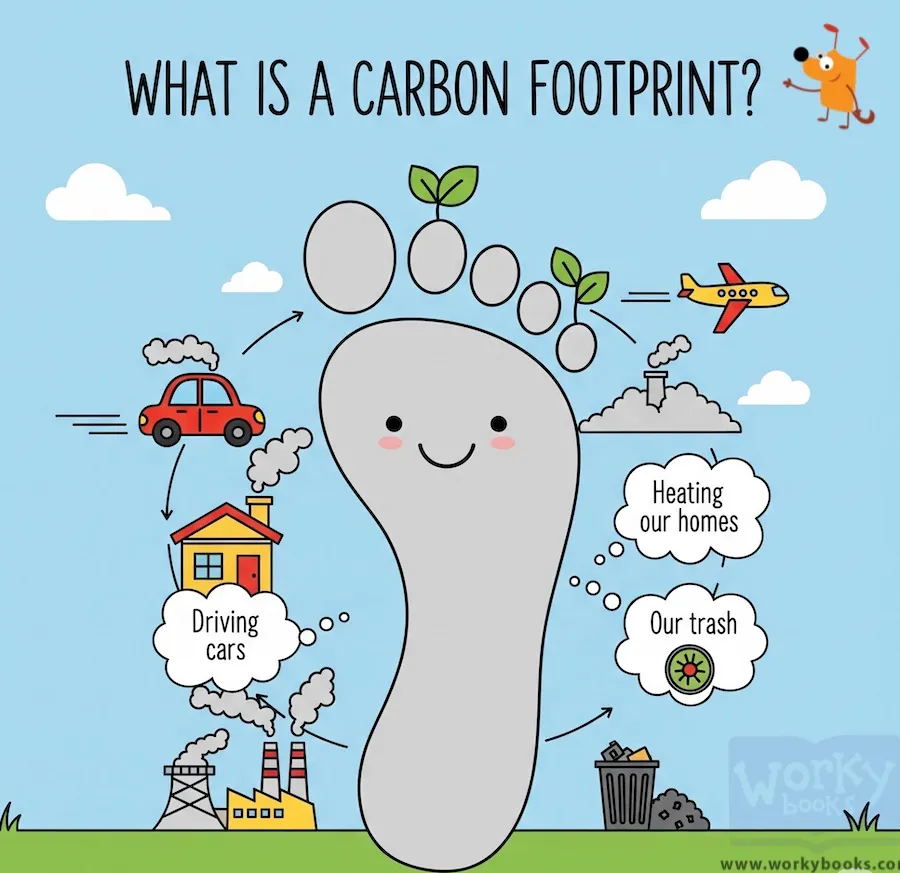
Greenhouse gas emissions from human activities are a major force driving global climate change. Every year, scientists measure the total amount of these gases each person causes by their actions—this is known as a carbon footprint. A carbon footprint is the sum of all greenhouse gases released directly or indirectly by your daily life, measured in tons of CO₂ equivalent per year. Scientists use 'CO₂ equivalent' because it lets them combine different greenhouse gases, like methane and nitrous oxide, by converting their effects into the same units as carbon dioxide. This allows for easy comparison and understanding of total impact.
How Is a Carbon Footprint Created?
Your carbon footprint includes both direct emissions and indirect emissions. Direct emissions come from sources you control, such as driving a gasoline car, heating your home, or using electricity from fossil fuels. For example, when you drive to school, the gasoline burned releases CO₂ straight into the air. Indirect emissions come from products and services you use, but do not control directly. This includes emissions from making, transporting, and packaging food and products you buy. For instance, a hamburger’s footprint includes emissions from raising cattle, growing animal feed, processing the meat, and shipping it to stores. Both types add up to your annual carbon footprint.
Measuring and Comparing Carbon Footprints
The average person in the United States has a carbon footprint of about 16 tons of CO₂ equivalent per year, while the global average is closer to 4 tons. Scientists say that to slow climate change, people worldwide need to lower their average footprint to about 2 tons per person by 2050. Measuring your footprint involves looking at home energy use, transportation, food choices, purchases, and waste. Even small changes—like eating less meat, using public transit, or buying less—can reduce your footprint. Online calculators can estimate your footprint based on your habits and choices.
Why Reducing Your Carbon Footprint Matters
Caring about your carbon footprint links personal choices to a global challenge. When large groups of people lower their emissions, it can slow the buildup of greenhouse gases in the atmosphere. This helps reduce risks like rising sea levels, extreme weather, and harm to ecosystems. Understanding your footprint gives you the power to make changes, influence others, and support policies that protect the planet. It also connects to larger scientific ideas about systems, cause and effect, and human impacts on Earth.
Interesting Fact: One kilogram of beef can produce over 25 kilograms of CO₂ equivalent, making it one of the highest-carbon foods on the planet.
What is a carbon footprint?
The total amount of greenhouse gases a person causes each yearThe number of steps a person takes each dayThe amount of water a person uses each yearThe amount of oxygen a person breathes each day
Which of the following is an example of a direct emission?
Driving a gasoline carBuying a new bicycleEating a saladWearing a cotton T-shirt
Why do scientists use 'CO₂ equivalent'?
To combine the effects of different greenhouse gases into a single unitTo measure only CO₂ in the airTo count the number of carbon atomsTo estimate water pollution
What is the global average carbon footprint per person per year?
4 tons16 tons2 tons25 tons
Which gas is NOT a greenhouse gas mentioned in the passage?
OxygenCarbon dioxideMethaneNitrous oxide
What would likely happen if everyone reduced their carbon footprint?
Greenhouse gas levels would rise more slowlyThe oceans would become saltierThere would be more fossil fuels undergroundWeather would stop changing
What is an indirect emission?
An emission from making and transporting products you useAn emission from breathing airAn emission from walking to schoolAn emission from watching TV
Reducing meat consumption can help lower your carbon footprint.
TrueFalse
The main purpose of measuring your carbon footprint is to understand your impact on climate change.
TrueFalse
Which of these could help reduce your carbon footprint?
Using public transportationLeaving lights on all nightEating more beefBuying more new clothes
Perfect For:
👩🏫 Teachers
• Reading comprehension practice
• Auto-graded assessments
• Literacy skill development
👨👩👧👦 Parents
• Reading practice at home
• Comprehension improvement
• Educational reading time
🏠 Homeschoolers
• Reading curriculum support
• Independent reading practice
• Progress monitoring
Reading Features:
📖
Reading Passage
Engaging fiction or nonfiction text
❓
Comprehension Quiz
Auto-graded questions
📊
Instant Feedback
Immediate results and scoring
📄
Printable Version
Download for offline reading
🔊
Read Aloud
Voice-over with word highlighting
Reviews & Ratings
No reviews yet. Be the first to share your experience!
Related Content
Natural Disaster: Tornadoes
Tornadoes are dangerous spinning columns of air. Knowing the signs and having safety plans can help protect you from the...
RI.3.1RI.4.4RI.4.2RI.5.2
Natural Disaster: Hurricanes
Hurricanes are massive storms with strong winds and rain. Tracking and preparing for them helps protect people in their ...
RI.3.1RI.4.4RI.4.2RI.5.2
How Climate Change Affects Animal Migration
This NGSS-aligned science reading passage explains how climate change affects animal migration by altering seasonal cues...
MS-LS2-6MS-ESS3-5
What Is Global Warming?
This NGSS-aligned reading passage explains global warming, the greenhouse effect, and how human activities like burning ...
MS-ESS3-5
What Causes Global Warming?
This NGSS-aligned reading passage explains what causes global warming, focusing on how human activities like burning fos...
MS-ESS3-5
How to Stop Global Warming
This NGSS-aligned reading passage helps students understand how to stop global warming by reducing greenhouse gases. It ...
MS-ESS3-5
Human Impacts: Climate Change
This standards-aligned science reading passage for grades 6-8 explains the mechanisms and effects of human-driven climat...
MS-LS2-4MS-ESS3-5
Conservation Strategies
This comprehensive passage introduces students in grades 6-8 to the major strategies used in conservation biology, such ...
MS-LS2-5MS-ESS3-4
Environmental Problems and Solutions
This passage for grades 6-8 introduces major environmental problems such as habitat loss, pollution, climate change, inv...
MS-LS2-4MS-ESS3-3MS-ESS3-4
Sustainability and Individual Action
This reading passage for grades 6-8 introduces the concept of sustainability, defined as meeting current needs without c...
MS-ESS3-4
Climate Change: Vulnerable Ecosystems
This middle school science passage, aligned with NGSS standards MS-ESS3-5 and MS-LS2-4, helps students understand how cl...
MS-ESS3-5MS-LS2-4
Restoration Ecology
This passage introduces middle school students to the vital field of restoration ecology, aligning with NGSS standards M...
MS-LS2-4MS-ESS3-4
Climate Change: Solutions and Mitigation
This passage explores scientific solutions and mitigation strategies for climate change, designed for middle school scie...
MS-ESS3-4MS-ESS3-5
Scientific Inquiry in Earth Science
This passage explores scientific inquiry in Earth science for grades 6-8, aligned with NGSS standards MS-ESS1-4, MS-ESS2...
MS-ESS1-4MS-ESS2-1MS-ESS3-5SEP
Renewable vs. Nonrenewable Energy
This engaging passage, aligned with NGSS standards MS-PS3-4, MS-ESS3-3, and MS-ESS3-4, helps middle school students diff...
MS-PS3-4MS-ESS3-3MS-ESS3-4
Fossil Fuels: Coal
This middle school science reading passage explores the science behind coal, a major fossil fuel. Students will learn ho...
MS-PS3-4MS-ESS3-3MS-ESS3-4
Solar Energy
This engaging passage for grades 6-8 explores the science of solar energy, focusing on how sunlight is converted into el...
MS-PS3-4MS-ESS3-3MS-ESS3-4
Wind Energy
This comprehensive middle school science passage explores the scientific principles behind wind energy and how wind turb...
MS-PS3-4MS-ESS3-3MS-ESS3-4
Hydroelectric Energy
This comprehensive passage introduces middle school students to the science behind hydroelectric energy, directly aligni...
MS-PS3-4MS-ESS3-3MS-ESS3-4
Soil Conservation
This passage for grades 6-8 explains soil conservation, aligning with NGSS standard MS-ESS3-4. Students will learn about...