How Density Varies in Liquids
Interactive passage with audio narration, comprehension questions, and printable PDF.
By completing this purchase you agree to our Terms of Use and Privacy Policy. Your subscription renews automatically until you cancel. You can cancel anytime from your account settings. All sales are final and non-refundable. Digital content is available for download in your account immediately upon purchase.
What's included
How Density Varies in Liquids preview and details
About this printable How Density Varies in Liquids science reading passage, NGSS-aligned (Grades 5-8)
Sample passage and quiz from How Density Varies in Liquids
Reading passage and comprehension quiz preview
How Density Varies in Liquids
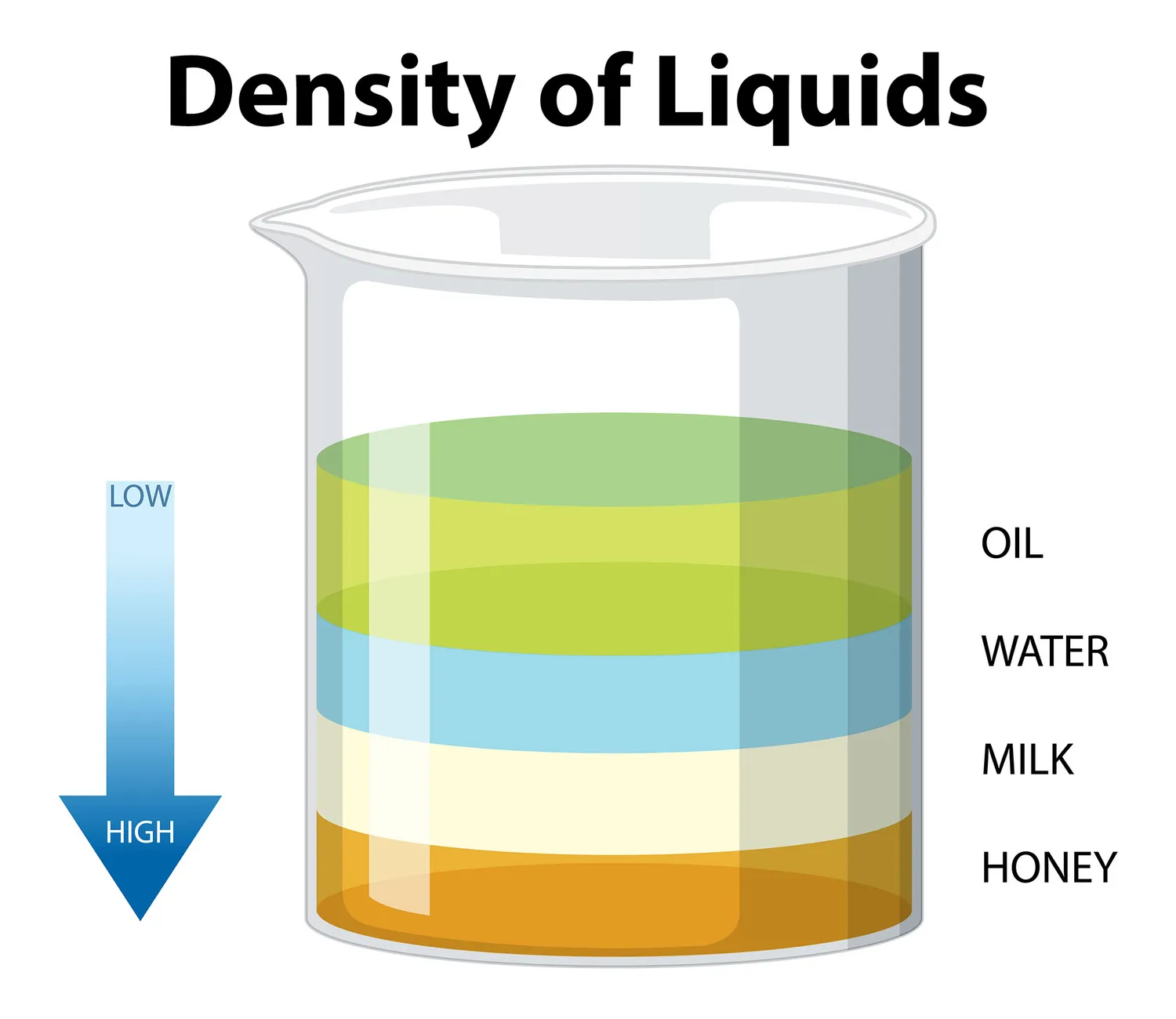
Density is a property that determines how much mass is packed into a certain volume of a substance. When you pour different liquids—such as water, oil, honey, alcohol, and mercury—into the same container, they often form distinct layers. This phenomenon is a result of differences in density. The way liquids stack on top of each other is not random; it follows specific scientific principles that help us understand material properties and their interactions.
How Density Works in Liquids
The mechanism behind layering is based on the density of each liquid. Density is calculated as mass divided by volume (D = m/V). If you compare 100 milliliters of honey and 100 milliliters of water, the honey is heavier because its particles are packed more tightly together. In a density column, the densest liquid will settle at the bottom, while the least dense liquid will rise to the top. For example, honey (about 1.42 g/cm³) will always sink below water (1.00 g/cm³), and oil (around 0.92 g/cm³) will float above water. Alcohol, which is less dense than water (about 0.79 g/cm³), floats even higher, while mercury (13.6 g/cm³), being extremely dense, sinks to the very bottom. This explains why oil always floats on water: its molecules are less tightly packed, making it lighter per unit volume. Scientists use graduated cylinders and balances to measure the volume and mass of a liquid, allowing them to calculate density precisely.
Applications and Interactions of Liquid Density
Understanding liquid density is essential in both natural and human-made systems. For instance, in oil spills, oil floats on the ocean surface because its density is less than seawater, making cleanup possible with skimming techniques. Density differences are also used in laboratories to separate liquids or test their purity. In medicine, mercury's high density makes it useful in traditional thermometers, where it rises and falls with temperature changes. Furthermore, density columns are used in geology to simulate how magma chambers separate different minerals due to density. The relationship between mass, volume, and density helps chemists and engineers design processes and materials for everything from food production to spacecraft fuel systems.
Complexities and Exceptions in Density Columns
While the layering of liquids usually follows the density rule, temperature and impurities can change density values. For example, heating a liquid generally decreases its density because the particles move further apart. Adding salt to water increases its density, allowing some objects to float that would normally sink. In real-world environments, liquids can mix if they are miscible, meaning they dissolve into each other, and this can disrupt the neat layers seen in simple demonstrations. Despite these complexities, the basic principle remains: the arrangement of liquids in a column is determined by their relative densities.
Density is a key scientific property that explains why some liquids float while others sink. Our ability to measure and compare densities allows us to predict and control the behavior of materials in countless settings. This concept connects to the larger scientific ideas of matter, structure, and interactions, helping us solve problems in the environment, industry, and everyday life.
Interesting Fact:
Mercury is so dense that even a solid object like iron can float on it, while a much lighter liquid like oil always floats above water!
Comprehension quiz (10 questions)
1. What property determines whether a liquid will float or sink in a density column?
2. Which of the following liquids is the densest according to the passage?
3. Why does oil float on water in a density column?
4. What tool is used to measure the volume of a liquid?
5. What does the word 'miscible' mean in the passage?
6. Which sentence best describes what happens when salt is added to water?
7. What effect does heating usually have on the density of a liquid?
8. Why can scientists use density columns to separate minerals in magma?
9. True or False: Mercury will always float on top of oil in a density column.
10. True or False: The arrangement of liquids in a column is determined by their relative densities.
Perfect for the way you teach
- Build comprehension skills
- Auto-graded quiz
- Differentiated reading
- Read together at home
- Improve fluency
- Quiet reading time
- Reading curriculum support
- Independent practice
- Track Lexile growth