Silk Road Trade Network
Interactive passage with audio narration, comprehension questions, and printable PDF.
By completing this purchase you agree to our Terms of Use and Privacy Policy. Your subscription renews automatically until you cancel. You can cancel anytime from your account settings. All sales are final and non-refundable. Digital content is available for download in your account immediately upon purchase.
What's included
Silk Road Trade Network preview and details
About this printable Silk Road Trade Network reading passage (Grades 5-8)
Sample passage and quiz from Silk Road Trade Network
Reading passage and comprehension quiz preview
Silk Road Trade
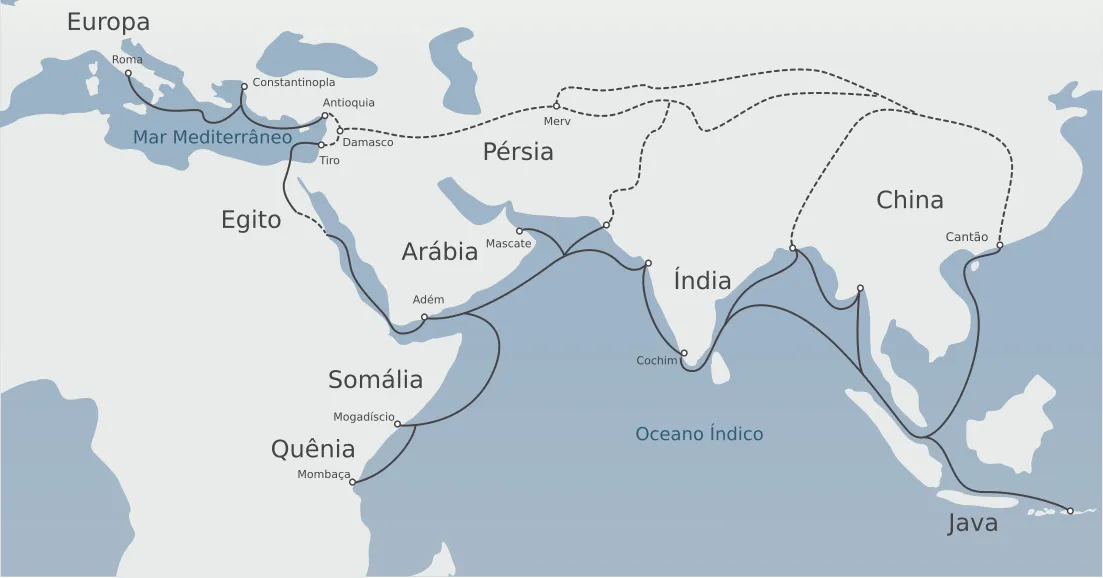
Source: Wikimedia Commons - Belsky (talk · contribs)
The Silk Road was a vast network of ancient trade routes that linked China with Central Asia, the Middle East, and even parts of Europe from roughly the 2nd century BCE to the 15th century CE. These trade routes were not a single path, but rather a collection of overland and sea routes that made it possible for merchants, pilgrims, and travelers to exchange goods, ideas, and technologies across thousands of miles. The Silk Road began during the Han dynasty (206 BCE–220 CE), when Emperor Wu sent an envoy named Zhang Qian to explore regions to the west. His reports helped open the way for regular trade between China and distant lands.
The Silk Road got its name from the highly valued Chinese silk cloth that was traded along the route. However, many other goods traveled these routes, including spices, glassware, horses, precious stones, and paper. Archaeological evidence, such as silk fragments found in ancient Egyptian tombs and Roman records describing Chinese silk, shows that products from China reached faraway places. Major cities along the route, like Chang’an (modern-day Xi’an), Samarkand, and Kashgar, became important trading centers and places where different cultures met. These cities also served as stops for caravans, groups of people and pack animals who traveled together for safety across dangerous deserts and mountains.
Trade on the Silk Road was not just about goods—it was also about cultural exchange. As people from various civilizations met, they shared languages, religions, art, and scientific knowledge. Buddhism, for example, spread from India to China and other parts of Asia through this network. The exchange of ideas also led to the transfer of inventions, such as papermaking and gunpowder, which would eventually shape societies far from their place of origin. Archaeological sites, such as the Mogao Caves near Dunhuang, contain art influenced by different cultures and tell the story of people who traveled these routes.
The Silk Road’s importance changed over time. During the Tang dynasty (618–907 CE), trade flourished, and the route was safer under strong government control. Later, political instability and new sea routes caused overland trade to decline. Despite these changes, the Silk Road’s impact continued, as it had already connected distant peoples and encouraged the movement of goods and ideas across continents.
Overall, the Silk Road played a vital role in world history by linking civilizations, spreading technology, and encouraging interactions that shaped societies. Its story connects to themes of geography, human movement, and the development of global networks.
Interesting Fact: The word “sericulture,” meaning silk farming, comes from the Latin word for silk, “sericum,” reflecting the influence of this ancient trade.
Comprehension quiz (8 questions)
1. When did the Silk Road begin?
2. What was the Silk Road mainly used for?
3. Which city was a major trading center?
4. What helped spread Buddhism to China?
5. Why did people travel in caravans?
6. How did the Silk Road change over time?
7. The Silk Road ended in the 15th century. True or false?
8. What does 'caravan' mean?
Perfect for the way you teach
- Build comprehension skills
- Auto-graded quiz
- Differentiated reading
- Read together at home
- Improve fluency
- Quiet reading time
- Reading curriculum support
- Independent practice
- Track Lexile growth