Socrates and Greek Philosophy — Reading Comprehension
Rate this
Premium Resource
Present
Present in classroom. No work saved
Assign
Classroom with student accounts, Track progress
Quick Play
No student accounts, assign with a link
Grades
6
7
8
PRINT+DIGITAL RESOURCE
This learning resource is available in interactive and printable formats. The interactive worksheet can be played online and assigned to students. The Printable PDF version can be downloaded and printed for completion by hand.
This engaging history reading passage explores the life and legacy of Socrates, the ancient Greek philosopher renowned for his method of questioning and his influence on Western philosophy. Students will learn about Socrates’ background in Athens, his unique approach to teaching, and his impact on critical thinking and democratic society. The passage includes references to primary sources like Plato’s dialogues and archaeological discoveries, and discusses the social context of ancient Greece. Activities include a glossary, multiple-choice quiz, writing tasks, graphic organizers, and a timeline, all aligned with CA HSS 6.4.1 and CCSS RH.6-8.1 standards. Students can access a Spanish translation and read aloud audio, ensuring accessibility. This resource supports inquiry-based learning and historical analysis, making connections to broader themes in world history and the development of human thought.
CONTENT PREVIEW
Expand content preview
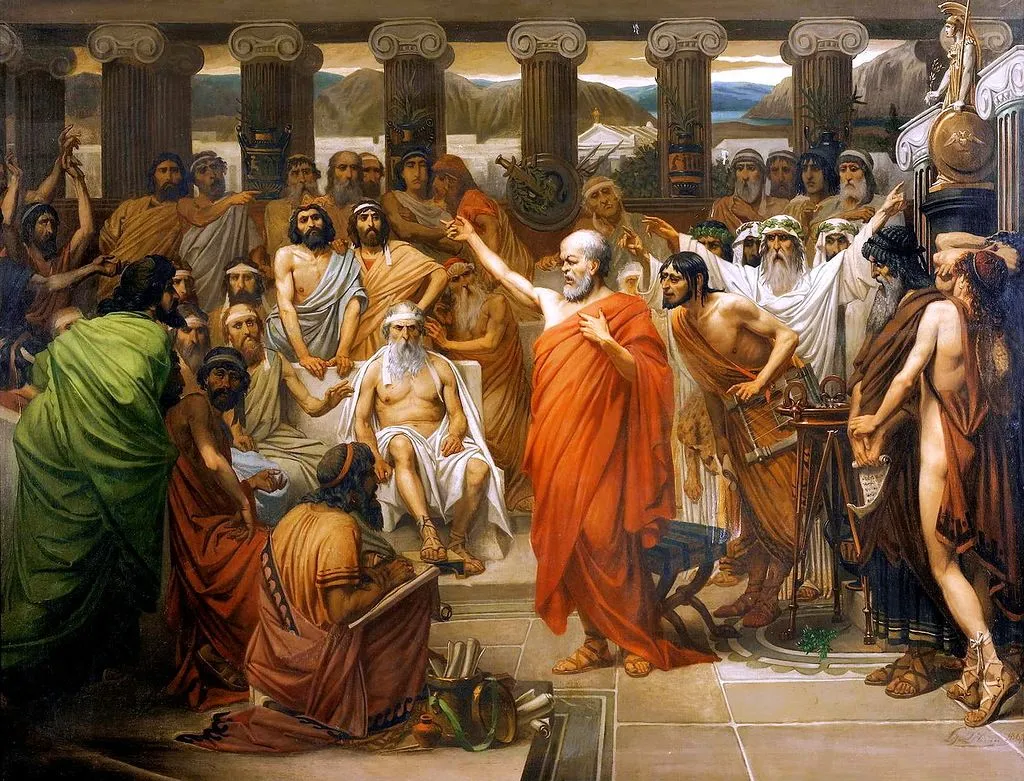
Socrates Address by Belgian artist Louis Joseph Lebrun, 1867 by Louis Le Brun / Wikimedia Commons
Socrates was a famous philosopher from ancient Athens, Greece, who lived from about 470 to 399 BCE. He is known for his unique teaching style and his deep influence on Western thought. Socrates never wrote down his ideas, but his student Plato recorded many of his conversations. These dialogues have allowed historians to learn about Socrates’ life, beliefs, and the impact he had on his city-state and the world.
Socrates was born in Athens, a powerful city-state known for its democracy and rich culture. He spent most of his life walking through the city’s agora, or public marketplace, asking people challenging questions about justice, courage, and the meaning of life. Instead of giving lectures, Socrates used a method called the Socratic Method. He asked a series of questions to help people examine their own beliefs. This method encouraged people to think critically and not simply accept traditions or opinions without evidence.
Primary sources, like Plato’s "Apology," describe how Socrates questioned not only ordinary citizens but also powerful leaders. For example, in 399 BCE, Socrates was put on trial for supposedly corrupting the youth and disrespecting the city’s gods. In his defense, as recorded by Plato, Socrates argued that he was actually helping the city by encouraging citizens to think for themselves. Archaeological discoveries in Athens, such as inscriptions and remains of the agora, show that public debate was a central part of Athenian life, making Socrates’ activities both important and controversial.
Socrates’ ideas had a lasting effect on philosophy and society. His teachings inspired Plato and, later, Aristotle, helping to shape the foundations of Western philosophy. Socrates’ focus on critical thinking influenced democratic societies, where open debate and questioning of authority are important values. However, his life also shows the risks of challenging popular beliefs. The city’s decision to execute Socrates reflected the tensions in Athenian society and the limits of free speech at that time.
Today, the Socratic Method is still used in schools and courts around the world. Socrates’ story helps us understand the importance of questioning, evidence, and open discussion in both ancient and modern societies.
Interesting Fact:Did you know? Socrates was so poor that he often walked barefoot and wore simple clothes, showing that he valued wisdom over wealth.
Where was Socrates born?
AthensSpartaRomeCorinth
Who was Socrates' famous student?
PlatoAristotlePericlesAlexander
In what year was Socrates put on trial?
399 BCE323 BCE500 BCE100 BCE
Why did Socrates use the Socratic Method?
Help people think criticallyTell people what to believeWrite poetryBuild temples
What was the agora in Athens?
A public marketplaceA templeA schoolA palace
What effect did Socrates have on democracy?
Encouraged open debateEnded democracyBecame kingBuilt the Parthenon
Socrates was executed for his ideas. True or false?
TrueFalse
What does 'primary source' mean?
A document from the timeA modern bookA legendA guess
Perfect For:
👩🏫 Teachers
• Reading comprehension practice
• Auto-graded assessments
• Literacy skill development
👨👩👧👦 Parents
• Reading practice at home
• Comprehension improvement
• Educational reading time
🏠 Homeschoolers
• Reading curriculum support
• Independent reading practice
• Progress monitoring
Reading Features:
📖
Reading Passage
Engaging fiction or nonfiction text
❓
Comprehension Quiz
Auto-graded questions
📊
Instant Feedback
Immediate results and scoring
📄
Printable Version
Download for offline reading
🔊
Read Aloud
Voice-over with word highlighting
Reviews & Ratings
No reviews yet. Be the first to share your experience!
Related Content
Geography of Ancient Greece
This rigorous history reading passage explores 'The Geography of Ancient Greece,' examining how the region’s mountains, ...
Homer: Epic Poet of Ancient Greece
This history reading passage explores the life and historical significance of Homer, the legendary epic poet of Ancient ...
Ancient Sparta
This reading passage explores the unique military society of Sparta, an influential city-state in Ancient Greece. Studen...
Greek Polis
This in-depth history reading passage explores the rise and development of the Greek polis, or city-state, a foundationa...
Ancient Greek City-States
This history reading passage explores the development and significance of city-states in ancient civilizations, focusing...
Greece's Lasting Legacy
This engaging history reading passage explores the enduring legacy of Ancient Greece and its profound influence on the m...
Evidence in Ancient History
This engaging history reading passage investigates how archaeologists and historians discover clues about how ancient pe...
Ancient Philosophy
This reading passage takes students on a journey through the philosophical traditions of ancient Greece, India, and Chin...
Euripides and Greek Drama
This engaging passage introduces students to Euripides, one of the greatest ancient Greek playwrights, known for his exp...
Women in Ancient Societies
This reading passage explores the complex roles of women in the ancient world, focusing on civilizations such as Mesopot...
Sophocles and Greek Tragedy
This passage explores the life and legacy of Sophocles, one of the most influential playwrights of ancient Greece, whose...
Ancient Literature
This passage explores the importance of ancient stories and poems from civilizations such as Greece, India, and Israel. ...
Ancient Science and Medicine
This comprehensive reading passage explores the development of science and medicine in ancient civilizations, including ...
Slavery in Ancient World
This passage explores the complex history of slavery in the ancient world, examining its presence in societies such as M...
Ancient Theocracy
This engaging history reading passage explores the concept of theocracy in ancient civilizations, where priests and reli...
Ancient Mathematics
This passage explores the essential role of mathematics in ancient civilizations, including Mesopotamia, Egypt, Greece, ...
Ancient Canaan
This educational passage explores the land of Canaan, the historical homeland of the ancient Israelites. Students will l...
Geography of Ancient Israel
This passage explores the rich geography of Ancient Israel, focusing on how landforms, climate, and natural resources sh...
Ancient Writing Systems
This engaging history reading passage explores the origins and evolution of ancient writing systems, including cuneiform...
Ancient Agriculture Farming
This passage explores the transformative impact of farming on ancient societies, examining how the Neolithic Revolution ...