This learning resource is available in interactive and printable formats. The interactive worksheet can be played online and assigned to students. The Printable PDF version can be downloaded and printed for completion by hand.
This comprehensive history reading passage examines the Persian Wars, a defining conflict between ancient Greece and the vast Persian Empire. Aligned with CA HSS 6.4, TEKS 6.13, and CCSS RI.6-8, the passage explores events such as the Battle of Marathon, the stand at Thermopylae, and the impact of these wars on Greek unity and Western civilization. Students will learn about key figures like King Xerxes and Themistocles, analyze cause-and-effect relationships, and consider the significance of geography and social structure. The passage includes a glossary of academic vocabulary, a read aloud audio option, and full Spanish translation for accessibility. Accompanying activities such as quizzes, writing prompts, graphic organizers, and a timeline support critical thinking and evidence-based historical analysis. This resource is ideal for developing students' understanding of ancient history, historical causation, and the foundations of democracy.
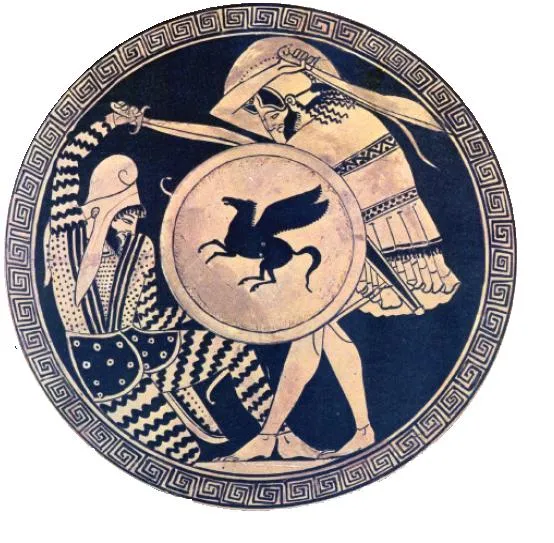
The Persian Wars were a series of conflicts fought between the city-states of ancient Greece and the powerful Persian Empire from 499 to 449 BCE. These wars dramatically shaped the course of Greek civilization and had a lasting impact on world history. The battles took place mainly in regions around the Aegean Sea, including mainland Greece and the coasts of Asia Minor.
The Persian Empire, led by kings Darius I and later Xerxes I, was the largest empire the world had ever seen at that time. It stretched from the Indus River in the east to Egypt and Thrace in the west. In 499 BCE, some Greek city-states in Asia Minor, such as Miletus, rebelled against Persian rule. Athens supported this revolt, angering Darius I and prompting the Persians to seek revenge against the Greeks. This decision set off a chain of events leading to major battles between the two powers.
One of the most famous battles was the Battle of Marathon in 490 BCE. According to the historian Herodotus, about 10,000 Athenian soldiers, fighting alongside a small force from Plataea, faced a much larger Persian army. Using better armor and a strong formation called the phalanx, the Greeks won a surprising victory. Legend says a messenger ran over 26 miles to Athens to announce the victory, inspiring the modern marathon race. Another crucial event was the Battle of Thermopylae in 480 BCE. Here, King Leonidas of Sparta and 300 Spartans, with help from other Greeks, made a legendary stand against the huge army of King Xerxes I. Though the Greeks were defeated, their bravery inspired other Greeks to unite.
The final turning point came at the Battle of Salamis, a naval battle fought near Athens. Themistocles, an Athenian leader, cleverly lured the Persian fleet into narrow waters where the smaller Greek ships could attack effectively. The Persian navy suffered heavy losses, forcing Xerxes to retreat. After more battles, the Persians eventually withdrew from Greece, ending their attempts to conquer the Greek mainland.
The Persian Wars were significant for many reasons. They encouraged cooperation between Greek city-states, especially Athens and Sparta, even though these city-states were often rivals. The wars also led to the rise of Athens as a powerful city-state and the development of democracy. Greek artists, writers, and philosophers used the memory of these wars to celebrate freedom and the defense of their sovereignty. The wars showed how geography, such as narrow mountain passes and the sea, could influence military strategy and outcomes.
The struggle between Greece and Persia highlights important themes in history: how societies defend their independence, how alliances form, and how conflicts can change the course of civilizations.
Interesting Fact: The Greek historian Herodotus, often called the "Father of History," wrote a detailed account of the Persian Wars, providing much of what we know today.
Who led the Persian Empire?
Darius I and Xerxes ILeonidas and ThemistoclesHerodotus and MiletusAthens and Sparta
Where did the Battle of Marathon occur?
Near AthensIn EgyptOn the Indus RiverIn Persia
Which Greek city-state became powerful after the wars?
AthensMiletusSpartaPlataea
Why did the Persian Wars begin?
Greek revolt in Asia MinorRoman invasionTrade disputesFlooding of the Nile
What effect did the Battle of Thermopylae have?
Inspired Greek unityDestroyed AthensEnded the warsGave Persia new land
How did geography affect Greek strategy?
Narrow passes and seas helped defenseMade travel easy for PersiansPrevented alliancesCaused food shortages
The Persians won the Battle of Salamis. True or false?
TrueFalse
What is a 'phalanx'?
A Greek military formationA Persian cityA type of shipA government official
Perfect For:
👩🏫 Teachers
• Reading comprehension practice
• Auto-graded assessments
• Literacy skill development
👨👩👧👦 Parents
• Reading practice at home
• Comprehension improvement
• Educational reading time
🏠 Homeschoolers
• Reading curriculum support
• Independent reading practice
• Progress monitoring
Reading Features:
📖
Reading Passage
Engaging fiction or nonfiction text
❓
Comprehension Quiz
Auto-graded questions
📊
Instant Feedback
Immediate results and scoring
📄
Printable Version
Download for offline reading
🔊
Read Aloud
Voice-over with word highlighting
Reviews & Ratings
No reviews yet. Be the first to share your experience!
Related Content
Geography of Ancient Greece
This rigorous history reading passage explores 'The Geography of Ancient Greece,' examining how the region’s mountains, ...
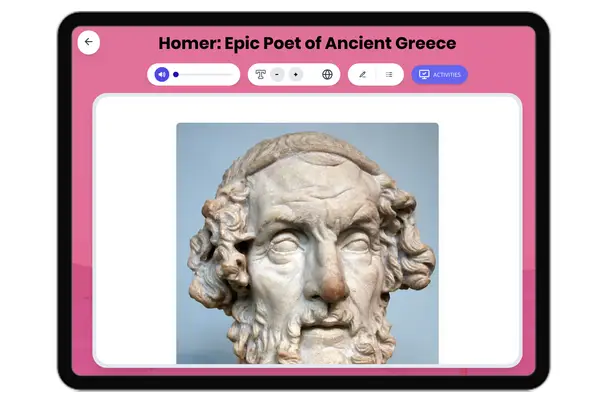
Homer: Epic Poet of Ancient Greece
This history reading passage explores the life and historical significance of Homer, the legendary epic poet of Ancient ...
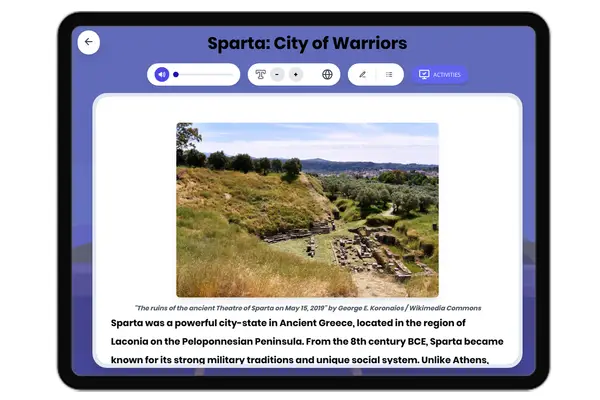
Ancient Sparta
This reading passage explores the unique military society of Sparta, an influential city-state in Ancient Greece. Studen...
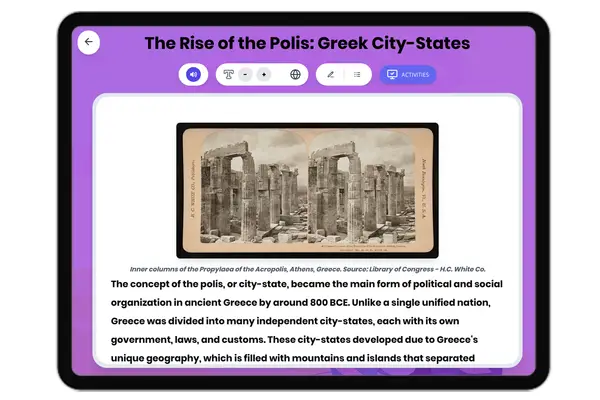
Greek Polis
This in-depth history reading passage explores the rise and development of the Greek polis, or city-state, a foundationa...
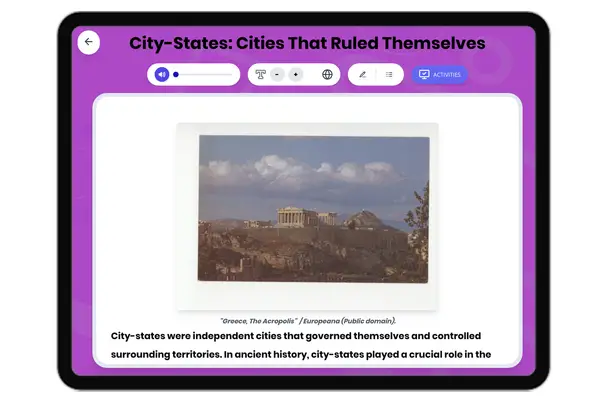
Ancient Greek City-States
This history reading passage explores the development and significance of city-states in ancient civilizations, focusing...
Greece's Lasting Legacy
This engaging history reading passage explores the enduring legacy of Ancient Greece and its profound influence on the m...
Evidence in Ancient History
This engaging history reading passage investigates how archaeologists and historians discover clues about how ancient pe...
Ancient Philosophy
This reading passage takes students on a journey through the philosophical traditions of ancient Greece, India, and Chin...
Euripides and Greek Drama
This engaging passage introduces students to Euripides, one of the greatest ancient Greek playwrights, known for his exp...
Women in Ancient Societies
This reading passage explores the complex roles of women in the ancient world, focusing on civilizations such as Mesopot...
Sophocles and Greek Tragedy
This passage explores the life and legacy of Sophocles, one of the most influential playwrights of ancient Greece, whose...
Ancient Literature
This passage explores the importance of ancient stories and poems from civilizations such as Greece, India, and Israel. ...
Ancient Science and Medicine
This comprehensive reading passage explores the development of science and medicine in ancient civilizations, including ...
Slavery in Ancient World
This passage explores the complex history of slavery in the ancient world, examining its presence in societies such as M...
Ancient Theocracy
This engaging history reading passage explores the concept of theocracy in ancient civilizations, where priests and reli...
Ancient Mathematics
This passage explores the essential role of mathematics in ancient civilizations, including Mesopotamia, Egypt, Greece, ...
Ancient Canaan
This educational passage explores the land of Canaan, the historical homeland of the ancient Israelites. Students will l...
Geography of Ancient Israel
This passage explores the rich geography of Ancient Israel, focusing on how landforms, climate, and natural resources sh...
Ancient Writing Systems
This engaging history reading passage explores the origins and evolution of ancient writing systems, including cuneiform...
Ancient Agriculture Farming
This passage explores the transformative impact of farming on ancient societies, examining how the Neolithic Revolution ...