The Telephone Connects the Nation
Interactive passage with audio narration, comprehension questions, and printable PDF.
By completing this purchase you agree to our Terms of Use and Privacy Policy. Your subscription renews automatically until you cancel. You can cancel anytime from your account settings. All sales are final and non-refundable. Digital content is available for download in your account immediately upon purchase.
What's included
The Telephone Connects the Nation preview and details
About this printable The Telephone Connects the Nation reading passage (Grades 6-8)
Sample passage and quiz from The Telephone Connects the Nation
Reading passage and comprehension quiz preview
The Telephone Connects the Nation
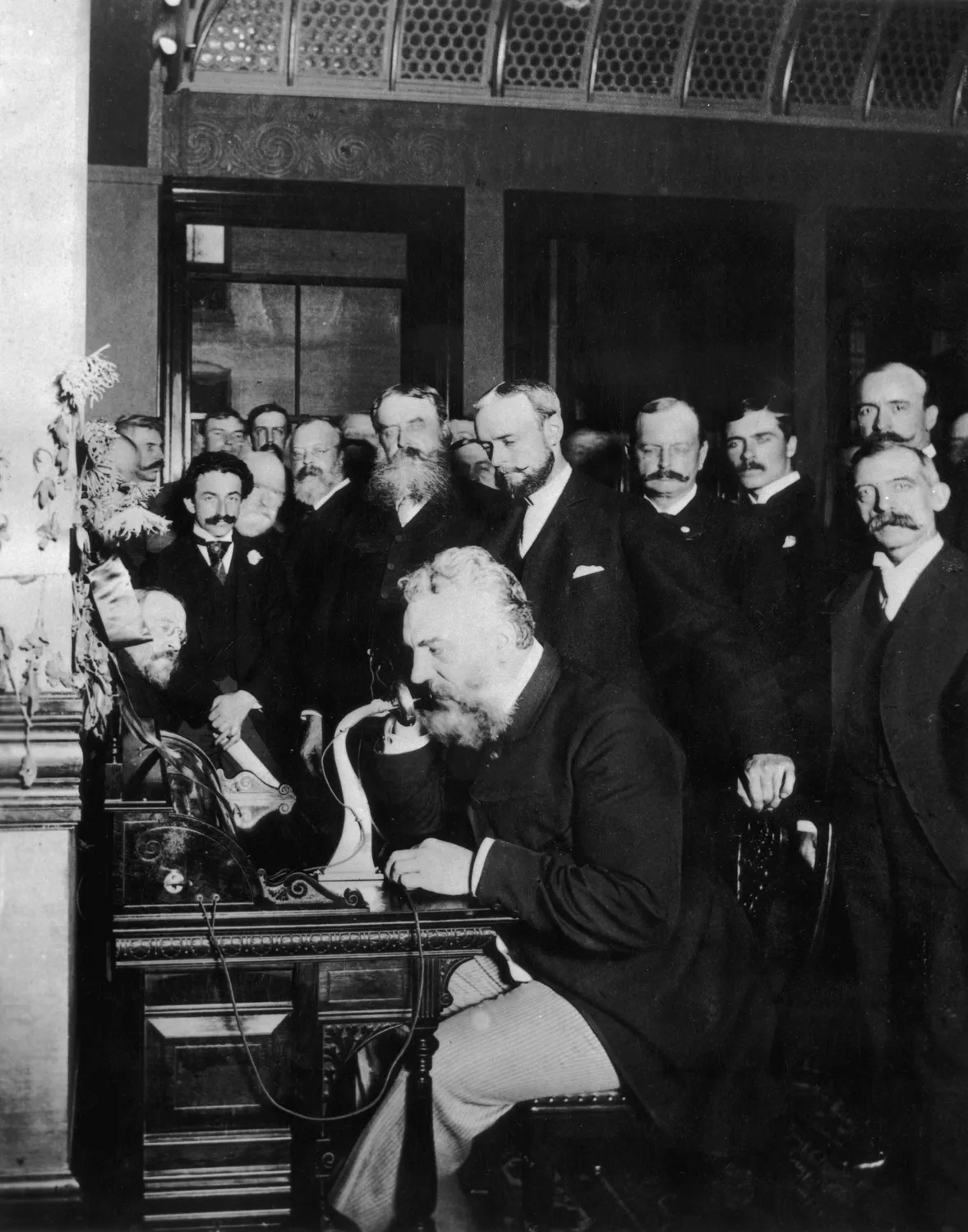
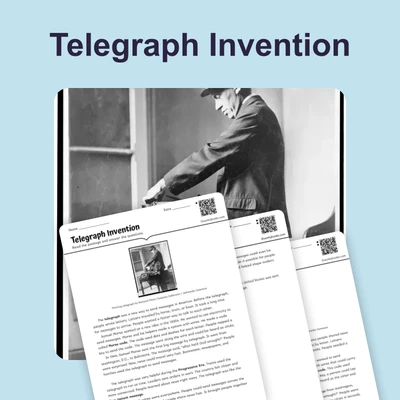
"Alexander Graham Telephone in Newyork" by Gilbert H. Grosvenor Collection, Prints and Photographs Division, Library of Congress. /
Source: Wikimedia Commons (Public domain).
In 1876, Alexander Graham Bell received a patent for the telephone, an invention that would revolutionize communication in the United States and beyond. Before this breakthrough, people relied on letters or the telegraph for distant communication, both of which could be slow or limited. The telephone allowed people to hear each other's voices across great distances, creating new possibilities for personal and business connections.
The problem of slow communication had challenged Americans for decades. As the country expanded westward, families, businesses, and government officials needed to exchange information quickly. The telegraph, invented earlier in the 1800s, sent messages using electrical signals, but only as written code. This system was efficient, yet it lacked the personal touch and immediacy of voice. The invention of the telephone provided a solution: it transmitted sound waves as electrical signals, so people could talk in real time, even from hundreds of miles apart.
Bell’s invention was only the beginning. The first telephones had limited range and required operators to connect calls, making the process complicated. Over time, technology improved. Telephone lines stretched across cities, rural towns, and eventually from coast to coast. The infrastructure needed for a national network grew, with telephone poles and wires becoming common sights throughout the landscape. These changes made it easier for Americans to stay in touch, share news, and do business across long distances.
The telephone’s impact extended beyond basic communication. It contributed to the industrialization of America, helping companies grow and manage operations in different regions. Emergency services, such as police and doctors, could respond more quickly. Political leaders used the telephone to coordinate efforts during crises. The rise of the telephone also created new jobs, including operators, line installers, and engineers, while encouraging women to join the workforce as telephone operators.
The adoption of the telephone was not without conflict. Some people worried about privacy, as phone calls were not always secure. Others feared that face-to-face communication would be lost. Despite these concerns, the benefits proved greater than the drawbacks. By the early 1900s, millions of Americans had access to telephones, which changed the rhythm of daily life.
As the network expanded, new innovations, such as rotary dials and automatic switching, made the system even more efficient and accessible. The telephone connected the nation, shrinking distances and shaping the way Americans lived, worked, and understood the world.
Interesting Fact: The first words ever spoken over the telephone by Alexander Graham Bell were, "Mr. Watson, come here, I want to see you."
Comprehension quiz (8 questions)
1. Who invented the telephone?
2. In what year was the telephone patented?
3. What did early telephones need to connect calls?
4. How did the telephone improve communication?
5. Why was the telephone important to businesses?
6. What concern did some people have about the telephone?
7. The telephone was first used to send pictures. True or false?
8. What is 'infrastructure' in the passage?
Perfect for the way you teach
- Build comprehension skills
- Auto-graded quiz
- Differentiated reading
- Read together at home
- Improve fluency
- Quiet reading time
- Reading curriculum support
- Independent practice
- Track Lexile growth