The Mexican-American War Comes to California — Reading Comprehension
Rate this
Premium Resource
Present
Present in classroom. No work saved
Assign
Classroom with student accounts, Track progress
Quick Play
No student accounts, assign with a link
Grades
3
4
5
Standards
D2.HIS.2.3-5
D2.HIS.6.3-5
RI.4.3
RI.4.4
W.4.2
PRINT+DIGITAL RESOURCE
This learning resource is available in interactive and printable formats. The interactive worksheet can be played online and assigned to students. The Printable PDF version can be downloaded and printed for completion by hand.
This passage explores the key events of the Mexican-American War as it reached California, focusing on the period leading up to California’s statehood in 1850. Students will learn about the causes and effects of the war, the people involved, and how California became part of the United States. The passage uses accessible language and a clear sequence of events to support foundational literacy and historical thinking. It also features a glossary of important terms, a Spanish translation, a timeline, and related activities including a quiz, writing prompts, and a graphic organizer. Teachers and students benefit from integrated literacy and history standards, with alignment to D2.His.2.3-5, D2.His.6.3-5, RI.4.3, RI.4.4, W.4.2. This passage includes a read aloud audio option and activities designed to deepen understanding of westward expansion and California’s journey to statehood.
CONTENT PREVIEW
Expand content preview
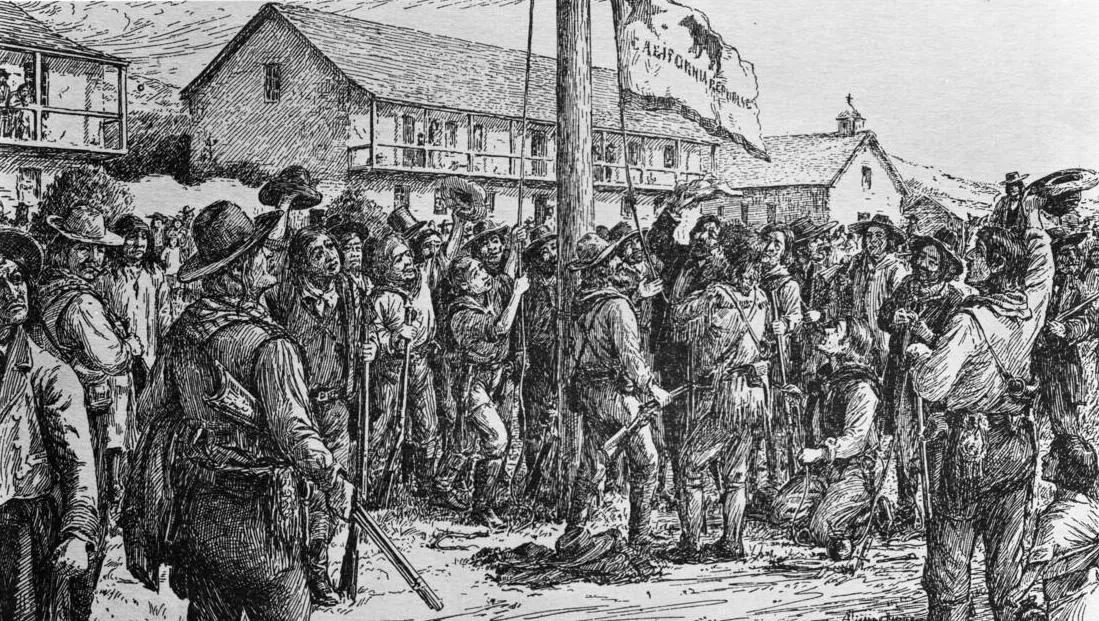
"Raising of the Bear Flag over Sonoma, June 14, 1846" by Charlies Pierce / Wikimedia Commons (Public domain).
The Mexican-American War was a conflict between Mexico and the United States from 1846 to 1848. During this war, California was under Mexican rule. The United States wanted to expand its land all the way to the Pacific Ocean. This goal was called westward expansion.
In 1846, American settlers in California started an uprising known as the Bear Flag Revolt. They wanted California to become part of the United States, not Mexico. At the same time, U.S. troops entered California. They fought battles against Mexican soldiers in several towns, including Los Angeles and San Diego.
By 1847, most of California was controlled by the United States military. The war was difficult for both sides. Some Californios, who were people living in California under Mexican rule, tried to fight back. However, they were outnumbered by the U.S. army.
In 1848, the war ended with the signing of the Treaty of Guadalupe Hidalgo. This treaty was a formal agreement between Mexico and the United States. The treaty gave California and other lands to the United States. In return, the United States paid Mexico $15 million and promised to protect the rights of people living in these new territories.
The change from Mexican to American rule was a big territorial change. It changed the government, laws, and culture in California. American settlers began to arrive in large numbers. Many people came looking for gold after the Gold Rush began in 1848. This caused towns to grow quickly and brought many new cultures together.
The Mexican-American War and the Treaty of Guadalupe Hidalgo transformed California. It became a part of the United States and started a new chapter in its history. The war showed the bravery of people on both sides and the importance of working for peace.
Interesting Fact: The Treaty of Guadalupe Hidalgo added more than 500,000 square miles of land to the United States, including California, Nevada, Utah, and parts of Arizona, New Mexico, Colorado, and Wyoming.
When did the Mexican-American War begin?
1846185017761865
What was the Bear Flag Revolt?
A gold discoveryA fight for U.S. controlA treaty signingA new law
What ended the Mexican-American War?
Gold RushBear Flag RevoltTreaty of Guadalupe HidalgoElection
Why did many people come to California after 1848?
For the Gold RushFor farmingFor tradeFor military jobs
What did the Treaty of Guadalupe Hidalgo do?
Gave California to MexicoGave land to the U.S.Started a new warProtected only soldiers
How did the war change California?
Changed its laws and leadersMoved it eastMade it colderClosed its towns
The Mexican-American War lasted two years.
TrueFalse
What is a treaty?
An agreement between countriesA kind of goldA type of foodA group of soldiers
Perfect For:
👩🏫 Teachers
• Reading comprehension practice
• Auto-graded assessments
• Literacy skill development
👨👩👧👦 Parents
• Reading practice at home
• Comprehension improvement
• Educational reading time
🏠 Homeschoolers
• Reading curriculum support
• Independent reading practice
• Progress monitoring
Reading Features:
📖
Reading Passage
Engaging fiction or nonfiction text
❓
Comprehension Quiz
Auto-graded questions
📊
Instant Feedback
Immediate results and scoring
📄
Printable Version
Download for offline reading
🔊
Read Aloud
Voice-over with word highlighting
Reviews & Ratings
No reviews yet. Be the first to share your experience!
Related Content
Native American Tribes Across America
This engaging history reading passage introduces students to Native American tribes across America, focusing on their da...
D2.HIS.1.3-5D2.HIS.2.3-5RI.4.1RI.4.2
Teepees: Homes on the Great Plains
This engaging history reading passage introduces students to teepees, the unique homes of Native American tribes on the ...
D2.HIS.2.3-5D2.HIS.14.3-5RI.4.1RI.4.2RI.4.4
Traditional Native American Clothing
This engaging history passage explores traditional Native American clothing and how it reflected the environment, values...
D2.HIS.2.3-5D2.HIS.3.3-5RI.4.3RI.4.4
The Iroquois Confederacy: A System of Peace
This engaging U.S. History reading passage introduces students to the Iroquois Confederacy, a powerful alliance of Nativ...
D2.HIS.2.3-5D2.HIS.3.3-5RI.4.3RI.4.4
The Cherokee Nation: History and Culture
This reading passage explores the rich history and culture of the Cherokee Nation, one of the largest Native American tr...
D2.HIS.2.3-5D2.HIS.14.3-5RI.4.3RI.4.4RI.4.10
The Sioux: Warriors and Tribal Leaders
This history reading passage explores the Sioux Nation, focusing on their roles as warriors and tribal leaders. Students...
D2.HIS.1.3-5D2.HIS.2.3-5RI.4.1RI.4.3
Native American Respect for Nature
This engaging history reading passage explores Native American respect for nature, emphasizing the close relationship be...
D2.HIS.2.3-5D2.HIS.3.3-5RI.4.3RI.4.4
Jamestown: The First Permanent English Colony
This engaging history passage explores the founding of Jamestown, the first permanent English colony in America. Aligned...
D2.HIS.1.3-5D2.HIS.2.3-5RI.4.3RI.4.4
Pocahontas and the Powhatan People
This engaging reading passage explores the life of Pocahontas and the Powhatan people and their important role in early ...
D2.HIS.1.3-5D2.HIS.2.3-5RI.4.1RI.4.3
Colonial Children: School and Chores
This reading passage explores the daily lives of colonial children, focusing on their experiences at school and their ma...
D2.HIS.2.3-5D2.HIS.3.3-5RI.4.1RI.4.2RI.4.4
Colonial Clothing and Homemade Goods
This engaging U.S. history passage explores the daily life of early American colonists with a focus on colonial clothing...
D2.HIS.2.3-5RI.4.3RI.4.4
Colonial Jobs: Blacksmiths, Bakers, and Craftsmen
This engaging history reading passage explores the vital roles of blacksmiths, bakers, and craftsmen in colonial America...
D2.HIS.2.3-5D2.HIS.3.3-5RI.4.3RI.4.4
Colonial Towns and Village Life
This engaging history reading passage explores the daily life, work, and unity found in colonial towns and villages. Ali...
D2.HIS.1.3-5D2.HIS.2.3-5RI.4.3RI.4.4
Colonial Trade with England and Africa
This history reading passage explores colonial trade between the American colonies, England, and Africa, focusing on the...
D2.HIS.2.3-5D2.HIS.14.3-5RI.4.3RI.4.4
Benjamin Franklin: Printer, Inventor, and Leader
This history reading passage explores the life and achievements of Benjamin Franklin, one of America's most important ea...
D2.HIS.2.3-5D2.HIS.3.3-5RI.4.1RI.4.3
George Washington Leads the Army
This engaging history reading passage explores how George Washington bravely led the Continental Army during the America...
D2.HIS.1.3-5D2.HIS.2.3-5RI.4.3RI.4.4
Women and Children During the Revolutionary War
This reading passage explores the important roles women and children played during the Revolutionary War. Students will ...
D2.HIS.2.3-5RI.4.3RI.5.3
African Americans Fight for Freedom
This educational passage explores the brave and inspiring story of how African Americans fought for freedom in the Unite...
D2.HIS.2.3-5D2.HIS.3.3-5RI.4.3RI.4.4
The Battle of Yorktown Ends War
This engaging U.S. history reading passage explores the Battle of Yorktown, a key event that ended the American Revoluti...
D2.HIS.1.3-5D2.HIS.2.3-5RI.4.1RI.4.3
Loyalists vs. Patriots: Divided Families
This engaging U.S. history reading passage explores the division between Loyalists and Patriots during the American Revo...