Reading Columbus's Letters from 1493 — Reading Comprehension
Rate this
Premium Resource
Present
Present in classroom. No work saved
Assign
Classroom with student accounts, Track progress
Quick Play
No student accounts, assign with a link
Grades
3
4
5
Standards
D2.HIS.3.3-5
D2.HIS.6.3-5
RI.4.3
RI.4.4
W.4.2
PRINT+DIGITAL RESOURCE
This learning resource is available in interactive and printable formats. The interactive worksheet can be played online and assigned to students. The Printable PDF version can be downloaded and printed for completion by hand.
This engaging U.S. history reading passage explores Christopher Columbus's 1493 letters, one of the earliest primary sources describing the Americas from a European viewpoint. Students will learn about Columbus's journey, his writings to Spain, and the impact of his discoveries on both Europe and the Native peoples. The passage features simple vocabulary, concrete examples, and two authentic quotes from Columbus's letter, helping students build foundational literacy skills alongside history content. Activities include a multiple-choice quiz, writing prompts, and a graphic organizer to compare European and Native perspectives. The resource also includes a Spanish translation of the passage and is aligned with C3 Framework and Common Core standards (D2.His.3.3-5, D2.His.6.3-5, RI.4.3, RI.4.4, W.4.2). Audio read-aloud and a public domain image enhance accessibility and engagement. This resource is ideal for teaching about early colonial encounters and primary sources in the classroom.
CONTENT PREVIEW
Expand content preview
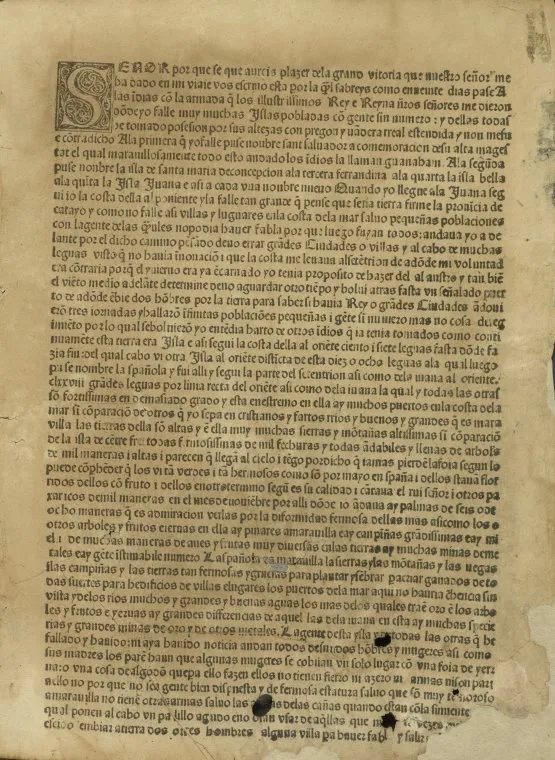
"Columbus's letter on the first voyage" by Christopher Columbus / Source: Wikimedia Commons (Public domain).
The Columbus Letters of 1493 are some of the earliest and most important records of European exploration in the Americas. In March 1493, Christopher Columbus wrote letters to the King and Queen of Spain to tell them about what he had found on his first voyage across the Atlantic Ocean. These letters quickly spread across Europe, sharing news of his discoveries.
Columbus described a land full of green islands, new plants, and friendly people. He wrote about meeting the native inhabitants and said they were gentle and willing to trade. He told stories of gold, spices, and resources that he believed the land could provide. These exciting descriptions made many Europeans want to learn more about the New World.
The letters served as a primary source for other explorers and rulers. Because they came directly from Columbus, people believed the stories were true. The letters were printed and shared in many languages, including Spanish and Latin. This helped spread the news very quickly across Europe.
Columbus also wrote about his hope to bring back riches and take new lands for Spain. He said the native people could be taught about Christianity and become friends of Spain. The letters made exploration seem like a great adventure and opportunity. Kings, queens, and merchants became more interested in sending ships across the ocean after reading Columbus’s words.
This led to many more voyages from Spain, Portugal, and other countries. The letters started a new period of exploration and competition among European powers. Many explorers wanted to find gold, claim land, and become famous like Columbus.
Today, the Columbus Letters of 1493 help historians understand how Europeans first learned about the Americas. They show how powerful words can be in shaping history. The letters are still studied as important documents that changed the world.
Interesting Fact: The letters were printed in several cities just weeks after Columbus returned, making them one of the first "news stories" to spread quickly across Europe.
Who wrote the letters of 1493?
Christopher ColumbusKing FerdinandQueen IsabellaAmerigo Vespucci
To whom did Columbus write his letters?
The King and Queen of SpainNative inhabitantsPortuguese sailorsFrench explorers
What did Columbus describe in the letters?
Green islands and goldMountains and desertsOnly animalsOnly ships
Why did the letters spread quickly?
They were printed and sharedThey were hiddenOnly read by ColumbusThrown away
How did the letters affect Europe?
Started more explorationStopped all travelMade people afraidLed to war
What is a primary source?
An original recordA modern summaryA storybookA law
Columbus’s letters made people want to explore. True or false?
TrueFalse
What does 'inhabitants' mean?
People who live in a placeShipsGoldMountains
Perfect For:
👩🏫 Teachers
• Reading comprehension practice
• Auto-graded assessments
• Literacy skill development
👨👩👧👦 Parents
• Reading practice at home
• Comprehension improvement
• Educational reading time
🏠 Homeschoolers
• Reading curriculum support
• Independent reading practice
• Progress monitoring
Reading Features:
📖
Reading Passage
Engaging fiction or nonfiction text
❓
Comprehension Quiz
Auto-graded questions
📊
Instant Feedback
Immediate results and scoring
📄
Printable Version
Download for offline reading
🔊
Read Aloud
Voice-over with word highlighting
Reviews & Ratings
No reviews yet. Be the first to share your experience!
Related Content
Traditional Native American Clothing
This engaging history passage explores traditional Native American clothing and how it reflected the environment, values...
D2.HIS.2.3-5D2.HIS.3.3-5RI.4.3RI.4.4
The Iroquois Confederacy: A System of Peace
This engaging U.S. History reading passage introduces students to the Iroquois Confederacy, a powerful alliance of Nativ...
D2.HIS.2.3-5D2.HIS.3.3-5RI.4.3RI.4.4
Native American Respect for Nature
This engaging history reading passage explores Native American respect for nature, emphasizing the close relationship be...
D2.HIS.2.3-5D2.HIS.3.3-5RI.4.3RI.4.4
Colonial Jobs: Blacksmiths, Bakers, and Craftsmen
This engaging history reading passage explores the vital roles of blacksmiths, bakers, and craftsmen in colonial America...
D2.HIS.2.3-5D2.HIS.3.3-5RI.4.3RI.4.4
Benjamin Franklin: Printer, Inventor, and Leader
This history reading passage explores the life and achievements of Benjamin Franklin, one of America's most important ea...
D2.HIS.2.3-5D2.HIS.3.3-5RI.4.1RI.4.3
African Americans Fight for Freedom
This educational passage explores the brave and inspiring story of how African Americans fought for freedom in the Unite...
D2.HIS.2.3-5D2.HIS.3.3-5RI.4.3RI.4.4
France Helps America Win Independence
This engaging history reading passage explores how France helped America win independence during the American Revolution...
D2.HIS.3.3-5D2.HIS.5.3-5RI.4.3RI.4.4RI.5.3
George Washington: Our First President
This engaging U.S. history reading passage introduces students to George Washington, America’s first president, through ...
D2.HIS.2.3-5D2.HIS.3.3-5RI.4.3RI.4.4
Life as a Pioneer Family
This history reading passage explores the daily life of a pioneer family as they moved west and settled on new land in A...
D2.HIS.2.3-5D2.HIS.3.3-5RI.4.3RI.4.4
Building Log Cabin Homes
This engaging history reading passage explores the process and significance of building log cabin homes in the early Ame...
D2.HIS.2.3-5D2.HIS.3.3-5RI.4.3RI.4.4
Women's Hard Work on the Frontier
This reading passage explores the important role of women on the American frontier. Students will learn how women faced ...
D2.HIS.2.3-5D2.HIS.3.3-5RI.4.1RI.4.3
Blue and Gray: Union vs. Confederate
This reading passage explores the history of the Union and Confederate sides during the American Civil War, focusing on ...
D2.HIS.2.3-5D2.HIS.3.3-5RI.4.3RI.4.4
Children and Women During the Civil War
This engaging history reading passage explores the important roles of children and women during the Civil War. Aligned w...
D2.HIS.2.3-5D2.HIS.3.3-5D2.HIS.16.3-5RI.4.1
General Robert E. Lee and Grant
This reading passage introduces students to General Robert E. Lee and General Ulysses S. Grant, two important leaders du...
D2.HIS.2.3-5D2.HIS.3.3-5RI.4.3RI.4.4
Thomas Edison Invents the Light Bulb
This passage explores the inspiring story of Thomas Edison and his invention of the light bulb, a key moment in U.S. his...
D2.HIS.2.3-5D2.HIS.3.3-5RI.4.3RI.4.4
Starting a New Life in America
This engaging passage for students explores the journey of immigrants starting a new life in America. Aligned with the C...
D2.HIS.2.3-5D2.HIS.3.3-5RI.4.3RI.4.4
The Space Race to the Moon
This engaging U.S. history reading passage explores the Space Race to the Moon, highlighting the fierce competition betw...
D2.HIS.2.3-5D2.HIS.3.3-5RI.4.1RI.4.3
Native American Civilizations Before European Contact
This engaging U.S. History reading passage explores Native American civilizations before European contact, focusing on t...
D2.HIS.2.3-5D2.HIS.3.3-5RI.4.3RI.4.4
Native vs European Land Views
This passage examines the contrasting beliefs about land between Native American societies and European settlers, highli...
D2.HIS.2.3-5D2.HIS.3.3-5RI.4.3RI.4.4
Women's Power in Iroquois Society
This passage explores women's power and influence in Iroquois society, focusing on their roles in government, family, an...