This learning resource is available in interactive and printable formats. The interactive worksheet can be played online and assigned to students. The Printable PDF version can be downloaded and printed for completion by hand.
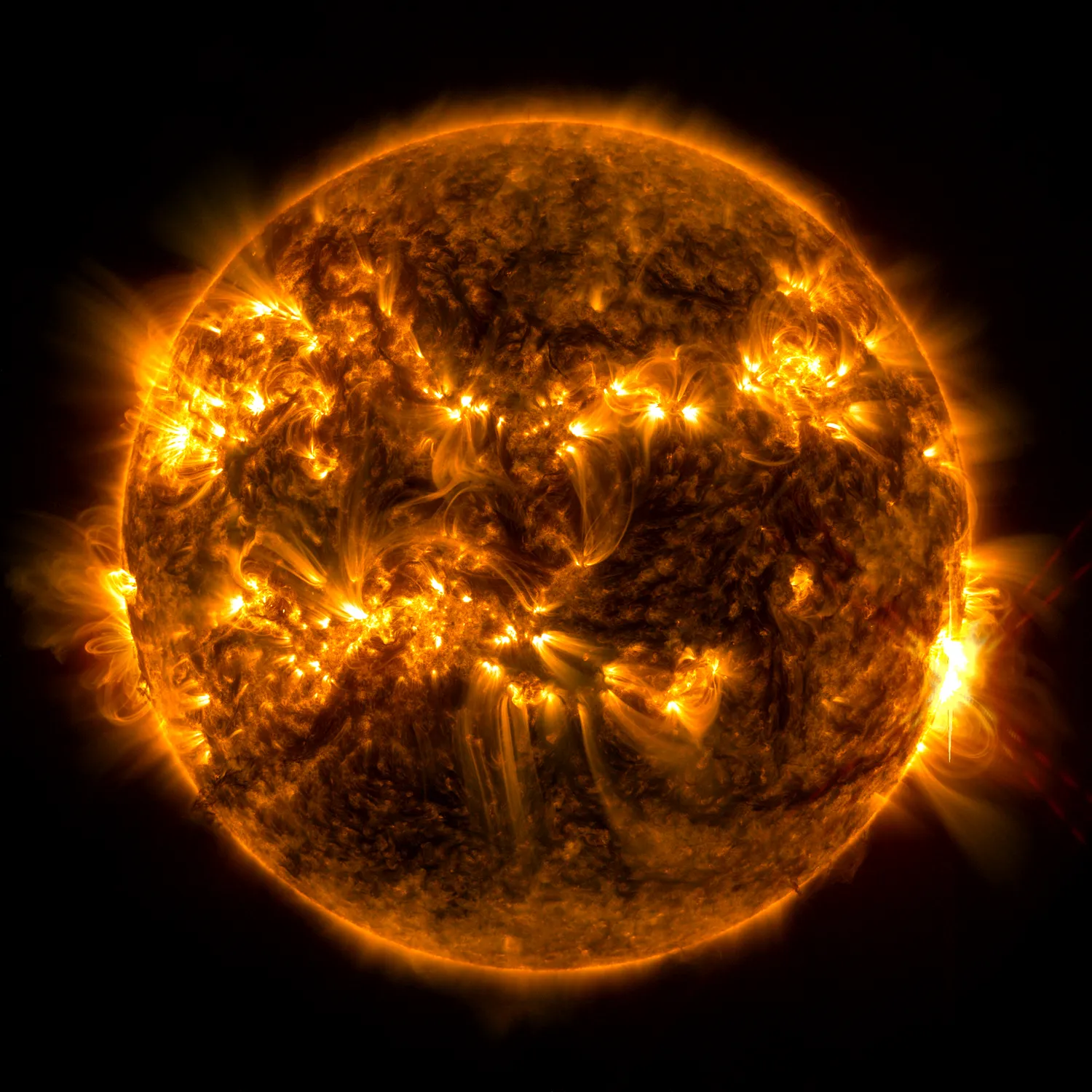
"Continuing Strong Solar Flares- May 15-16, 2024 (SVS14593 - SDO 131-171 5-15-2024 0845UT)" by NASA's Scientific Visualization Studio - KBR Wyle Services, LLC/Scott Wiessinger, KBR Wyle Services, LLC/Lacey Young, Global Science and Technology, Inc./Tom Bridgman, Wyle Information Systems/Mara Johnson-Groh / Wikimedia Commons (Public domain).
What are Solar Flares?
A solar flare is a sudden, powerful burst of energy from the Sun’s surface. These explosions happen when a large amount of magnetic energy built up in the Sun is suddenly released. Solar flares send out intense radiation, light, and heat into space. The energy from a single flare can be as strong as millions of nuclear bombs!
How Do Solar Flares Happen?
The Sun has a strong and ever-changing magnetic field. Sometimes, magnetic field lines on the Sun twist and tangle, like rubber bands being stretched. When the tension becomes too great, these lines snap and quickly reconnect. This sudden change lets out a huge amount of stored energy as a solar flare! Solar flares shoot out light across the electromagnetic spectrum—from radio waves to X-rays and beyond.
Different Sizes of Solar Flares
Scientists group solar flares by how powerful they are: A, B, C, M, and X. X-class flares are the strongest. Most flares are small and don’t cause problems on Earth, but the biggest flares can affect our planet.
Effects on Earth
Solar flares can cause space weather. They may interrupt radio signals, mess up GPS satellites, and even cause power grid problems. Flares can also make beautiful auroras—the northern and southern lights. Astronauts in space must be protected from the extra radiation.
Sunspots and Solar Flares
Solar flares often happen near sunspots, which are dark areas on the Sun where magnetic fields are strongest. Scientists watch the Sun all the time to predict and warn us about dangerous solar flares.
Safety Tip
Never look directly at the Sun, even during a solar flare! It can damage your eyes.
Solar flares are like the Sun throwing a tantrum—built-up magnetic stress suddenly releases in a massive explosion of energy that can reach Earth in just 8 minutes!
Interesting Fact: The largest solar flare ever recorded happened in 2003, and it was so strong that it overloaded sensors on satellites!
What is a solar flare?
A burst of energy from the SunA star in spaceA planet's orbitA new moon phase
What causes a solar flare?
Released magnetic energyWind on the SunMeteor strikesEarth's gravity
Which flares are the strongest?
A-classM-classX-classC-class
What do solar flares create in the sky?
AurorasCloudsRainbowsStorms
Why do scientists watch the Sun?
To forecast solar flaresTo count moonsTo find new planetsTo study rainbows
What can happen to satellites during big flares?
They can be affectedThey freezeThey meltNothing changes
Solar flares are always safe for Earth.
TrueFalse
What is a sunspot?
A dark spot with strong magnetismA red planetA type of stormA radio wave
Perfect For:
👩🏫 Teachers
• Reading comprehension practice
• Auto-graded assessments
• Literacy skill development
👨👩👧👦 Parents
• Reading practice at home
• Comprehension improvement
• Educational reading time
🏠 Homeschoolers
• Reading curriculum support
• Independent reading practice
• Progress monitoring
Reading Features:
📖
Reading Passage
Engaging fiction or nonfiction text
❓
Comprehension Quiz
Auto-graded questions
📊
Instant Feedback
Immediate results and scoring
📄
Printable Version
Download for offline reading
🔊
Read Aloud
Voice-over with word highlighting
Reviews & Ratings
No reviews yet. Be the first to share your experience!
Related Content
Earth: Our Home in Space
This engaging Grade 4-5 science passage, aligned to NGSS, introduces students to Earth's special place in the solar syst...
Earth's Place in the Universe
This reading passage explains Earth's place in the universe, supporting NGSS 1-ESS1-1. It describes how Earth is one of ...
1-ESS1-1
Tools and Technology in Earth Science
This middle school science reading passage explores the wide range of tools and technologies used in Earth science, from...
MS-ESS2-2MS-ESS3-2MS-ETS1-1MS-PS4-3
What Is Space Weather and How Does It Affect the Earth?
This NGSS-aligned science passage for middle school explains what space weather is and how it affects Earth. Students le...
MS-ESS2-2
Scientific Inquiry in Earth Science
This passage explores scientific inquiry in Earth science for grades 6-8, aligned with NGSS standards MS-ESS1-4, MS-ESS2...
MS-ESS1-4MS-ESS2-1MS-ESS3-5SEP
The Space Needle
Students read a passage about the history and features of Seattle's Space Needle, then answer comprehension questions to...
RI.4.2
Space Stations
This informational science reading passage for grades 6-8 explores the complex systems and technology behind space stati...
MS-ESS1-3MS-ETS1-1
Reading Comprehension— Storms
Practie summarizing paragraphs with this fun science informational text on storms! Students will give the main idea of t...
RI.2.2RF.2.4.ARF.2.4RI.2.10
Interpreting visual information on Layers of the Earth
This informational text on the layers of the earth is a great way to practice using images during reading. Students will...
RI.1.7RI.10RF.1.4.ARF.1.4
Escape Velocity and Space Travel
This middle school science passage introduces students to the concept of escape velocity—the minimum speed required to b...
MS-ESS1-2MS-PS2-4
The Space Garden
This innovative passage combines plant science with space exploration, aligning with NGSS standards for life sciences an...
RL.3.1RL.2.1RL.4.9
What Is Earth Science?
This engaging middle school science passage introduces students to the field of Earth science, aligning with NGSS standa...
MS-ESS1MS-ESS2MS-ESS3SEP
Reading Comprehension - Science and Social Studies
RI.2.10RI.2.1RI.2.2RI.2.4
Reading Comprehension: The Grand Canyon
This informational text on the Grand Canyon will teach your students all about this incredible wonder of the world! Free...
RI.3.1RI.3.10RI.3.4RF.3.4
Facts About Earth
This engaging science reading passage introduces Grade 4 and 5 students to Earth, our home planet. Aligned with NGSS sta...
Earth: Our Home Planet
This comprehensive science passage for grades 6-8 explores Earth’s unique characteristics and the interconnected systems...
MS-ESS1-2
Meteorite Impacts on Earth
This engaging science reading passage for Grades 4-5 explores meteorite impacts on Earth, aligning with NGSS standards. ...
The Diameter of Earth
This science reading passage explains the diameter of Earth, describing it as about 12,742 kilometers or 7,918 miles acr...
5-PS2-1
Measuring Distances in Space
This middle school science passage explores how astronomers measure the vast distances in space, aligning with NGSS stan...
MS-ESS1-3
Informational Text — Habitats
This short informational text on habitats will teach your students what a habitat is, as well as provide some examples o...