What Is the Science of Astronomy — Reading Comprehension
Rate this
Premium Resource
Present
Present in classroom. No work saved
Assign
Classroom with student accounts, Track progress
Quick Play
No student accounts, assign with a link
Grades
6
7
8
Standards
MS-ESS1-1
PRINT+DIGITAL RESOURCE
This learning resource is available in interactive and printable formats. The interactive worksheet can be played online and assigned to students. The Printable PDF version can be downloaded and printed for completion by hand.
This comprehensive reading passage introduces middle school students to the field of astronomy and its importance in understanding our place in the universe. Students will learn how astronomy is the scientific study of space and celestial objects, including stars, planets, galaxies, and other phenomena beyond Earth's atmosphere. The passage explains how astronomers use observations, telescopes, and technology to study the universe and answer fundamental questions about Earth's position in the solar system. Aligned with NGSS MS-ESS1-1, this resource helps students develop an understanding of Earth's place in the solar system and the patterns of motion among celestial objects. The passage includes audio integration for enhanced accessibility, making complex scientific concepts accessible to all learners. Students will explore key vocabulary terms such as celestial objects, light-year, galaxy, solar system, and universe while connecting to real-world applications of astronomical research. This standards-aligned content supports science curriculum goals for grades 6-8 and includes differentiated versions for diverse learners.
CONTENT PREVIEW
Expand content preview
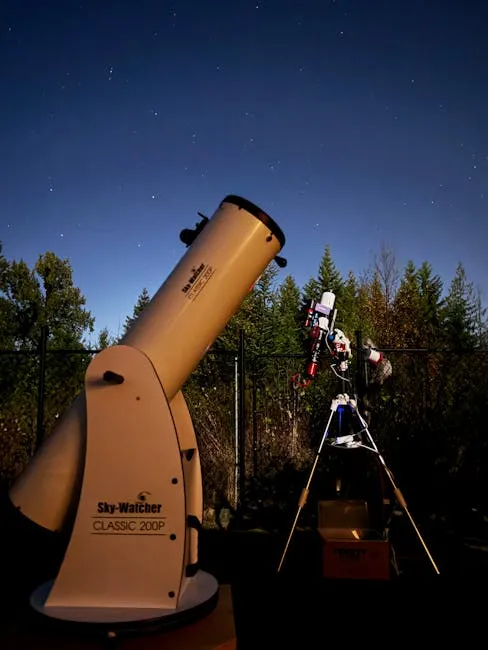
Telescope pointing at starry night sky, forest backdrop. by Jason Pittman / Pexels.
Astronomy is the scientific study of space and everything in it. Astronomers study celestial objects such as stars, planets, moons, asteroids, and comets. They also investigate larger structures like galaxies and the entire universe. Astronomy helps us understand Earth's place in the solar system and answer questions about how the universe works.
Astronomers use observations to gather information about space. They cannot travel to distant stars or galaxies, so they must study light and other forms of energy that reach Earth. Telescopes are the main tools astronomers use to collect this light. Some telescopes are located on Earth's surface, while others orbit in space to avoid interference from the atmosphere. By analyzing the light from celestial objects, astronomers can determine their temperature, composition, distance, and motion.
Our solar system is one focus of astronomical study. The solar system includes the Sun, eight planets, their moons, and smaller objects like asteroids and comets. Earth is the third planet from the Sun and orbits at a distance of about 93 million miles. Astronomers have learned that Earth is part of a much larger structure called the Milky Way galaxy, which contains billions of stars. The Milky Way is just one of billions of galaxies in the observable universe.
Astronomy also examines patterns of motion in space. Earth rotates on its axis once every 24 hours, causing day and night. Earth also revolves around the Sun once every 365.25 days, creating our year. The Moon orbits Earth approximately once every 27 days. These predictable patterns help astronomers understand the forces that govern motion in space, particularly gravity. Gravity is the force that pulls objects toward each other and keeps planets in orbit around the Sun.
Distances in space are enormous and difficult to comprehend using miles or kilometers. Astronomers use a unit called a light-year to measure these vast distances. A light-year is the distance light travels in one year, which equals about 5.88 trillion miles. For example, the nearest star to our Sun, Proxima Centauri, is about 4.2 light-years away. This means the light we see from that star today actually left the star over four years ago.
Modern astronomy relies on advanced technology and scientific methods. Astronomers use not only optical telescopes that collect visible light but also radio telescopes, X-ray telescopes, and infrared telescopes that detect other forms of electromagnetic radiation. Space probes and rovers collect data from other planets and moons in our solar system. Computer models help astronomers simulate cosmic events and test their theories about how the universe formed and changed over time.
Astronomy continues to reveal new information about our universe. Scientists have discovered thousands of planets orbiting other stars, called exoplanets. They study black holes, exploding stars called supernovae, and mysterious dark matter that makes up most of the universe's mass. By studying astronomy, we learn not only about distant objects but also about Earth's unique position in space and the conditions that make life possible on our planet.
Interesting Fact: The light from some distant galaxies has been traveling through space for over 13 billion years, meaning we see these galaxies as they appeared when the universe was very young.
What is astronomy?
The scientific study of space and everything in itThe study of weather patterns on EarthThe study of rocks and mineralsThe study of plants and animals
Which tool do astronomers mainly use to collect light from celestial objects?
MicroscopesTelescopesThermometersCompasses
What does the term 'light-year' measure?
The brightness of a starThe age of the universeThe distance light travels in one yearThe time it takes Earth to orbit the Sun
Based on the passage, what can astronomers learn by analyzing light from celestial objects?
Only the color of the objectTemperature, composition, distance, and motionOnly how far away the object isThe exact age of every star
How does gravity affect objects in the solar system?
It pushes planets away from the SunIt has no effect on planetary motionIt pulls objects toward each other and keeps planets in orbitIt only affects objects on Earth's surface
Why do some telescopes orbit in space instead of staying on Earth's surface?
To be closer to the SunTo avoid interference from Earth's atmosphereBecause they are too heavy for EarthTo study only the Moon
If a star is 10 light-years away, what does this tell us about the light we see from it?
The light left the star 10 years agoThe light is 10 years old when it reaches EarthThe star is 10 years oldBoth A and B are correct
According to the passage, what can studying astronomy teach us about Earth?
Only information about other planetsEarth's unique position in space and conditions that make life possibleNothing useful about our own planetOnly how to build better telescopes
True or False: The Milky Way galaxy contains billions of stars and is just one of billions of galaxies in the universe.
TrueFalse
True or False: Astronomers can only use optical telescopes that collect visible light to study space.
TrueFalse
Perfect For:
👩🏫 Teachers
• Reading comprehension practice
• Auto-graded assessments
• Literacy skill development
👨👩👧👦 Parents
• Reading practice at home
• Comprehension improvement
• Educational reading time
🏠 Homeschoolers
• Reading curriculum support
• Independent reading practice
• Progress monitoring
Reading Features:
📖
Reading Passage
Engaging fiction or nonfiction text
❓
Comprehension Quiz
Auto-graded questions
📊
Instant Feedback
Immediate results and scoring
📄
Printable Version
Download for offline reading
🔊
Read Aloud
Voice-over with word highlighting
Reviews & Ratings
No reviews yet. Be the first to share your experience!
Related Content
What is Solar Radiation
This NGSS-aligned science reading passage for middle school students explores the concept of solar radiation. Solar radi...
MS-ESS1-1
How Incoming Solar Radiation Changes with Latitude
This NGSS-aligned science reading passage helps middle school students understand how solar radiation, or insolation, ch...
MS-ESS1-1
Tides and Tidal Forces
This middle school science passage explores the mechanisms of tides and tidal forces, aligning with NGSS standards MS-ES...
MS-ESS1-1MS-ESS1-2
The Night Sky
This comprehensive science reading passage for grades 6-8 aligns with NGSS standard MS-ESS1-1 and explores the systems a...
MS-ESS1-1
Ancient Astronomy
This engaging passage for grades 6-8 explores the history of astronomy through the lens of ancient observations. Student...
MS-ESS1-1
Tools of Modern Astronomy
This passage introduces middle school students to modern astronomy, aligning with NGSS standard MS-ESS1-1. It explains h...
MS-ESS1-1
How Astronomy Became a Science
This passage explores the transformative period known as the Scientific Revolution, with a special focus on the history ...
MS-ESS1-1
Earth's Rotation
This middle school science passage, aligned with NGSS standard MS-ESS1-1, focuses on Earth's rotation—how Earth spins on...
MS-ESS1-1
Earth's Revolution
This middle school science passage explores the science behind Earth's revolution around the Sun, closely aligned with N...
MS-ESS1-1
Why We Have Seasons
This comprehensive middle school science reading passage explains the mechanisms behind Earth's seasons, directly addres...
MS-ESS1-1
Earth's Seasons
This comprehensive reading passage for grades 6-8 explains why Earth has seasons, revealing the scientific mechanisms be...
MS-ESS1-1
Phases of the Moon
This comprehensive middle school science passage explains the phases of the Moon, focusing on the mechanisms behind the ...
MS-ESS1-1
Tides
This comprehensive middle school science reading passage explores the phenomenon of ocean tides, aligned to NGSS standar...
MS-ESS1-1MS-ESS1-2
Eclipses
This comprehensive passage for grades 6-8 explores the science behind eclipses, including solar and lunar eclipses, thei...
MS-ESS1-1
The Moon's Characteristics
This comprehensive science reading passage for grades 6-8 examines the Moon's physical characteristics, including its si...
MS-ESS1-1MS-ESS1-2
Lunar Eclipses
This passage introduces middle school students to the phenomenon of lunar eclipses, connecting observable events to the ...
MS-ESS1-1
The Sun's Characteristics
This engaging science passage introduces middle school students to the Sun’s key characteristics, such as its classifica...
MS-ESS1-1MS-ESS1-2
What Is a Galaxy?
This comprehensive middle school science passage answers the question: What is a galaxy? Aligned to NGSS standard MS-ESS...
MS-ESS1-1
The Milky Way: Our Home Galaxy
This comprehensive science passage introduces middle school students to the Milky Way, the barred spiral galaxy that is ...
MS-ESS1-1
Types of Galaxies
This comprehensive middle school science passage introduces students to the classification and characteristics of galaxi...