This learning resource is available in interactive and printable formats. The interactive worksheet can be played online and assigned to students. The Printable PDF version can be downloaded and printed for completion by hand.
This informational science reading passage for grades 6-8 explores the complex systems and technology behind space stations, focusing on their role in sustaining long-term human presence in orbit. Students will learn about the International Space Station (ISS), its construction, international crew, and the unique scientific research conducted in microgravity. The passage describes how astronauts live and work in space, the development of new commercial and national stations like China's Tiangong, and the importance of these platforms for future Moon and Mars missions. It aligns with NGSS standards MS-ESS1-3 and MS-ETS1-1, emphasizing systems thinking, scientific processes, and engineering design. The resource includes a glossary, comprehension questions, writing prompts, graphic organizers, and both standard and simplified Spanish translations. Audio integration supports a range of learning styles, making this passage ideal for diverse middle school classrooms.
CONTENT PREVIEW
Expand content preview
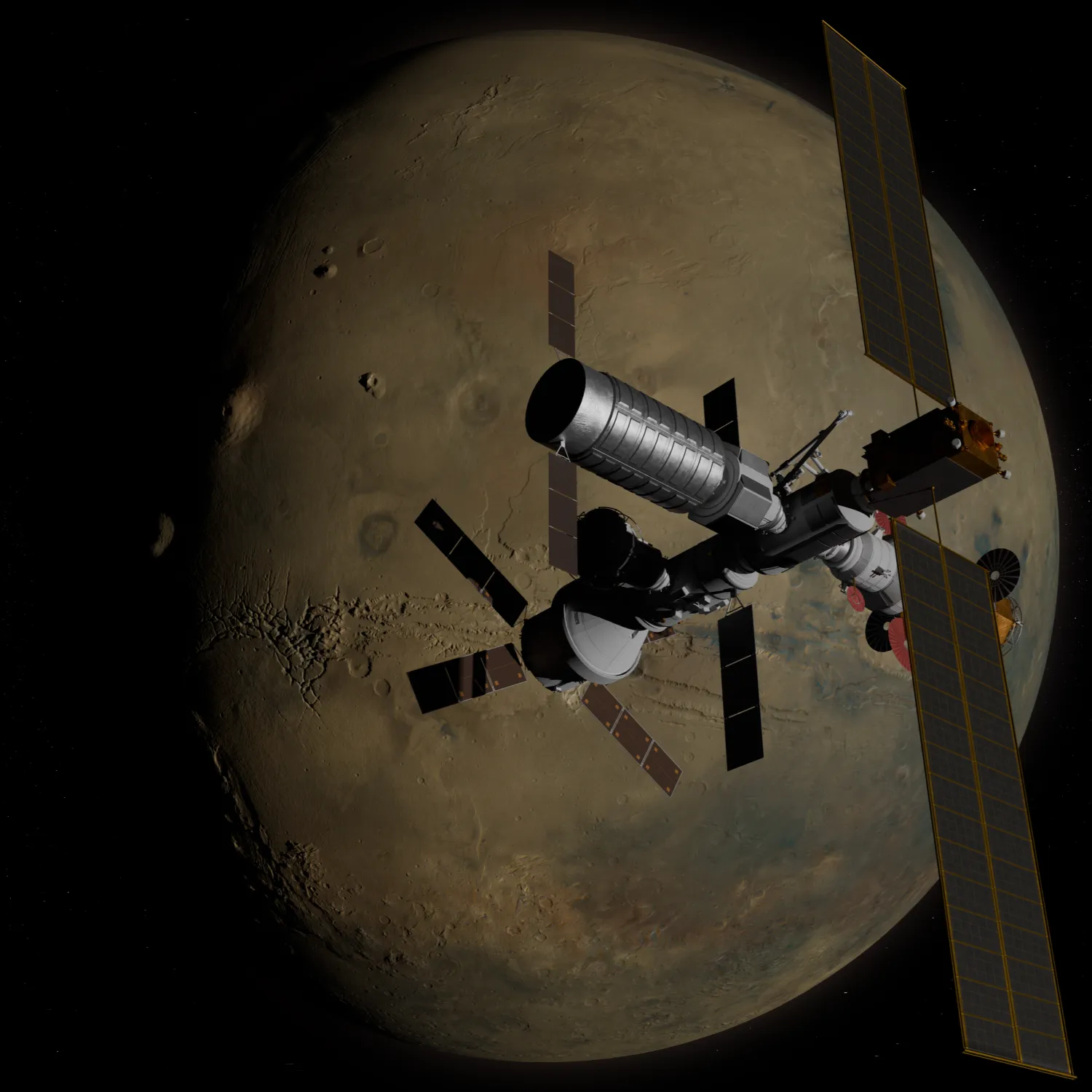
"Mars space station" by Wikideas1 / Source: Wikimedia Commons (CC0).
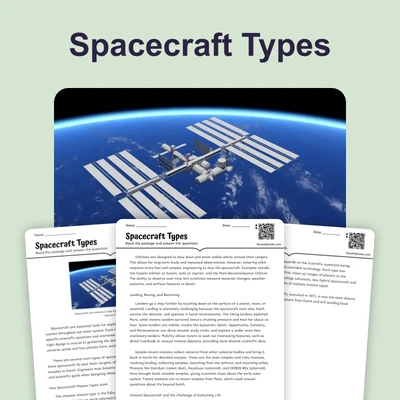
Space stations are among humanity’s greatest engineering achievements. Orbiting about 400 kilometers above Earth, the International Space Station (ISS) is a unique platform where humans can live and work in space for long periods. Space stations solve the challenge of supporting life in the harsh environment of space, enabling scientists to perform research that is impossible on Earth. They also serve as testing grounds for new technologies and provide critical experience for future missions to the Moon and Mars.
Living and Working in Microgravity
On the ISS, astronauts experience microgravity, a condition where the force of gravity is much weaker than on Earth. This environment affects the human body in many ways, such as causing muscles and bones to weaken over time. To stay healthy, astronauts exercise for more than two hours each day. They sleep in small bags attached to the walls to prevent floating, and their food is often dehydrated and needs water added before eating. Even going to the bathroom is different—special toilets use suction instead of gravity to collect waste. The ISS orbits Earth every 90 minutes, which means astronauts see 16 sunrises and sunsets each day.
International Collaboration and Construction
The ISS is the largest structure ever built in space, stretching 109 meters long and weighing about 420,000 kilograms. It was assembled in orbit from 1998 to 2011, with parts launched by rockets from several countries. The crew usually includes six or seven astronauts from different nations, showing the power of international cooperation. Each module of the ISS has a specific function, such as laboratories for experiments, living quarters, or control centers. This modular design allows new parts to be added or replaced over time, making the station adaptable to new scientific needs.
Science, Technology, and the Future
Research on the ISS covers many fields, including biology, physics, and Earth science. Scientists conduct experiments on how plants grow without gravity, how materials behave in space, and how the human body changes over months in orbit. The ISS also observes Earth, providing valuable data on weather, climate, and natural disasters. China’s Tiangong station, launched in 2022, is a newer platform for similar research and international crews. By 2030, the ISS is planned to retire, and commercial stations like Axiom and Orbital Reef are being developed. These space stations are stepping stones for building the Gateway station near the Moon and for sending humans to Mars.
Space stations demonstrate how science, engineering, and international collaboration can overcome extreme challenges. They are essential for understanding how humans can live beyond Earth and for preparing for the next era of space exploration.
Interesting Fact: The ISS travels around Earth at about 28,000 kilometers per hour—fast enough to circle the planet every 90 minutes!
What is the main purpose of space stations like the ISS?
To allow humans to live and work in space for long periodsTo visit other planetsTo store satellitesTo study only the Moon
How often does the ISS circle the Earth?
Every 24 hoursEvery 90 minutesOnce a weekEvery 12 hours
Which of the following is a new space station launched by China?
AxiomGatewayTiangongOrbital Reef
What does 'microgravity' mean as used in the passage?
A place with no airA condition where gravity is much weaker than on EarthA type of space foodA special space tool
What is the function of modules on the ISS?
They are parts of the station for different purposes like experiments or living quartersThey are small robots that clean the ISSThey generate electricity for the stationThey are the food storage rooms
Why do astronauts exercise for over two hours a day on the ISS?
To pass timeBecause there is nothing else to doTo keep their muscles and bones strong in microgravityTo prepare for spacewalks
What is one way the ISS is adaptable for new scientific needs?
It can move to other planetsModules can be added or replaced over timeIt has wheels for movementIt can change its color
True or False: The ISS orbits Earth every 24 hours.
TrueFalse
True or False: The ISS is used only by astronauts from one country.
TrueFalse
What is one broader goal for building and learning from space stations?
To prepare for missions to the Moon and MarsTo live in the oceanTo watch meteor showersTo create new sports
Perfect For:
👩🏫 Teachers
• Reading comprehension practice
• Auto-graded assessments
• Literacy skill development
👨👩👧👦 Parents
• Reading practice at home
• Comprehension improvement
• Educational reading time
🏠 Homeschoolers
• Reading curriculum support
• Independent reading practice
• Progress monitoring
Reading Features:
📖
Reading Passage
Engaging fiction or nonfiction text
❓
Comprehension Quiz
Auto-graded questions
📊
Instant Feedback
Immediate results and scoring
📄
Printable Version
Download for offline reading
🔊
Read Aloud
Voice-over with word highlighting
Reviews & Ratings
No reviews yet. Be the first to share your experience!
Related Content
Sunspots and Solar Flares
This quiz is designed to test your understanding of the fascinating phenomena of sunspots and solar flares, as described...
RI.4.1RI.4.4RI.5.1ESS1.A
The Hottest Planet in the Solar System
This NGSS-aligned middle school reading passage explains why Venus is the hottest planet in our solar system. Students l...
MS-ESS1-3
Scientific Investigations
This passage, aligned with NGSS standards for grades 6-8, introduces students to the process of scientific investigation...
MS-ETS1-1MS-ETS1-2MS-ETS1-3MS-ETS1-4
Tools and Technology in Earth Science
This middle school science reading passage explores the wide range of tools and technologies used in Earth science, from...
MS-ESS2-2MS-ESS3-2MS-ETS1-1MS-PS4-3
Types of Maps
This engaging science passage for grades 6-8 introduces students to the various types of maps and their uses, supporting...
MS-ESS2-2MS-ESS3-2MS-ETS1-1MS-ETS1-4
Remote Sensing
This middle school science passage introduces students to the concept of remote sensing—the collection of information ab...
MS-ESS3-3MS-PS4-2MS-ETS1-1MS-ETS1-3
Geographic Information Systems (GIS)
This engaging middle school science passage introduces students to Geographic Information Systems (GIS), aligning with N...
MS-ESS3-3MS-ETS1-1MS-ETS1-2MS-ETS1-3
Mercury: Closest to the Sun
This comprehensive, standards-aligned passage explores Mercury—the smallest and closest planet to the Sun. Students in g...
MS-ESS1-2MS-ESS1-3
Venus: Earth's Twin?
This comprehensive science passage for grades 6-8 examines Venus—often called Earth's twin—by exploring its similarities...
MS-ESS1-2MS-ESS1-3
Mars: The Red Planet
This middle school science passage explores Mars, the Red Planet, providing students in grades 6-8 with a comprehensive ...
MS-ESS1-2MS-ESS1-3
Hurricane Preparedness and Safety
This passage explores the science and practical strategies of hurricane preparedness and safety, designed for middle sch...
MS-ESS3-2MS-ETS1-1
What Is the Solar System?
This passage provides a comprehensive overview of the solar system for grades 6-8, aligned with NGSS standards MS-ESS1-2...
MS-ESS1-2MS-ESS1-3
Structure of the Solar System
This comprehensive science reading passage introduces middle school students (grades 6-8) to the structure of the solar ...
MS-ESS1-2MS-ESS1-3
Scale of the Solar System
This passage, aligned to NGSS standard MS-ESS1-3, helps middle school students grasp the immense scale of the solar syst...
MS-ESS1-3
Exploration of the Solar System
This comprehensive passage for grades 6-8 examines how humans explore the solar system, aligning with NGSS standards MS-...
MS-ESS1-3MS-ETS1-1
Optical Telescopes
This comprehensive passage explores the science of optical telescopes for middle school students, aligning with NGSS sta...
MS-ESS1-3MS-ETS1-1
Future of Alien Search
This informational passage for grades 6-8 explores how scientists are using cutting-edge missions and technology to sear...
MS-ESS1-3MS-ETS1-1
Communicating with Aliens
This middle school science passage, aligned with NGSS standard MS-ESS1-3, examines the scientific and technological chal...
MS-ESS1-3
How Animals Navigate
This engaging science passage for grades 6-8 examines the fascinating world of navigation strategies. Aligned with NGSS ...
MS-LS1-4MS-ESS3-3MS-ETS1-1
Measuring Distances in Space
This middle school science passage explores how astronomers measure the vast distances in space, aligning with NGSS stan...