Measuring Distances in Space — Reading Comprehension
Rate this
Premium Resource
Present
Present in classroom. No work saved
Assign
Classroom with student accounts, Track progress
Quick Play
No student accounts, assign with a link
Grades
5
6
7
8
Standards
MS-ESS1-3
PRINT+DIGITAL RESOURCE
This learning resource is available in interactive and printable formats. The interactive worksheet can be played online and assigned to students. The Printable PDF version can be downloaded and printed for completion by hand.
This middle school science passage explores how astronomers measure the vast distances in space, aligning with NGSS standard MS-ESS1-3. Students will learn about astronomical units, light-years, and parsecs—special units designed for the immense scales involved in astronomy. The passage explains underlying mechanisms, such as parallax, and investigates the importance of these units in understanding the structure of our solar system and the universe. Real-world examples, including the distance to Proxima Centauri and the Andromeda Galaxy, demonstrate how these measurements connect to broader scientific principles, such as looking back in time. The passage and activities integrate key vocabulary, comprehension questions, writing prompts, and graphic organizers, with audio support for accessibility. This resource is designed to build scientific literacy and reasoning for grades 6-8.
CONTENT PREVIEW
Expand content preview
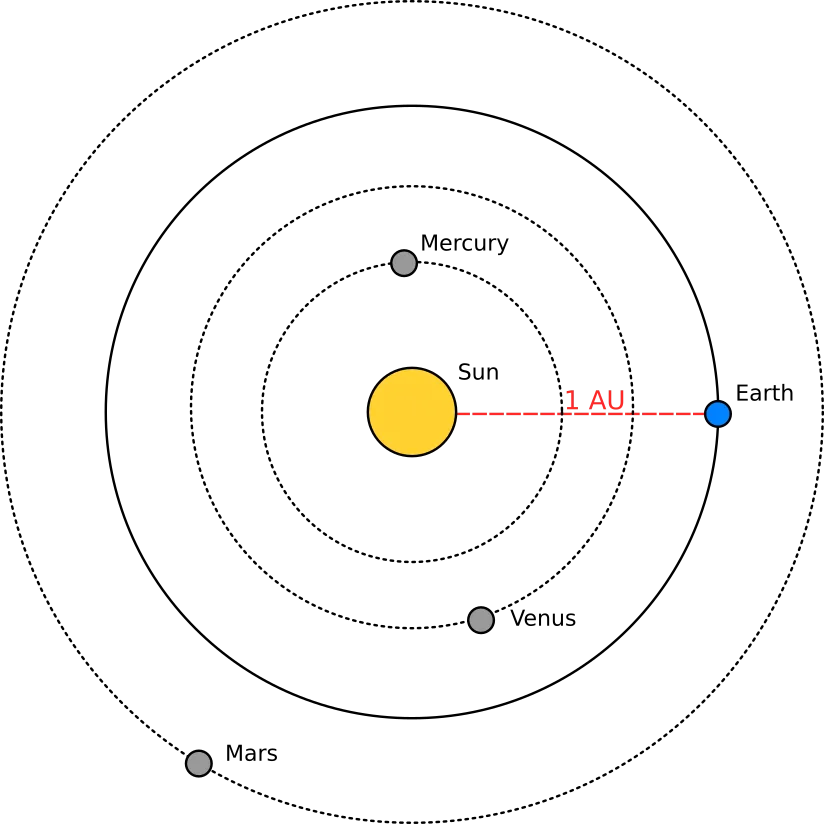
"Astronomical unit diagram" / Wikimedia Commons (CC0).
Astronomy faces a unique challenge: the universe is so vast that ordinary measurements like kilometers or miles quickly become impractical. For example, the distance from Earth to the Sun is about 150 million kilometers. To study objects both near and far, astronomers use special units and methods to make sense of these enormous distances. Understanding how we measure space helps scientists map the solar system, study distant stars, and explore the universe’s history.
Special Units for Vast Distances
The astronomical unit (AU) is a standard measure based on the average distance from Earth to the Sun, about 150 million kilometers (93 million miles). Scientists use AUs to describe positions and orbits within our solar system. For example, Jupiter is about 5.2 AU from the Sun. However, when measuring the distance to other stars, even AUs become too small. That’s why astronomers use the light-year, which is the distance light travels in one year—about 9.5 trillion kilometers (6 trillion miles). The nearest star to us, Proxima Centauri, is 4.2 light-years away. For even greater accuracy, professional astronomers use the parsec, which equals 3.26 light-years and is based on the principle of parallax.
How Astronomers Measure Distances
Measuring distances in space often relies on light and geometry. The concept of a light-year is not just a unit of distance; it also means we are looking back in time. When we observe the Andromeda Galaxy, which is about 2.5 million light-years away, we see it as it was 2.5 million years ago, because that’s how long its light has taken to reach us. For stars relatively close to Earth, astronomers use parallax, which is the apparent shift in a star’s position when viewed from two different points in Earth’s orbit. By measuring this angle, scientists use simple trigonometry to calculate the star’s distance. This technique is essential for mapping our galaxy.
Applications and Broader Implications
Accurate distance measurements allow scientists to understand the true scale of the universe and the relationships between objects in space. These measurements help us determine the size and age of the universe, study how galaxies move, and even search for exoplanets orbiting distant stars. The use of units like AU, light-year, and parsec makes it easier to communicate findings and compare observations. By measuring how long light takes to travel, astronomers can reconstruct cosmic events and piece together the history of stars and galaxies.
Measuring space distances relies on scientific reasoning, careful observation, and mathematical modeling. These tools allow us to explore beyond our solar system and deepen our understanding of the universe.
Interesting Fact: The Voyager 1 spacecraft, launched in 1977, is now over 160 AU from Earth—farther than any other human-made object!
Which unit do astronomers use to measure distances within our solar system?
Astronomical Unit (AU)Light-yearParsecKilometer
How far is Proxima Centauri from Earth?
4.2 light-years1 AU160 AU2.5 million light-years
What does the term 'light-year' mean in the passage?
The distance light travels in one yearThe time it takes Earth to orbit the SunA unit of mass for starsThe speed of light
Why do astronomers use special units like AU and light-year?
Because space distances are extremely largeTo make calculations more difficultTo measure the temperature of starsBecause kilometers are not accepted in science
According to the passage, what is parallax used for?
Measuring the distance to nearby starsFinding the age of the universeCalculating the mass of planetsDetermining the brightness of galaxies
What is an astronomical unit (AU) based on?
The average distance from Earth to the SunThe distance between two starsThe length of a year on EarthThe height of the tallest mountain
True or False: A parsec is equal to 3.26 light-years.
TrueFalse
True or False: When we observe a galaxy 2.5 million light-years away, we see it as it exists right now.
TrueFalse
If a new star is discovered 10 light-years away, what does this mean?
Its light takes 10 years to reach EarthIt is the same distance as the SunIt orbits Earth every 10 yearsIt is 10 AU from Earth
What do accurate distance measurements in space help scientists do?
Understand the size and age of the universeMake planets appear closerChange the speed of lightStop stars from moving
Perfect For:
👩🏫 Teachers
• Reading comprehension practice
• Auto-graded assessments
• Literacy skill development
👨👩👧👦 Parents
• Reading practice at home
• Comprehension improvement
• Educational reading time
🏠 Homeschoolers
• Reading curriculum support
• Independent reading practice
• Progress monitoring
Reading Features:
📖
Reading Passage
Engaging fiction or nonfiction text
❓
Comprehension Quiz
Auto-graded questions
📊
Instant Feedback
Immediate results and scoring
📄
Printable Version
Download for offline reading
🔊
Read Aloud
Voice-over with word highlighting
Reviews & Ratings
No reviews yet. Be the first to share your experience!
Related Content
Sunspots and Solar Flares
This quiz is designed to test your understanding of the fascinating phenomena of sunspots and solar flares, as described...
RI.4.1RI.4.4RI.5.1ESS1.A
The Hottest Planet in the Solar System
This NGSS-aligned middle school reading passage explains why Venus is the hottest planet in our solar system. Students l...
MS-ESS1-3
Mercury: Closest to the Sun
This comprehensive, standards-aligned passage explores Mercury—the smallest and closest planet to the Sun. Students in g...
MS-ESS1-2MS-ESS1-3
Venus: Earth's Twin?
This comprehensive science passage for grades 6-8 examines Venus—often called Earth's twin—by exploring its similarities...
MS-ESS1-2MS-ESS1-3
Mars: The Red Planet
This middle school science passage explores Mars, the Red Planet, providing students in grades 6-8 with a comprehensive ...
MS-ESS1-2MS-ESS1-3
What Is the Solar System?
This passage provides a comprehensive overview of the solar system for grades 6-8, aligned with NGSS standards MS-ESS1-2...
MS-ESS1-2MS-ESS1-3
Structure of the Solar System
This comprehensive science reading passage introduces middle school students (grades 6-8) to the structure of the solar ...
MS-ESS1-2MS-ESS1-3
Scale of the Solar System
This passage, aligned to NGSS standard MS-ESS1-3, helps middle school students grasp the immense scale of the solar syst...
MS-ESS1-3
Exploration of the Solar System
This comprehensive passage for grades 6-8 examines how humans explore the solar system, aligning with NGSS standards MS-...
MS-ESS1-3MS-ETS1-1
Optical Telescopes
This comprehensive passage explores the science of optical telescopes for middle school students, aligning with NGSS sta...
MS-ESS1-3MS-ETS1-1
Future of Alien Search
This informational passage for grades 6-8 explores how scientists are using cutting-edge missions and technology to sear...
MS-ESS1-3MS-ETS1-1
Communicating with Aliens
This middle school science passage, aligned with NGSS standard MS-ESS1-3, examines the scientific and technological chal...
MS-ESS1-3
Astronomy
This comprehensive reading passage introduces middle school students to the science of astronomy, which is the study of ...
MS-ESS1-2MS-ESS1-3MS-PS4-2MS-ETS1-1
The Solar System
This middle school science passage introduces students to the solar system, aligning with NGSS standards MS-ESS1-2 and M...
MS-ESS1-2MS-ESS1-3
The Inner Planets
This comprehensive science passage for grades 6-8 explores the inner (terrestrial) planets of our solar system—Mercury, ...
MS-ESS1-2MS-ESS1-3
The Outer Planets
This engaging science passage for grades 6-8 introduces students to the outer planets—Jupiter, Saturn, Uranus, and Neptu...
MS-ESS1-2MS-ESS1-3
Light-Years and Cosmic Distances
This middle school science passage, aligned to NGSS MS-ESS1-3, explores how astronomers measure the vast distances in sp...
MS-ESS1-3
Space Stations
This informational science reading passage for grades 6-8 explores the complex systems and technology behind space stati...
MS-ESS1-3MS-ETS1-1
Types of Spacecraft
This passage introduces middle school students to the various types of spacecraft used to explore our solar system and b...