How Satellites Help Scientists Study Earth From Space
Interactive passage with audio narration, comprehension questions, and printable PDF.
By completing this purchase you agree to our Terms of Use and Privacy Policy. Your subscription renews automatically until you cancel. You can cancel anytime from your account settings. All sales are final and non-refundable. Digital content is available for download in your account immediately upon purchase.
What's included
How Satellites Help Scientists Study Earth From Space preview and details
About this printable How Satellites Help Scientists Study Earth From Space science reading passage, NGSS-aligned (Grades 6-8)
Sample passage and quiz from How Satellites Help Scientists Study Earth From Space
Reading passage and comprehension quiz preview
How Satellites Help Scientists Study Earth From Space
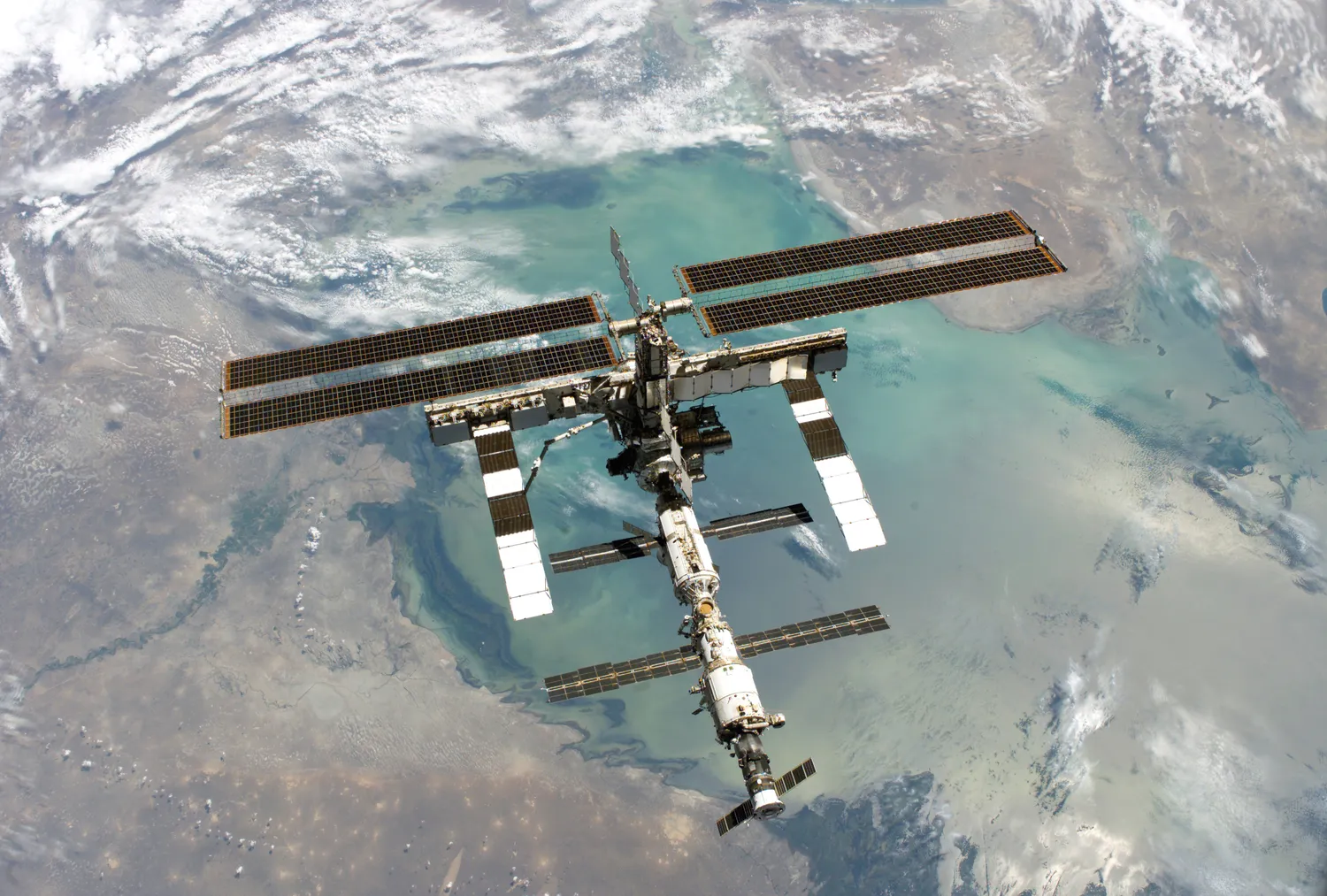
Scientists use satellites to study Earth from space. ISS Aug2005" by NASA / Wikimedia Commons
Scientists use satellites to study Earth from space. A satellite is an object that orbits around a planet. Earth-orbiting satellites carry special instruments that collect data about our planet's systems. These satellites provide a global view that ground-based instruments cannot match.
Satellites measure Earth's temperature using thermal sensors. Thermal sensors detect heat energy, called infrared radiation, that Earth's surface releases. Different surfaces release different amounts of heat. Warm ocean currents, for example, show up as bright areas on thermal images, while cooler water appears darker. Scientists use this temperature data to track weather patterns, monitor climate change, and study ocean currents around the entire planet. A single satellite can measure temperatures across thousands of miles in just one day.
Vegetation coverage is another important measurement satellites provide. Healthy plants absorb red light and reflect near-infrared light during photosynthesis. Satellites equipped with special cameras detect these light patterns. Scientists analyze the data to create maps showing where plants are growing, how healthy they are, and how vegetation changes over time. This information helps researchers track deforestation, monitor crop health, and understand how ecosystems respond to climate variations.
Satellites also monitor Earth's ice cover in polar regions and mountain ranges. Using radar technology, satellites can measure ice thickness and track changes in glaciers and ice sheets. Radar works by sending radio waves toward Earth's surface and measuring how long they take to bounce back. Some satellites use altimeters, which measure the height of ice surfaces with great precision. Scientists compare measurements taken over many years to understand how ice cover is changing. This data is critical for understanding sea level rise and global climate patterns.
Ocean color measurements reveal important information about marine ecosystems. Satellites detect the color of ocean water, which changes based on what is in it. Water containing phytoplankton—tiny plant-like organisms—appears greenish because these organisms contain chlorophyll. Clear ocean water looks deep blue. Scientists use ocean color data to track phytoplankton populations, which form the base of marine food webs and produce much of Earth's oxygen. They can also detect harmful algae blooms and monitor ocean health.
Atmospheric gases are measured by satellites using spectrometers. These instruments analyze sunlight passing through Earth's atmosphere. Different gases absorb specific wavelengths of light, creating unique patterns that scientists can identify. Satellites measure carbon dioxide, methane, ozone, and other gases that affect climate and air quality. This global atmospheric data helps scientists understand how gases move through the atmosphere and how human activities impact air composition.
The advantage of satellite observations is their ability to collect data continuously over large areas. Ground-based weather stations provide detailed local information, but they are limited to specific locations. A satellite orbiting Earth can observe entire continents and oceans repeatedly. Scientists combine satellite data with ground measurements to create comprehensive models of Earth's interconnected systems. This global perspective is essential for understanding complex environmental changes that affect the entire planet.
Interesting Fact: The Landsat program, which began in 1972, has created the longest continuous record of Earth's surface from space. Scientists can compare images from 50 years ago with current images to see exactly how our planet has changed.
Comprehension quiz (10 questions)
1. What is a satellite?
2. How do thermal sensors help scientists study Earth?
3. What does the term 'infrared radiation' mean in the passage?
4. Why do healthy plants appear differently on satellite images?
5. How does radar technology help satellites measure ice cover?
6. What does ocean color reveal about marine ecosystems?
7. How do spectrometers identify atmospheric gases?
8. What is the main advantage of satellite observations compared to ground-based instruments?
9. True or False: Ground-based weather stations can observe entire continents and oceans like satellites can.
10. True or False: The Landsat program has been collecting images of Earth's surface for over 50 years.
Perfect for the way you teach
- Build comprehension skills
- Auto-graded quiz
- Differentiated reading
- Read together at home
- Improve fluency
- Quiet reading time
- Reading curriculum support
- Independent practice
- Track Lexile growth