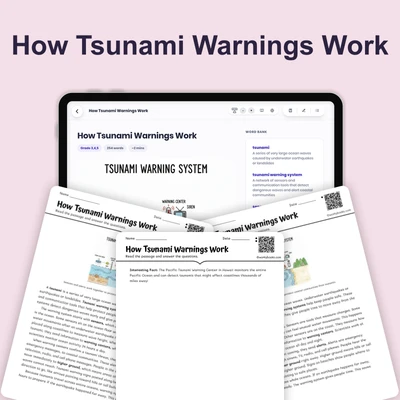
This learning resource is available in interactive and printable formats. The interactive worksheet can be played online and assigned to students. The Printable PDF version can be downloaded and printed for completion by hand.
This Grade 4 science reading passage introduces students to tsunamis, aligning with NGSS standard 4-ESS3-2. Students learn that a tsunami is a series of enormous ocean waves caused by underwater earthquakes, volcanic eruptions, or landslides. The passage explains how tsunamis behave differently in deep ocean water versus shallow coastal waters, growing from just a few feet tall to as high as buildings. Students discover that tsunamis can travel across entire oceans at hundreds of miles per hour, carrying tremendous energy. The passage uses age-appropriate language and real-world examples to help fourth graders understand this natural hazard. Audio-integrated features support diverse learners by providing multiple ways to access the content. Activities include comprehension questions, writing prompts, and graphic organizers that help students analyze cause-and-effect relationships and understand the sequence of tsunami formation and movement. This foundational knowledge prepares students for deeper investigations into natural hazards and their impacts on human populations.
CONTENT PREVIEW
Expand content preview
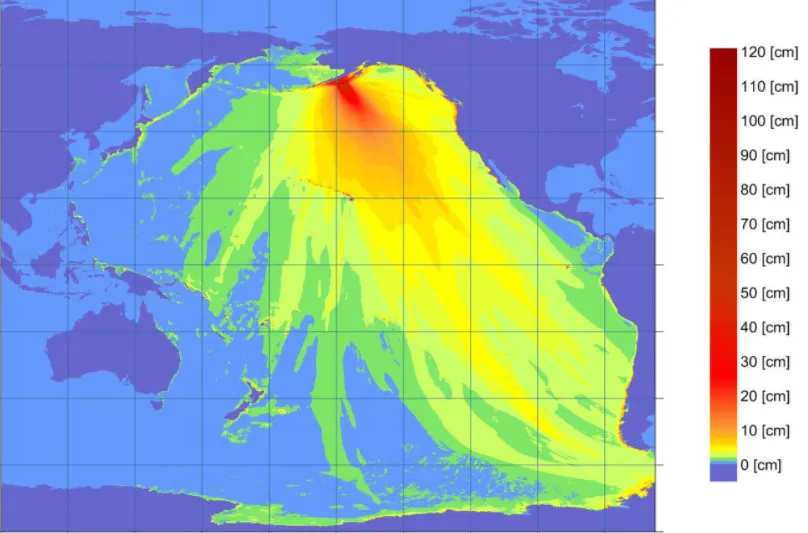
2021 Chignik earthquake Tsunami map" by U.S. Tsunami Warning System / Wikimedia Commons
A tsunami is a series of enormous ocean waves caused by sudden movements under the ocean. These movements can be an underwater earthquake (when the ocean floor shakes and shifts), a volcanic eruption beneath the sea, or a landslide that falls into the water. When these events happen, they push huge amounts of water and create powerful waves that spread out in all directions.
Out in the deep ocean, a tsunami wave may be only a few feet tall and hard to notice. Ships can sail right over them without anyone realizing a tsunami is passing beneath. However, as the tsunami approaches shallow water near the coast, something important happens. The wave slows down because it drags along the ocean bottom. As it slows down, the water piles up and the wave grows much taller—sometimes as high as a building.
Tsunamis can travel across entire oceans at speeds of 500 miles per hour or more, similar to how fast a jet airplane flies. When a tsunami finally hits shore, the powerful wall of water rushes inland, flooding everything in its path. The force of the water can destroy buildings, sweep away cars, and cause serious damage to coastal communities. Understanding tsunamis helps scientists warn people living near oceans so they can move to higher ground and stay safe.
Interesting Fact: The word "tsunami" comes from Japanese words meaning "harbor wave" because these waves often cause the most damage in harbors and bays where the water gets squeezed into smaller spaces.
What causes a tsunami to form?
Strong winds blowing across the oceanUnderwater earthquakes, volcanoes, or landslidesShips moving too fastHeavy rainfall near the coast
How tall is a tsunami in deep ocean?
As tall as a buildingOnly a few feet tallAs tall as a mountainHundreds of feet tall
How fast can tsunamis travel across oceans?
About 50 miles per hourAbout 100 miles per hourAbout 500 miles per hourAbout 1,000 miles per hour
Why does a tsunami grow taller near shore?
Wind makes it biggerIt slows down and water piles upMore water falls from the skyFish push the water higher
What happens when tsunami hits the coast?
It disappears into the sandIt turns into regular wavesIt rushes inland and floods everythingIt goes back to the ocean
How do scientists help people stay safe?
They stop tsunamis from formingThey warn people to move higherThey build walls around all citiesThey make the waves smaller
Ships in deep ocean can notice tsunamis easily.
TrueFalse
What does the word tsunami mean?
Big waveHarbor waveFast waterDangerous ocean
Perfect For:
👩🏫 Teachers
• Reading comprehension practice
• Auto-graded assessments
• Literacy skill development
👨👩👧👦 Parents
• Reading practice at home
• Comprehension improvement
• Educational reading time
🏠 Homeschoolers
• Reading curriculum support
• Independent reading practice
• Progress monitoring
Reading Features:
📖
Reading Passage
Engaging fiction or nonfiction text
❓
Comprehension Quiz
Auto-graded questions
📊
Instant Feedback
Immediate results and scoring
📄
Printable Version
Download for offline reading
🔊
Read Aloud
Voice-over with word highlighting
Reviews & Ratings
No reviews yet. Be the first to share your experience!
Related Content
How Tsunamis Affect People
This engaging 250-word reading passage introduces fourth-grade students to the devastating impacts of tsunamis on coasta...
NGSS 4-ESS3-2
What Are Avalanches
This engaging 250-word reading passage introduces fourth-grade students to avalanches and their impact on mountain commu...
NGSS 4-ESS3-2
Landslides
This engaging 350-word reading passage introduces Grade 4-5 students to landslides as powerful natural events where soil...
NGSS 4-ESS3-2
What Are Earthquakes
This engaging 250-word reading passage introduces fourth-grade students to the concept of earthquakes as natural hazards...
NGSS 4-ESS3-2
How Earthquakes Affect People
This 250-word informational reading passage introduces Grade 4 students to the ways earthquakes affect people and commun...
NGSS 4-ESS3-2ESS3.B
What Are Volcanoes
This engaging 250-word reading passage introduces fourth-grade students to volcanoes and volcanic activity, aligned with...
NGSS 4-ESS3-2
How Volcanoes Affect People
This 250-word reading passage introduces fourth-grade students to the ways volcanic eruptions affect people and communit...
NGSS 4-ESS3-2
What Are Weather Hazards
This Grade 4 science reading passage introduces students to weather hazards as part of the NGSS 4-ESS3-2 standard focusi...
NGSS 4-ESS3-2ESS3.B
What Are Tornadoes
This engaging Grade 4 science reading passage introduces students to tornadoes, one of nature's most powerful and danger...
NGSS 4-ESS3-2
What Are Hurricanes
This Grade 4 science reading passage introduces students to hurricanes and their impact on coastal communities, aligned ...
NGSS 4-ESS3-2
What Are Floods
This engaging 250-word reading passage introduces fourth-grade students to floods as natural hazards, aligned with NGSS ...
NGSS 4-ESS3-2
What Are Wildfires
This 250-word reading passage explains what wildfires are and introduces Grade 4 students to key concepts about these na...
NGSS 4-ESS3-2
What Are Droughts
This 250-word reading passage introduces fourth-grade students to the concept of droughts as defined in NGSS 4-ESS3-2. S...