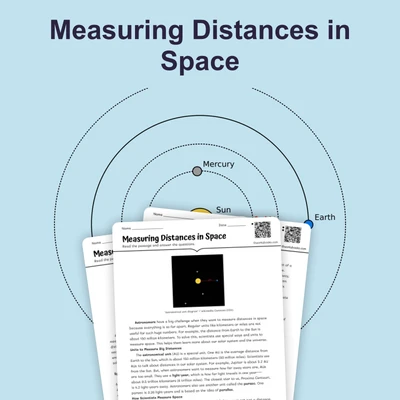
This engaging 450-word science passage explains how astronomers measure distances in space using different tools and techniques. Students in grades 6-8 will learn about radar for nearby objects like planets, parallax for nearby stars, and brightness comparisons for distant galaxies. The passage is aligned with NGSS MS-ESS1-3 and the Disciplinary Core Idea MS-ESS1.B: Earth and the Solar System. Audio-integrated content supports diverse learners, including English Language Learners and students with reading difficulties. The passage includes a simplified differentiated version, Spanish translations, glossary terms, multiple-choice questions, writing activities, and graphic organizers. Students explore why different distances require different measurement methods and how scientists use evidence to understand the universe. This resource helps students develop scientific literacy and critical thinking skills while learning about Earth's place in space.
Written by Workybooks TeamPublished by Workybooks
Preview
Sample passage and quiz content
CONTENT PREVIEW
Expand content preview
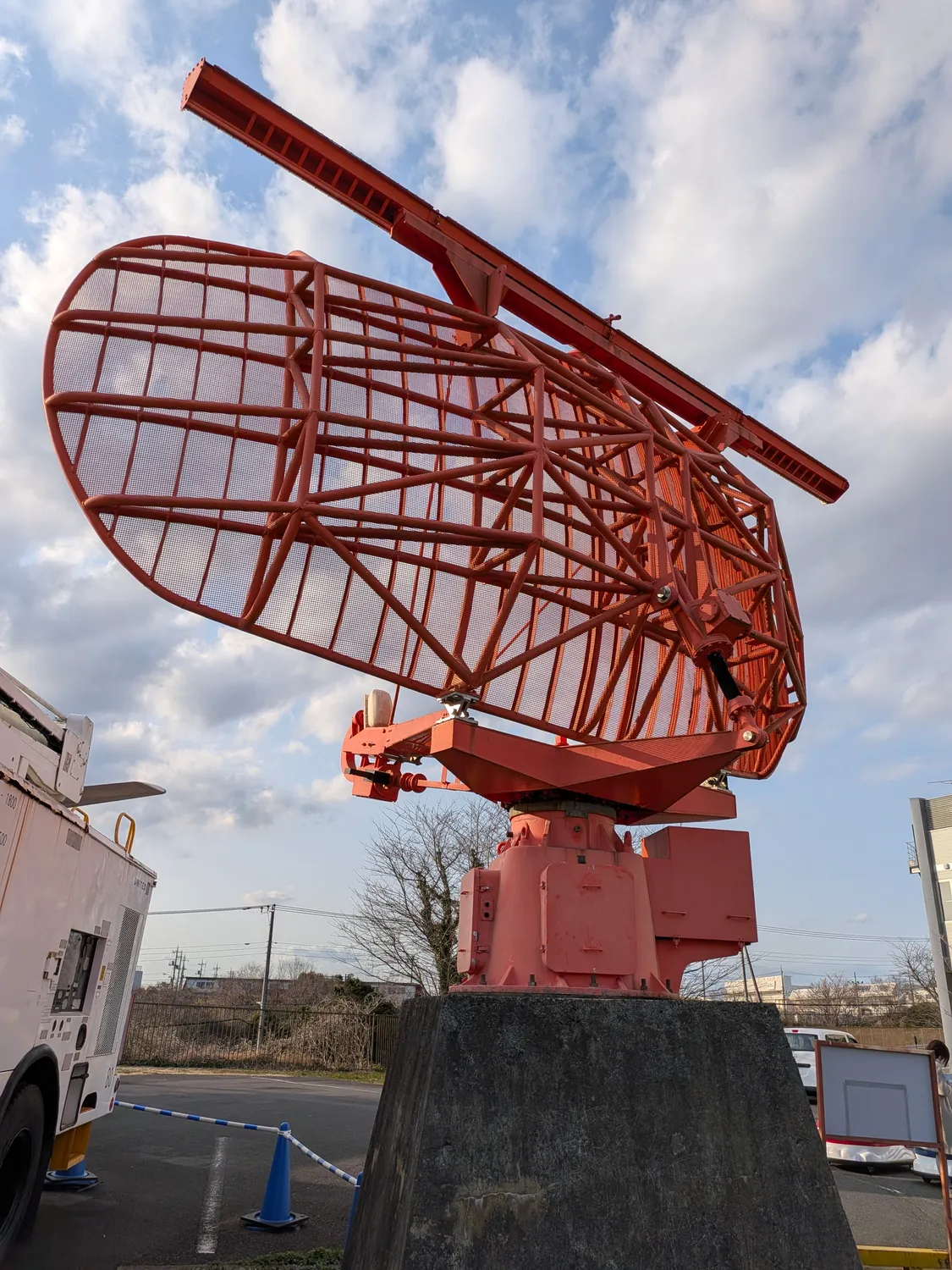
Scientists measure space distances using different tools depending on how far away objects are. "Radar at Museum of Aeronautical Science" by Syced / Wikimedia Commons
Scientists measure space distances using different tools depending on how far away objects are. Astronomers cannot use regular rulers or tape measures in space. Instead, they use special techniques that work across millions or billions of miles. The method they choose depends on whether they are measuring nearby planets, stars, or distant galaxies.
For objects close to Earth, scientists use radar. Radar works by sending radio waves toward a planet or asteroid. The waves bounce back to Earth, and scientists measure how long the trip takes. Since radio waves travel at the speed of light, scientists can calculate distance. This method works well for planets like Venus or Mars. However, radar cannot reach objects that are too far away because the signal becomes too weak.
For nearby stars, astronomers use a method called parallax. Parallax measures how a star appears to shift position when viewed from different locations. Scientists observe a star from Earth in January, then again in July. Earth has moved to the opposite side of its orbit during those six months. The star appears to shift slightly against the background of more distant stars. By measuring this shift angle, scientists can calculate the star's distance. This method works for stars within a few thousand light-years of Earth.
For distant objects like faraway galaxies, scientists compare brightness. They identify stars with known brightness levels called standard candles. If scientists know how bright a star should appear, they can determine its distance by how dim it looks from Earth. Evidence shows that dimmer objects are usually farther away. In 1998, scientists used this method to discover that the universe is expanding faster than expected. They measured distances to supernovae in distant galaxies and found surprising results.
Understanding these measurement methods matters because they help scientists map the universe. Different distances require different tools, just like measuring a room requires a ruler but measuring a city requires a map. These techniques allow astronomers to determine Earth's place in the vast universe and understand how space itself changes over time.
Interesting Fact: The nearest star to Earth (besides the Sun) is Proxima Centauri, located 4.24 light-years away. That means light from this star takes over four years to reach us!
What method do scientists use to measure distances to nearby planets like Venus or Mars?
It measures how long radio waves take to bounce backIt compares the brightness of different starsIt measures how a star appears to shift position when viewed from different locationsIt calculates the speed of light from distant galaxies
What are 'standard candles' in astronomy?
Radio waves used in radar measurementsStars with known brightness levels used to measure distanceTools that measure parallax anglesPlanets that reflect light from the Sun
In the passage, what does the term 'orbit' mean?
The brightness of a starThe curved path an object takes as it moves around another object in spaceThe distance light travels in one yearA method for measuring space distances
Why can't radar be used to measure very distant objects?
Radio waves travel too slowlyThe signal becomes too weak over long distancesDistant objects don't reflect radio wavesRadar only works during daytime
Based on the passage, what can you infer about why scientists need different measurement methods?
Each method is more expensive than the othersDifferent distances and object types require techniques that work at those scalesScientists prefer to use complicated methodsAll methods give the same results
How did scientists use brightness comparison to make a discovery in 1998?
They found new planets in our solar systemThey discovered that the universe is expanding faster than expectedThey proved that parallax doesn't work for distant starsThey measured the exact size of Earth's orbit
If an astronomer wants to measure the distance to a star 2,000 light-years away, which method would likely work best?
RadarParallaxBrightness comparisonMeasuring with a telescope ruler
True or False: Radio waves used in radar travel at the speed of light.
TrueFalse
True or False: The parallax method works by observing a star from Earth at two different times when Earth is on opposite sides of its orbit.
TrueFalse
Who it's for
Perfect for the way you teach
Teachers
Build comprehension skills
Auto-graded quiz
Differentiated reading
Parents
Read together at home
Improve fluency
Quiet reading time
Homeschoolers
Reading curriculum support
Independent practice
Track Lexile growth
Topics
space distancesastronomical measurementsparallaxradar astronomybrightness comparisonlight-yearNGSS MS-ESS1-3middle school science
Reviews & Ratings
No reviews yet. Be the first to share your experience!
More reading you might love
20 more
Sunspots and Solar Flares
This quiz is designed to test your understanding of the fascinating phenomena of sunspots and solar flares, as described...
RI.4.1RI.4.4RI.5.1ESS1.A
The Hottest Planet in the Solar System
This NGSS-aligned middle school reading passage explains why Venus is the hottest planet in our solar system. Students l...
MS-ESS1-3
Mercury: Closest to the Sun
This comprehensive, standards-aligned passage explores Mercury—the smallest and closest planet to the Sun. Students in g...
MS-ESS1-2MS-ESS1-3
Venus: Earth's Twin?
This comprehensive science passage for grades 6-8 examines Venus—often called Earth's twin—by exploring its similarities...
MS-ESS1-2MS-ESS1-3
Mars: The Red Planet
This middle school science passage explores Mars, the Red Planet, providing students in grades 6-8 with a comprehensive ...
MS-ESS1-2MS-ESS1-3
What Is the Solar System?
This passage provides a comprehensive overview of the solar system for grades 6-8, aligned with NGSS standards MS-ESS1-2...
MS-ESS1-2MS-ESS1-3
Structure of the Solar System
This comprehensive science reading passage introduces middle school students (grades 6-8) to the structure of the solar ...
MS-ESS1-2MS-ESS1-3
Scale of the Solar System
This passage, aligned to NGSS standard MS-ESS1-3, helps middle school students grasp the immense scale of the solar syst...
MS-ESS1-3
Exploration of the Solar System
This comprehensive passage for grades 6-8 examines how humans explore the solar system, aligning with NGSS standards MS-...
MS-ESS1-3MS-ETS1-1
Optical Telescopes
This comprehensive passage explores the science of optical telescopes for middle school students, aligning with NGSS sta...
MS-ESS1-3MS-ETS1-1
Future of Alien Search
This informational passage for grades 6-8 explores how scientists are using cutting-edge missions and technology to sear...
MS-ESS1-3MS-ETS1-1
Communicating with Aliens
This middle school science passage, aligned with NGSS standard MS-ESS1-3, examines the scientific and technological chal...
MS-ESS1-3
Measuring Distances in Space
This middle school science passage explores how astronomers measure the vast distances in space, aligning with NGSS stan...
MS-ESS1-3
Astronomy
This comprehensive reading passage introduces middle school students to the science of astronomy, which is the study of ...
MS-ESS1-2MS-ESS1-3MS-PS4-2MS-ETS1-1
The Solar System
This middle school science passage introduces students to the solar system, aligning with NGSS standards MS-ESS1-2 and M...
MS-ESS1-2MS-ESS1-3
The Inner Planets
This comprehensive science passage for grades 6-8 explores the inner (terrestrial) planets of our solar system—Mercury, ...
MS-ESS1-2MS-ESS1-3
The Outer Planets
This engaging science passage for grades 6-8 introduces students to the outer planets—Jupiter, Saturn, Uranus, and Neptu...
MS-ESS1-2MS-ESS1-3
Light-Years and Cosmic Distances
This middle school science passage, aligned to NGSS MS-ESS1-3, explores how astronomers measure the vast distances in sp...
MS-ESS1-3
Space Stations
This informational science reading passage for grades 6-8 explores the complex systems and technology behind space stati...
MS-ESS1-3MS-ETS1-1
Types of Spacecraft
This passage introduces middle school students to the various types of spacecraft used to explore our solar system and b...