This 400-500 word informational science passage explains how space probes work, designed for middle school students in grades 6-8. The passage aligns with NGSS standard MS-ESS1-3 and DCI MS-ESS1.B: Earth and the Solar System. Students learn the complete mechanism of space probe operation: launching on rockets, using gravity assists to reach distant targets, carrying scientific instruments to collect measurements, and transmitting data back to Earth via radio signals. The passage traces the entire chain from launch to data appearing on scientists' screens. Audio-integrated features support diverse learners, including English Language Learners and students with reading difficulties. The content includes real-world examples, scientific terminology appropriate for the grade level, and connections to broader space exploration concepts. Activities include comprehension questions, writing prompts, and graphic organizers that reinforce understanding of sequential processes and structure-function relationships in space technology.
Written by Workybooks TeamPublished by Workybooks
Preview
Sample passage and quiz content
CONTENT PREVIEW
Expand content preview
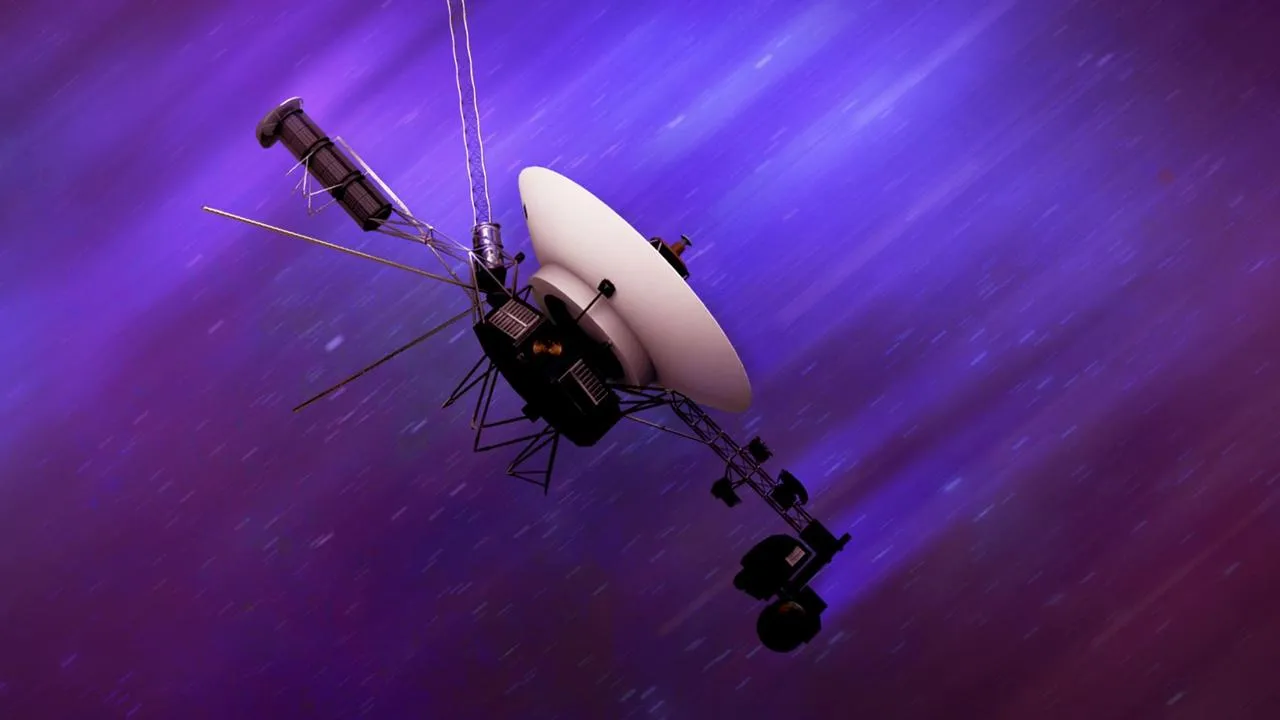
NASA's twin Voyager spacecraft, launched in 1977, are traveling through interstellar space. "NASA's Voyager Probe Speeds Through Space (Artist's Concept)" / NASA.
Space probes are robotic spacecraft designed to explore distant parts of our solar system and beyond. Scientists use these machines to gather information from places where humans cannot travel. A space probe works through a connected chain of steps, from launch to data collection and transmission back to Earth.
The journey begins with a powerful rocket that lifts the probe into space. Once the probe escapes Earth's atmosphere, it follows a carefully planned path toward its target. Engineers often use a technique called gravity assist to help probes reach distant destinations. During a gravity assist, the probe flies close to a planet and uses that planet's gravitational pull to increase speed and change direction. This method saves fuel and allows probes to travel much farther than they could on rocket power alone. Evidence shows that many successful missions, including those to the outer planets, have relied on gravity assists to reach their targets.
Space probes carry specialized instruments designed to collect specific types of data. These instruments can measure temperature, detect magnetic fields, analyze chemical compositions, and capture images. Each instrument serves a particular function based on the mission's scientific goals. For example, cameras take photographs of planetary surfaces, while spectrometers identify elements in atmospheres or on rocks. The probe's computer system controls when and how these instruments operate.
After collecting measurements, the probe must send information back to Earth. This process uses radio signals, which are a form of electromagnetic radiation that can travel through the vacuum of space. The probe's antenna transmits these signals toward Earth, where large dish antennas receive them. Scientists then convert the radio signals into usable data that appears on computer screens. The Voyager 1 probe, launched in 1977, continues to send data from beyond our solar system, more than 14 billion miles away. The radio signals from Voyager 1 take over 22 hours to reach Earth, traveling at the speed of light.
Space probes matter because they extend human knowledge beyond Earth's boundaries. They help scientists understand how planets formed, whether conditions exist for life elsewhere, and how our solar system fits into the larger universe. Each mission provides evidence that shapes our understanding of Earth's place in space.
Interesting Fact: The New Horizons probe used a gravity assist from Jupiter in 2007 to reach Pluto in 2015, cutting the travel time by three years and saving fuel for extended missions beyond Pluto.
What is the main purpose of space probes?
To carry astronauts to distant planetsTo explore parts of space where humans cannot travelTo create new planets in the solar systemTo destroy asteroids that threaten Earth
How does a gravity assist help a space probe?
It slows the probe down to land safelyIt provides fuel for the rocket enginesIt increases speed and changes direction using a planet's gravityIt protects the probe from solar radiation
What does the word 'instruments' mean in the context of this passage?
Musical devices for entertainmentScientific tools that collect specific types of dataParts of the rocket engineCommunication devices only
According to the passage, how do space probes send information back to Earth?
Through physical delivery by returning to EarthUsing light beams visible to the human eyeThrough radio signals transmitted by antennasBy writing messages on rocks
Why do engineers use gravity assists instead of relying only on rocket power?
Gravity assists are more exciting to watchThey save fuel and allow probes to travel much fartherRocket power does not work in spaceGravity assists are cheaper to build
What can you infer about the relationship between distance and signal travel time?
Distance has no effect on signal travel timeGreater distances result in longer signal travel timesSignals travel faster over longer distancesSignal travel time depends only on the size of the antenna
If a new space probe were designed to study the atmosphere of Saturn, which instrument would be most important?
A drill for collecting rock samplesA spectrometer to analyze chemical compositionA telescope to view distant galaxiesA thermometer to measure ocean temperatures
How might the information from space probes help scientists understand Earth better?
By showing how Earth compares to other planets in formation and conditionsBy providing weather forecasts for next weekBy creating new continents on EarthBy changing Earth's orbit around the Sun
True or False: Radio signals from Voyager 1 take over 22 hours to reach Earth because the probe is more than 14 billion miles away.
TrueFalse
True or False: Space probes carry human pilots to control the instruments and collect data.
TrueFalse
Who it's for
Perfect for the way you teach
Teachers
Build comprehension skills
Auto-graded quiz
Differentiated reading
Parents
Read together at home
Improve fluency
Quiet reading time
Homeschoolers
Reading curriculum support
Independent practice
Track Lexile growth
Topics
space probesrobotic spacecraftgravity assistsolar system explorationradio signalsspace instrumentsNGSS MS-ESS1-3middle school science
Reviews & Ratings
No reviews yet. Be the first to share your experience!
More reading you might love
20 more
Sunspots and Solar Flares
This quiz is designed to test your understanding of the fascinating phenomena of sunspots and solar flares, as described...
RI.4.1RI.4.4RI.5.1ESS1.A
The Hottest Planet in the Solar System
This NGSS-aligned middle school reading passage explains why Venus is the hottest planet in our solar system. Students l...
MS-ESS1-3
Mercury: Closest to the Sun
This comprehensive, standards-aligned passage explores Mercury—the smallest and closest planet to the Sun. Students in g...
MS-ESS1-2MS-ESS1-3
Venus: Earth's Twin?
This comprehensive science passage for grades 6-8 examines Venus—often called Earth's twin—by exploring its similarities...
MS-ESS1-2MS-ESS1-3
Mars: The Red Planet
This middle school science passage explores Mars, the Red Planet, providing students in grades 6-8 with a comprehensive ...
MS-ESS1-2MS-ESS1-3
What Is the Solar System?
This passage provides a comprehensive overview of the solar system for grades 6-8, aligned with NGSS standards MS-ESS1-2...
MS-ESS1-2MS-ESS1-3
Structure of the Solar System
This comprehensive science reading passage introduces middle school students (grades 6-8) to the structure of the solar ...
MS-ESS1-2MS-ESS1-3
Scale of the Solar System
This passage, aligned to NGSS standard MS-ESS1-3, helps middle school students grasp the immense scale of the solar syst...
MS-ESS1-3
Exploration of the Solar System
This comprehensive passage for grades 6-8 examines how humans explore the solar system, aligning with NGSS standards MS-...
MS-ESS1-3MS-ETS1-1
Optical Telescopes
This comprehensive passage explores the science of optical telescopes for middle school students, aligning with NGSS sta...
MS-ESS1-3MS-ETS1-1
Future of Alien Search
This informational passage for grades 6-8 explores how scientists are using cutting-edge missions and technology to sear...
MS-ESS1-3MS-ETS1-1
Communicating with Aliens
This middle school science passage, aligned with NGSS standard MS-ESS1-3, examines the scientific and technological chal...
MS-ESS1-3
Measuring Distances in Space
This middle school science passage explores how astronomers measure the vast distances in space, aligning with NGSS stan...
MS-ESS1-3
Astronomy
This comprehensive reading passage introduces middle school students to the science of astronomy, which is the study of ...
MS-ESS1-2MS-ESS1-3MS-PS4-2MS-ETS1-1
The Solar System
This middle school science passage introduces students to the solar system, aligning with NGSS standards MS-ESS1-2 and M...
MS-ESS1-2MS-ESS1-3
The Inner Planets
This comprehensive science passage for grades 6-8 explores the inner (terrestrial) planets of our solar system—Mercury, ...
MS-ESS1-2MS-ESS1-3
The Outer Planets
This engaging science passage for grades 6-8 introduces students to the outer planets—Jupiter, Saturn, Uranus, and Neptu...
MS-ESS1-2MS-ESS1-3
Light-Years and Cosmic Distances
This middle school science passage, aligned to NGSS MS-ESS1-3, explores how astronomers measure the vast distances in sp...
MS-ESS1-3
Space Stations
This informational science reading passage for grades 6-8 explores the complex systems and technology behind space stati...
MS-ESS1-3MS-ETS1-1
Types of Spacecraft
This passage introduces middle school students to the various types of spacecraft used to explore our solar system and b...