What Are Space Telescopes
Interactive passage with audio narration, comprehension questions, and printable PDF.
By completing this purchase you agree to our Terms of Use and Privacy Policy. Your subscription renews automatically until you cancel. You can cancel anytime from your account settings. All sales are final and non-refundable. Digital content is available for download in your account immediately upon purchase.
What's included
What Are Space Telescopes preview and details
About this printable What Are Space Telescopes science reading passage, NGSS-aligned (Grades 5-8)
Sample passage and quiz from What Are Space Telescopes
Reading passage and comprehension quiz preview
What Are Space Telescopes
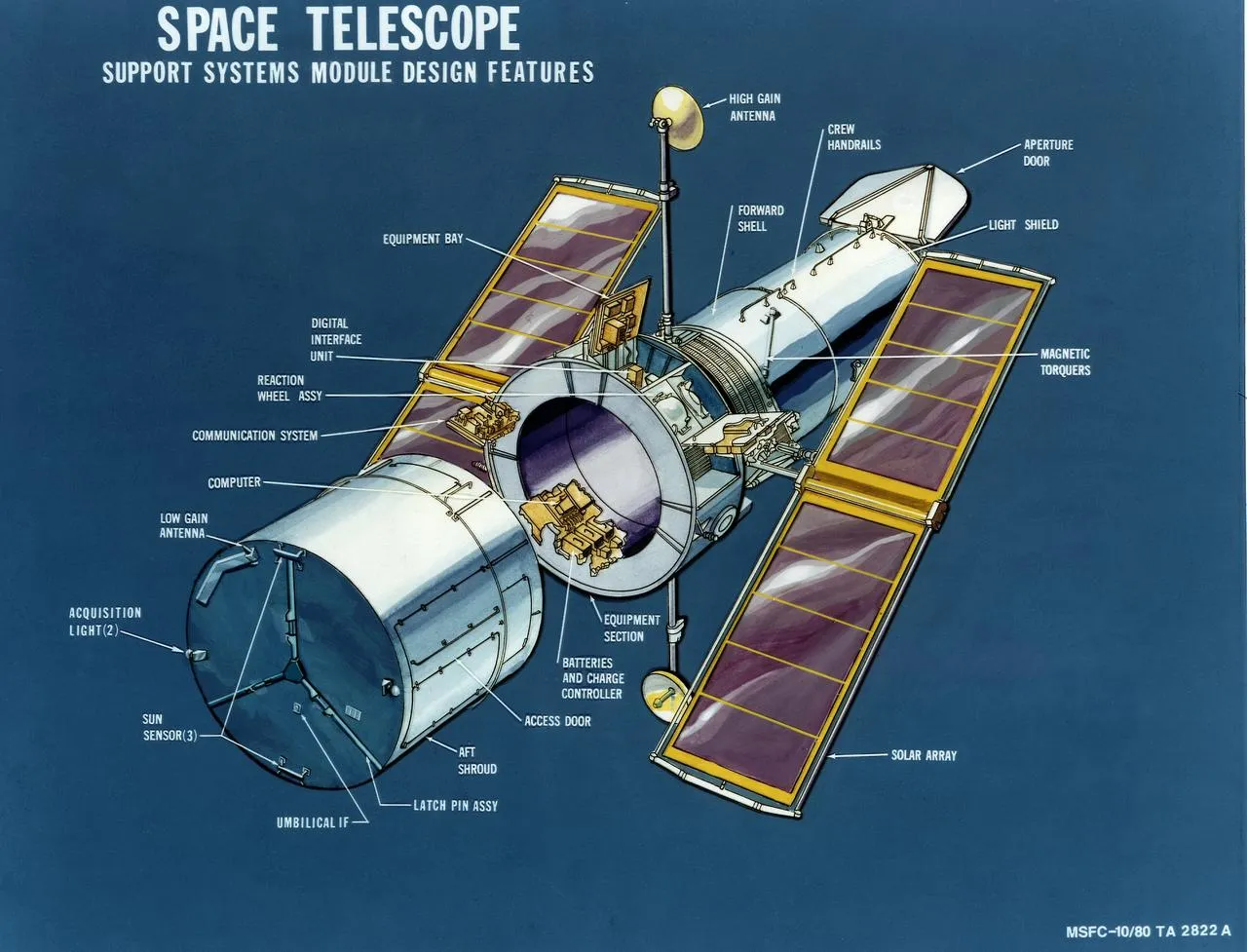
are instruments that orbit Earth or sit far in space to observe the universe. Unlike telescopes on the ground, space telescopes operate above Earth's atmosphere. This location gives them a clear advantage. Earth's atmosphere distorts light and blocks many wavelengths from reaching the surface. Space telescopes avoid these problems and can capture light that ground-based telescopes cannot see.
The electromagnetic spectrum includes all types of light, from radio waves to gamma rays. Our eyes detect only visible light, a small part of this spectrum. The atmosphere blocks most ultraviolet light, X-rays, and much of the infrared light from space. This blocking protects life on Earth but limits what astronomers can observe from the ground. Space telescopes capture these blocked wavelengths, revealing objects and processes invisible to ground-based instruments.
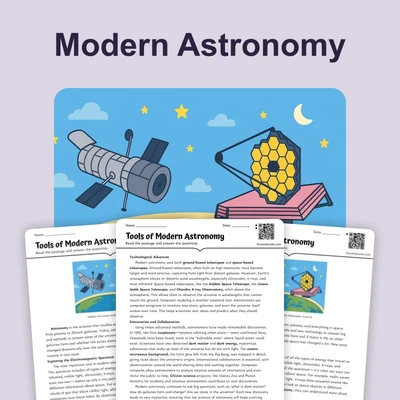
Different space telescopes detect different wavelengths. The Hubble Space Telescope, launched in 1990, observes visible, ultraviolet, and near-infrared light. Scientists use Hubble to study distant galaxies, star formation, and planetary atmospheres. The James Webb Space Telescope, launched in 2021, focuses on infrared light. Webb can see through dust clouds where stars are born and observe the earliest galaxies in the universe. The Chandra X-ray Observatory detects X-rays from extremely hot regions, such as exploding stars and material around black holes.
Space telescopes must overcome challenges. They orbit in harsh conditions with extreme temperatures and radiation. Engineers design them to last many years without repair visits. Evidence shows that space telescopes have transformed our understanding of the universe. They have discovered new planets, measured the age of the universe, and revealed how galaxies form and evolve.
Space telescopes matter because they expand what humans can observe. They help scientists answer fundamental questions about the origin and structure of the universe. By capturing light across the electromagnetic spectrum, these instruments provide a more complete picture of cosmic events and objects. This knowledge connects to Earth by helping us understand our planet's place in the vast universe.
Interesting Fact: The Hubble Space Telescope travels at about 17,000 miles per hour and completes an orbit around Earth every 95 minutes, capturing images from above the atmosphere's distorting effects.
Comprehension quiz (10 questions)
1. Where do space telescopes operate?
2. What does Earth's atmosphere do to light from space?
3. What does the term 'electromagnetic spectrum' mean in the passage?
4. Which wavelengths does Earth's atmosphere block?
5. Why can space telescopes see things that ground-based telescopes cannot?
6. What type of light does the James Webb Space Telescope primarily observe?
7. Based on the passage, what can scientists learn from the Chandra X-ray Observatory?
8. How have space telescopes changed our understanding of the universe?
9. True or False: The Hubble Space Telescope was launched in 2021.
10. True or False: Space telescopes operate in harsh conditions with extreme temperatures and radiation.
Perfect for the way you teach
- Build comprehension skills
- Auto-graded quiz
- Differentiated reading
- Read together at home
- Improve fluency
- Quiet reading time
- Reading curriculum support
- Independent practice
- Track Lexile growth