This learning resource is available in interactive and printable formats. The interactive worksheet can be played online and assigned to students. The Printable PDF version can be downloaded and printed for completion by hand.
This 450-word informational science passage for grades 6-8 explores how astronauts live aboard the International Space Station, where they experience 16 sunrises and sunsets every day. Students learn about orbital mechanics as the ISS travels at 17,500 mph about 250 miles above Earth, completing an orbit every 90 minutes. The passage examines daily-life challenges astronauts face without natural day-night cycles, including disrupted sleep patterns, bone density loss, and muscle weakness. It explains how the station uses Coordinated Universal Time and special lighting systems to maintain crew health. Aligned with NGSS standard MS-ESS1-1, this passage connects Earth's rotation to human biology and helps students understand how deeply our planet's daily cycle shapes life. The content includes audio integration for enhanced accessibility and engagement, making complex scientific concepts accessible to middle school learners while maintaining scientific accuracy and appropriate vocabulary.
CONTENT PREVIEW
Expand content preview
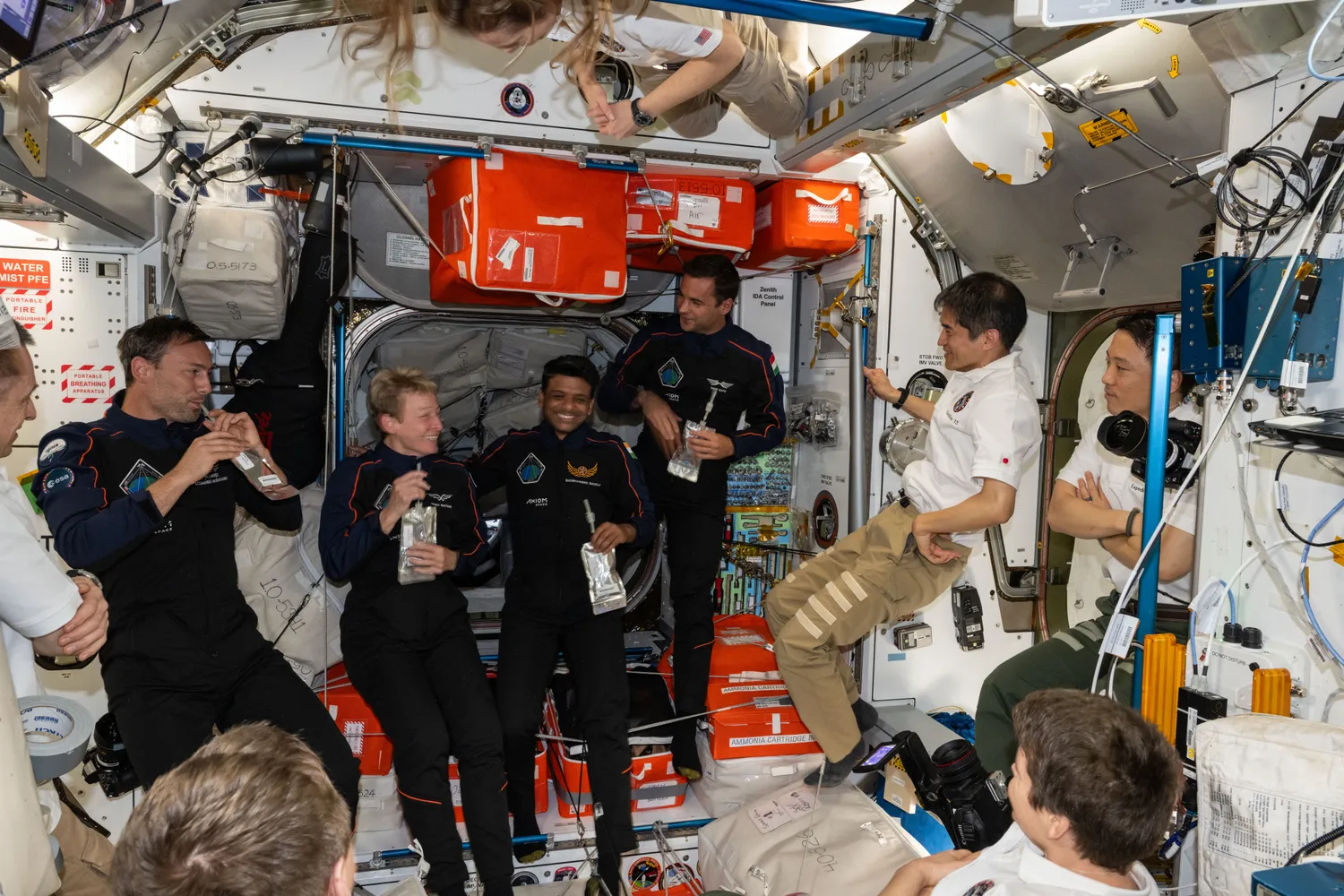
Astronauts gather inside the International Space Station by NASA Johnson Space Center / Wikimedia Commons
Astronauts on the International Space Station experience something remarkable. They see 16 sunrises and 16 sunsets every single day. This happens because the station orbits Earth once every 90 minutes. Each orbit takes the astronauts from bright daylight into complete darkness and back again. The constant transitions between day and night create unique challenges for human health.
Scientists explain that human bodies follow a natural circadian rhythm. This internal clock tells us when to sleep and when to wake up. On Earth, our circadian rhythm depends on the 24-hour day-night cycle. Sunlight signals our brains to stay alert and awake. Darkness triggers the release of melatonin, a hormone that makes us feel sleepy. Evidence shows that disrupting this rhythm can cause serious health problems. Astronauts face constant disruption because their environment changes from day to night 16 times in 24 hours.
The space station travels at approximately 28,000 kilometers per hour. At this speed, astronauts complete one full orbit in just 90 minutes. During each orbit, they experience about 45 minutes of daylight and 45 minutes of darkness. This rapid cycling confuses the body's natural clock. Without intervention, astronauts may struggle to sleep, feel tired during work hours, and experience decreased alertness. These effects can impact mission safety and scientific research aboard the station.
To address these challenges, astronauts follow strict schedules and use artificial lighting systems. The station has special LED lights that can change color and brightness. During scheduled work hours, the lights produce blue-enriched white light that mimics morning sunlight. This helps astronauts stay alert and focused. Before sleep time, the lights shift to warmer tones with less blue light. This change signals the body that night is approaching. Astronauts also maintain consistent sleep and wake times based on Coordinated Universal Time, regardless of the sunrise-sunset cycle outside their windows.
The experience of astronauts reveals how much human bodies depend on Earth's natural environment. Our circadian rhythms evolved over millions of years to match Earth's 24-hour rotation. When this rhythm is disrupted, our health suffers. Understanding these effects helps scientists develop better strategies for long-term space missions. It also helps people on Earth who work night shifts or travel across time zones. The lessons learned in space can improve health and performance for everyone.
Interesting Fact: Astronauts on the International Space Station must cover their windows with shades during scheduled sleep periods. Otherwise, the bright sunrises every 45 minutes would constantly wake them up!
How many sunrises and sunsets do astronauts on the International Space Station experience each day?
8 sunrises and 8 sunsets16 sunrises and 16 sunsets24 sunrises and 24 sunsets12 sunrises and 12 sunsets
How long does it take the International Space Station to complete one orbit around Earth?
24 hours45 minutes90 minutes3 hours
What is a circadian rhythm?
The speed at which the space station travelsA type of artificial lighting systemThe natural internal clock that regulates sleep and wake cyclesThe path that objects take as they orbit in space
What hormone does darkness trigger the body to release?
AdrenalineInsulinMelatoninDopamine
Why do astronauts use blue-enriched white light during work hours?
It helps them see better in the darkIt mimics morning sunlight and helps them stay alertIt signals that night is approachingIt helps them fall asleep faster
Based on the passage, what can be inferred about the relationship between Earth's rotation and human health?
Human health is not affected by Earth's rotationHuman bodies evolved to depend on Earth's 24-hour day-night cycleHumans can easily adapt to any day-night cycleEarth's rotation only affects astronauts in space
How might the lessons learned from astronauts' experiences help people on Earth?
They can help people who work night shifts or travel across time zonesThey can help people exercise more effectivelyThey can help people eat healthier foodsThey can help people communicate better
If an astronaut did not follow a strict schedule or use artificial lighting, what would most likely happen?
They would become stronger and healthierThey would adapt naturally within a few daysThey would struggle with sleep, fatigue, and decreased alertnessThey would not notice any difference
True or False: The International Space Station travels at approximately 28,000 kilometers per hour.
TrueFalse
True or False: Astronauts must cover their windows with shades during sleep periods to prevent constant awakenings from frequent sunrises.
TrueFalse
Perfect For:
👩🏫 Teachers
• Reading comprehension practice
• Auto-graded assessments
• Literacy skill development
👨👩👧👦 Parents
• Reading practice at home
• Comprehension improvement
• Educational reading time
🏠 Homeschoolers
• Reading curriculum support
• Independent reading practice
• Progress monitoring
Reading Features:
📖
Reading Passage
Engaging fiction or nonfiction text
❓
Comprehension Quiz
Auto-graded questions
📊
Instant Feedback
Immediate results and scoring
📄
Printable Version
Download for offline reading
🔊
Read Aloud
Voice-over with word highlighting
Reviews & Ratings
No reviews yet. Be the first to share your experience!
Related Content
What is Solar Radiation
This NGSS-aligned science reading passage for middle school students explores the concept of solar radiation. Solar radi...
MS-ESS1-1
How Incoming Solar Radiation Changes with Latitude
This NGSS-aligned science reading passage helps middle school students understand how solar radiation, or insolation, ch...
MS-ESS1-1
Tides and Tidal Forces
This middle school science passage explores the mechanisms of tides and tidal forces, aligning with NGSS standards MS-ES...
MS-ESS1-1MS-ESS1-2
The Night Sky
This comprehensive science reading passage for grades 6-8 aligns with NGSS standard MS-ESS1-1 and explores the systems a...
MS-ESS1-1
Ancient Astronomy
This engaging passage for grades 6-8 explores the history of astronomy through the lens of ancient observations. Student...
MS-ESS1-1
Tools of Modern Astronomy
This passage introduces middle school students to modern astronomy, aligning with NGSS standard MS-ESS1-1. It explains h...
MS-ESS1-1
How Astronomy Became a Science
This passage explores the transformative period known as the Scientific Revolution, with a special focus on the history ...
MS-ESS1-1
Earth's Rotation
This middle school science passage, aligned with NGSS standard MS-ESS1-1, focuses on Earth's rotation—how Earth spins on...
MS-ESS1-1
Earth's Revolution
This middle school science passage explores the science behind Earth's revolution around the Sun, closely aligned with N...
MS-ESS1-1
Why We Have Seasons
This comprehensive middle school science reading passage explains the mechanisms behind Earth's seasons, directly addres...
MS-ESS1-1
Earth's Seasons
This comprehensive reading passage for grades 6-8 explains why Earth has seasons, revealing the scientific mechanisms be...
MS-ESS1-1
Phases of the Moon
This comprehensive middle school science passage explains the phases of the Moon, focusing on the mechanisms behind the ...
MS-ESS1-1
Tides
This comprehensive middle school science reading passage explores the phenomenon of ocean tides, aligned to NGSS standar...
MS-ESS1-1MS-ESS1-2
Eclipses
This comprehensive passage for grades 6-8 explores the science behind eclipses, including solar and lunar eclipses, thei...
MS-ESS1-1
The Moon's Characteristics
This comprehensive science reading passage for grades 6-8 examines the Moon's physical characteristics, including its si...
MS-ESS1-1MS-ESS1-2
Lunar Eclipses
This passage introduces middle school students to the phenomenon of lunar eclipses, connecting observable events to the ...
MS-ESS1-1
The Sun's Characteristics
This engaging science passage introduces middle school students to the Sun’s key characteristics, such as its classifica...
MS-ESS1-1MS-ESS1-2
What Is a Galaxy?
This comprehensive middle school science passage answers the question: What is a galaxy? Aligned to NGSS standard MS-ESS...
MS-ESS1-1
The Milky Way: Our Home Galaxy
This comprehensive science passage introduces middle school students to the Milky Way, the barred spiral galaxy that is ...
MS-ESS1-1
Types of Galaxies
This comprehensive middle school science passage introduces students to the classification and characteristics of galaxi...