This learning resource is available in interactive and printable formats. The interactive worksheet can be played online and assigned to students. The Printable PDF version can be downloaded and printed for completion by hand.
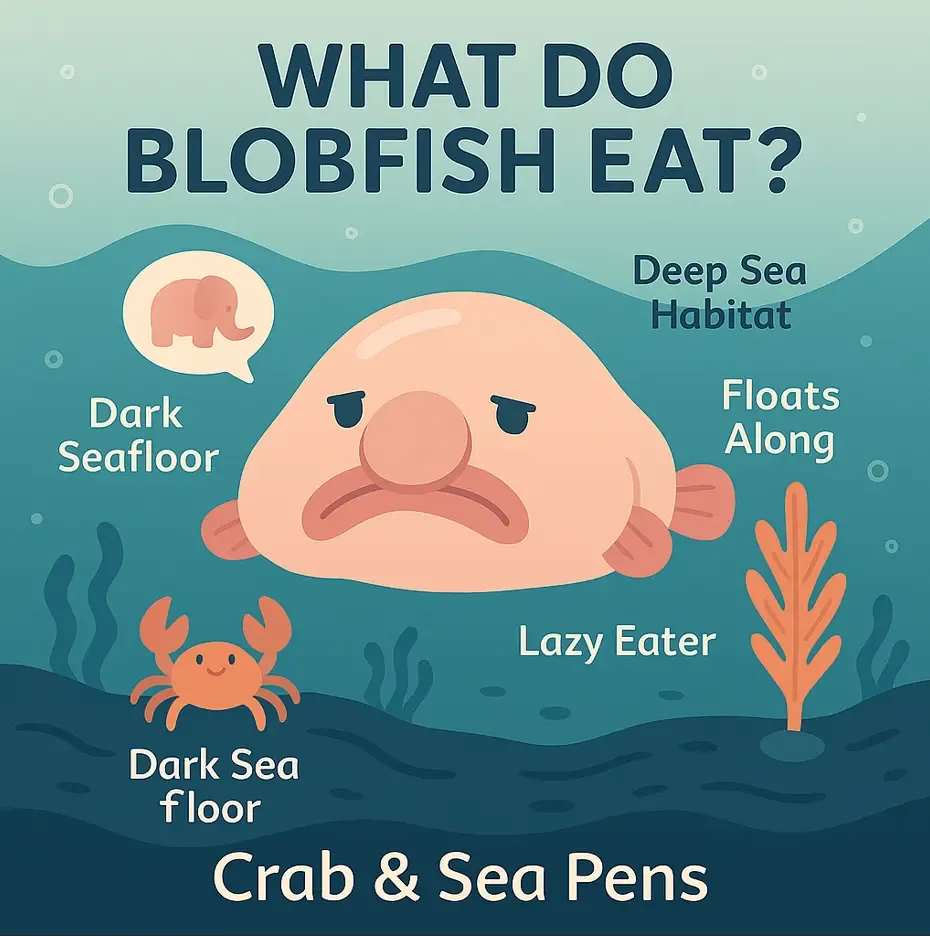
This science reading passage, titled "What Do Blobfish Eat?", offers an engaging exploration into the feeding habits of this unusual deep-sea creature. Aligned with NGSS Life Science standards, particularly MS-LS2-1 concerning resource availability and organism interactions, the passage explains how the blobfish, with its unique jelly-like body, is perfectly adapted to its low-energy environment. It delves into the blobfish's method of acquiring food, describing it as a passive feeder that drifts and waits for small organisms like crustaceans and sea pens to float within reach. The text highlights how this "lazy" eating style is an efficient survival strategy in the deep ocean where food is scarce and high-energy hunting is impractical. By focusing on the blobfish's diet, students gain insight into the diverse ways organisms obtain energy in different ecosystems and how physical adaptations are linked to feeding strategies. This resource is excellent for developing reading comprehension, understanding ecological concepts, and appreciating the remarkable adaptations found in marine life, fostering curiosity about biodiversity in extreme environments.
CONTENT PREVIEW
Expand content preview
We know the blobfish looks super strange, but have you ever wondered what it eats in its deep-sea home? Unlike many fish that swim fast to catch food, the blobfish has a very different way of getting its meals!
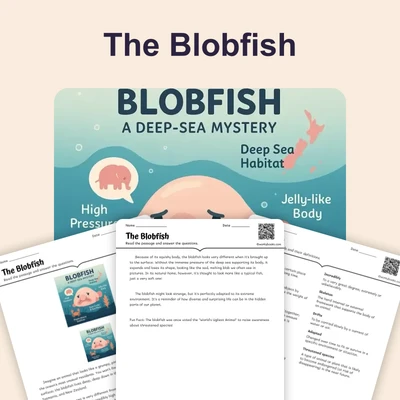
Remember, the blobfish lives way down deep where it's dark and the water pressure is enormous. Its body is mostly made of jelly, which helps it float. This soft, squishy body means it doesn't have much muscle for swimming or chasing. So, the blobfish is a bit of a lazy eater! It just floats along, barely moving, right above the seafloor.
What kind of food floats by in the deep, dark ocean? The blobfish eats whatever small, edible bits drift down near it. This can include tiny crabs that crawl slowly by, or other small creatures called sea pens (which look like feathery plants but are actually animals!). It might also eat other very small organisms or even bits of dead stuff that sink from above.
Because its mouth is usually turned upwards, it's easy for the blobfis
h to simply open wide and swallow whatever yummy bits come close. This way of eating uses very little energy, which is perfect for an animal living in a place where food can be hard to find and life is slow. So, while it might look grumpy, the blobfish has a very smart way of finding its dinner!
What kind of body does a blobfish mostly have?
Hard scalesStrong musclesJellySharp teeth
How does the blobfish mainly get its food?
By chasing fast fish.By digging in sand.By waiting for food to float by. By eating plants from rocks.
What is one type of food a blobfish might eat?
Big sharksSmall crabsFast birdsGreen plants
Which way does the blobfish's mouth usually face?
DownwardsSidewaysUpwardsBackwards
Why does the blobfish not chase its food?
It has too many muscles.It has a squishy body.It is too fast.It likes to play.
Why is using little energy important for a blobfish to find food?
Food is easy to find.There's not much food.They are very active.They need to sleep a lot.
What is this passage mostly about?
Where blobfish live.How blobfish find food.Why blobfish are ugly.What blobfish look like.
An animal that waits hidden for its food to come close is using what kind of hunting strategy?
Active chasingBuilding trapsAmbushFarming
Perfect For:
👩🏫 Teachers
• Reading comprehension practice
• Auto-graded assessments
• Literacy skill development
👨👩👧👦 Parents
• Reading practice at home
• Comprehension improvement
• Educational reading time
🏠 Homeschoolers
• Reading curriculum support
• Independent reading practice
• Progress monitoring
Reading Features:
📖
Reading Passage
Engaging fiction or nonfiction text
❓
Comprehension Quiz
Auto-graded questions
📊
Instant Feedback
Immediate results and scoring
📄
Printable Version
Download for offline reading
🔊
Read Aloud
Voice-over with word highlighting
Reviews & Ratings
No reviews yet. Be the first to share your experience!
Related Content
The Narwhal: Arctic’s Unicorn of the Sea
This NGSS-aligned passage (MS-LS2-1) explores how narwhals survive in Arctic ecosystems. Students learn about specialize...
MS-LS2-1RI.6.3RI.7.3RI.8.8
The Blue-Ringed Octopus
This NGSS aligned passage explores how the tiny blue-ringed octopus impacts its ecosystem through predator-prey relation...
MS-LS2-1RI.6.3RI.7.3RI.8.8
Tardigrades: Microscopic Superheroes
Aligned to MS-LS1-1, this passage examines how tardigrade cell structures (TDP proteins, DNA-repair enzymes) allow survi...
MS-LS2-1RI.6.3RI.7.3RI.8.8
The Leafy Sea Dragon: Nature's Living Seaweed
This NGSS-aligned passage explores how leafy sea dragons (Phycodurus eques) demonstrate key life science concepts for mi...
MS-LS2-1RI.6.3RI.7.3RI.8.8
What Do Axolotls Eat?
This science reading passage, titled "What Do Axolotls Eat?", offers an engaging exploration into the feeding habits of ...
MS-LS2-1
Where Do Axolotls Live?
This science reading passage, titled "The Axolotl's Home," delves into the specific natural environment of the fascinati...
MS-LS4-DMS-LS2-1
The Blobfish
This science reading passage, titled "The Blobfish: A Deep-Sea Mystery," introduces students to one of Earth's most pecu...
MS-LS4-DMS-LS2-1
Where Do Penguins Live?
This engaging science reading passage, titled "Where Do Penguins Live? A Cold and Coastal World," clarifies the diverse ...
MS-LS2-1
The Emperor Penguin
This science reading passage, titled "The Emperor Penguin: Antarctica's Royal Survivor," introduces students to one of t...
MS-LS2-1
The Adélie Penguin
This engaging science reading passage, titled "The Adélie Penguin: Antarctica's Little Explorer," introduces students to...
MS-LS2-1
How Does Global Warming Affect Adélie Penguins?
This comprehensive science passage, titled "How Does Global Warming Affect Adélie Penguins?", details the significant im...
MS-LS2-1
Desert Birds
This informational passage for grades 6-8 examines how desert birds survive and thrive in some of the harshest environme...
MS-LS2-1MS-LS2-2MS-LS1-4
Abiotic Factors in Ecosystems
This comprehensive informational reading passage is designed for middle school science students and aligns with NGSS sta...
MS-LS2-1
Biomes: Terrestrial Ecosystems
This NGSS-aligned science reading passage for grades 6-8 provides a comprehensive survey of Earth’s major terrestrial bi...
MS-LS2-1
Biomes: Aquatic Ecosystems
This middle school science passage, aligned with NGSS standard MS-LS2-1, introduces students to the key features and mec...
MS-LS2-1
Galápagos Islands
This engaging science passage explores the Galápagos Islands, a volcanic archipelago located off the coast of Ecuador in...
MS-LS2-1MS-LS4-4MS-ESS3-4
Florida Everglades
This comprehensive passage introduces middle school students to the Florida Everglades, a distinctive wetland ecosystem ...
MS-LS2-1MS-LS2-4MS-ESS3-3MS-ESS3-4
Great Barrier Reef
This passage introduces middle school students to the Great Barrier Reef, the world's largest coral reef system, located...
MS-LS2-1MS-LS2-4MS-ESS3-5
Wetland Biomes
This comprehensive science passage introduces middle school students to the concept of wetland biomes. Aligned with NGSS...