This learning resource is available in interactive and printable formats. The interactive worksheet can be played online and assigned to students. The Printable PDF version can be downloaded and printed for completion by hand.
This engaging passage, complete with audio integration, introduces students to the concept of the Adiabatic Lapse Rate. It explains how the temperature of air changes as it rises and falls in the atmosphere, a key factor in understanding weather patterns and cloud formation. Students will learn about the role of air pressure, expansion, and condensation, aligning with NGSS MS-ESS2-5: Collect data to provide evidence for how the motions and complex interactions of air masses result in changes in weather conditions. The passage uses simple language, defines important terms, and is followed by interactive activities including multiple-choice questions, a glossary, and short answer questions to reinforce learning about air masses and their impact on weather.
CONTENT PREVIEW
Expand content preview
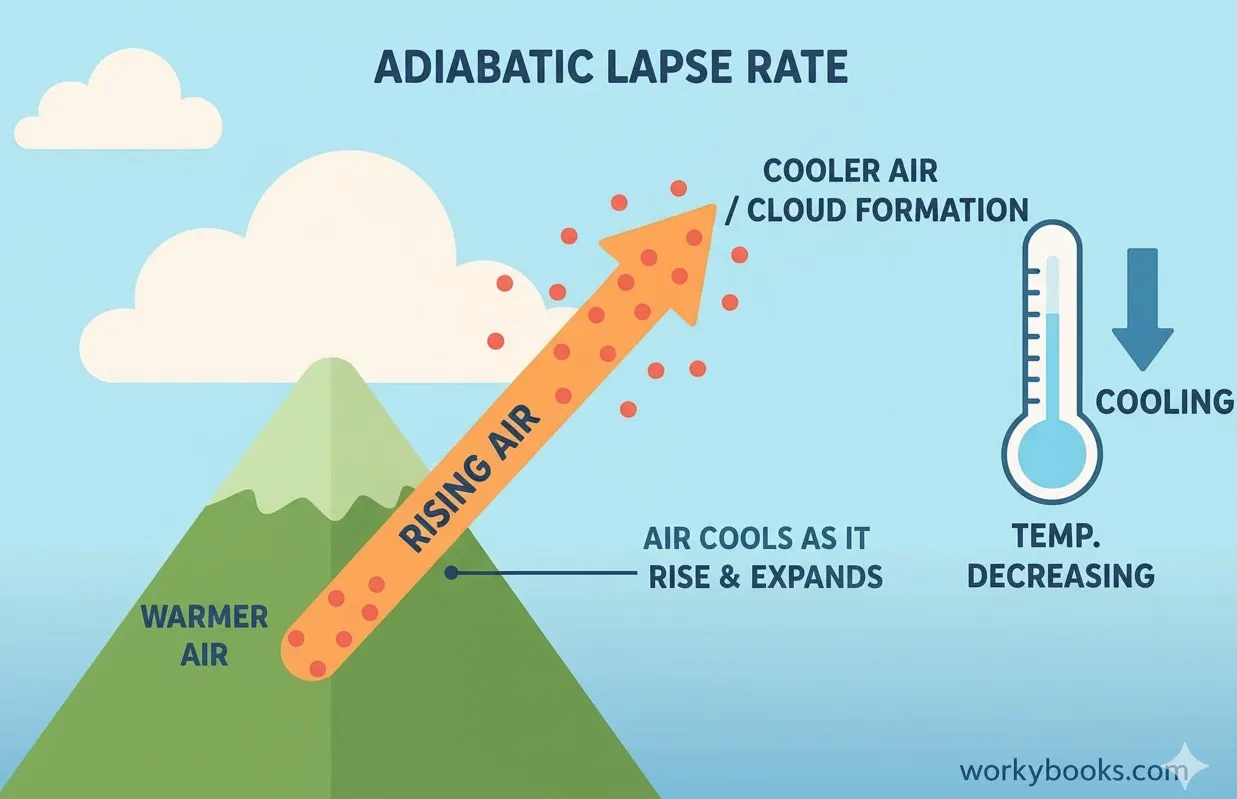
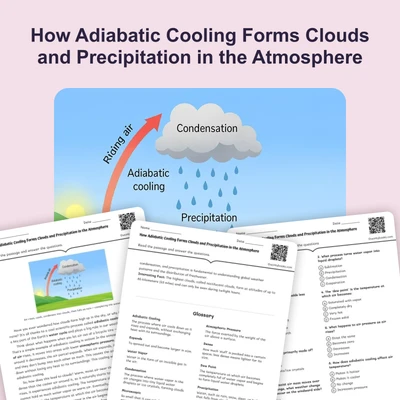
Adiabatic Lapse Rate helps us understand how the temperature of air changes as it moves up or down in the Earth's atmosphere.
Have you ever wondered why mountaintops are usually colder than valleys? Or why clouds often form high in the sky? The answer has a lot to do with something called the Adiabatic Lapse Rate. This scientific idea helps us understand how the temperature of air changes as it moves up or down in the Earth's atmosphere. It's a key part of how our weather works!
When a parcel of air rises, it moves into an area where the air pressure is lower. Imagine a balloon expanding as you let air out – that's similar to what happens with a rising air parcel. As the air expands, its molecules spread out, and they do less bumping into each other. This expansion uses up energy, which causes the air to cool down. This cooling happens without any heat being added or taken away from outside the air parcel itself, which is what "adiabatic" means. This is why the Adiabatic Lapse Rate is so important for understanding weather conditions.
There are actually two main types of adiabatic lapse rates. The first is the Dry Adiabatic Lapse Rate. This applies to air that is not saturated with water vapor (meaning it's not holding all the water it can). For every 1,000 meters a dry air parcel rises, its temperature drops by about 10 degrees Celsius. That's a pretty quick drop! This process helps us predict how temperature changes with altitude, which is the height above sea level.
The second type is the Moist Adiabatic Lapse Rate. This happens when air has cooled enough to become saturated, meaning it's full of water vapor. As this moist air continues to rise and cool, the water vapor starts to condense, forming tiny water droplets or ice crystals. This process of condensation actually releases a little bit of heat. Because of this released heat, moist air cools more slowly than dry air, typically by about 6 degrees Celsius for every 1,000 meters it rises. This slower cooling is vital for cloud formation and understanding air masses.
So, the Adiabatic Lapse Rate explains why air cools as it rises and warms as it sinks. This fundamental concept helps scientists and meteorologists forecast weather, understand why different regions have different climates, and even predict when and where it might rain or snow. It's all about how air interacts with pressure and altitude!
Interesting Fact: On average, the temperature in the atmosphere decreases by about 6.5 degrees Celsius for every 1,000 meters of altitude, which is known as the environmental lapse rate.
What happens to a parcel of air as it rises?
It warms upIt cools downIt stays sameIt gets denser
What does 'adiabatic' mean in the passage?
Heat is addedHeat is removedNo heat exchangeAir gets warmer
Why does rising air cool down without heat being added or removed?
It gains energyIt expandsIt gets compressedIt loses water
Which type of air cools faster as it rises?
Moist airDry airWarm airSaturated air
What forms when moist air cools and condenses?
RaindropsCloudsFogSnow
If a dry air parcel rises 2,000 meters, how much would its temperature drop?
5 degrees C10 degrees C20 degrees C12 degrees C
What causes the temperature difference between moist and dry adiabatic lapse rates?
Air pressureCondensation heatWind speedSunlight
Understanding the Adiabatic Lapse Rate helps meteorologists forecast weather. True or False?
TrueFalse
Why are mountaintops generally colder than valleys?
More sunlightHigher altitude airLess windMore trees
Which term describes the height above sea level?
PressureClimateAltitudeLapse
Perfect For:
👩🏫 Teachers
• Reading comprehension practice
• Auto-graded assessments
• Literacy skill development
👨👩👧👦 Parents
• Reading practice at home
• Comprehension improvement
• Educational reading time
🏠 Homeschoolers
• Reading curriculum support
• Independent reading practice
• Progress monitoring
Reading Features:
📖
Reading Passage
Engaging fiction or nonfiction text
❓
Comprehension Quiz
Auto-graded questions
📊
Instant Feedback
Immediate results and scoring
📄
Printable Version
Download for offline reading
🔊
Read Aloud
Voice-over with word highlighting
Reviews & Ratings
No reviews yet. Be the first to share your experience!
Related Content
Climate and weather activity
This worksheet is perfect for understanding the differences between climate and weather. Students will read the phrases ...
Climate and Weather — Distinguishing Characterstics
This worksheet highlights the differences between climate and weather. The chart format makes comparing and contrasting ...
Comparing Weather and Climate Texts
This reading comprehension worksheet has 5th graders read two informational texts about Weather and Climate. Students th...
RI.5.9
Tools and Technology in Earth Science
This middle school science reading passage explores the wide range of tools and technologies used in Earth science, from...
MS-ESS2-2MS-ESS3-2MS-ETS1-1MS-PS4-3
What Is Earth Science?
This engaging middle school science passage introduces students to the field of Earth science, aligning with NGSS standa...
MS-ESS1MS-ESS2MS-ESS3SEP
What Is Space Weather and How Does It Affect the Earth?
This NGSS-aligned science passage for middle school explains what space weather is and how it affects Earth. Students le...
MS-ESS2-2
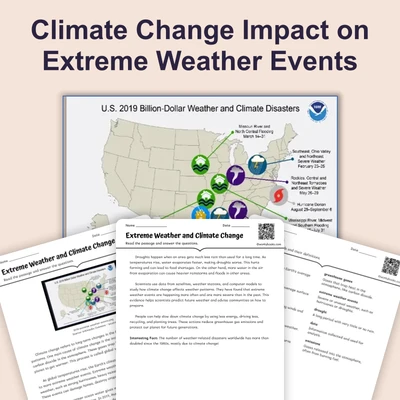
Extreme Weather and Climate Change
This Grade 6-8 science passage, aligned to NGSS standards, explores the impact of climate change on extreme weather even...
What Is The Difference Between Climate Model And Weather Model?
This reading passage delves into the fundamental differences between weather models and climate models, explaining their...
Scientific Inquiry in Earth Science
This passage explores scientific inquiry in Earth science for grades 6-8, aligned with NGSS standards MS-ESS1-4, MS-ESS2...
MS-ESS1-4MS-ESS2-1MS-ESS3-5SEP
Earth's Major Climate Zones Explained
This engaging science passage for grades 6-8 explains Earth's major climate zones, including tropical, temperate, and po...
Climate Through Earth's History
This engaging passage for grades 6-8 explores how Earth's climate has naturally changed over millions of years, highligh...
MS-ESS1-4MS-ESS2-6
Earth: Our Home in Space
This engaging Grade 4-5 science passage, aligned to NGSS, introduces students to Earth's special place in the solar syst...
Weather vs. Climate
This comprehensive passage for grades 6-8 explores the difference between weather and climate, aligning with NGSS standa...
MS-ESS2-6
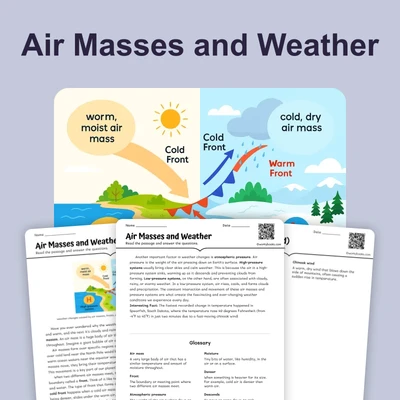
Air Masses and Weather
This audio-integrated passage, "Air Masses and Weather," is designed for 6th-grade students to understand how the moveme...
How is Climate Different from Weather?
This passage distinguishes climate from weather for young readers. It defines climate as the usual weather patterns over...
RI.3.1RI.4.14.ESS2.D
Antarctica Climate
This engaging science passage for grades 6-8 explores Antarctica, the coldest climate zone on Earth. Students will learn...
How Climate Change Affects Weather
This middle school science passage explores how and why weather patterns are changing globally. Students will learn abou...
MS-ESS3-5
Climate Zones Word Sort
This word sort activity helps students understand different climate zones through real-world locations. Students classif...
Escape Velocity and Space Travel
This middle school science passage introduces students to the concept of escape velocity—the minimum speed required to b...
MS-ESS1-2MS-PS2-4
Weather Tools & Measurements Word Sort
This word sort activity connects weather measurement tools with their corresponding measurements. Students match 12 weat...