Air Masses
Interactive passage with audio narration, comprehension questions, and printable PDF.
By completing this purchase you agree to our Terms of Use and Privacy Policy. Your subscription renews automatically until you cancel. You can cancel anytime from your account settings. All sales are final and non-refundable. Digital content is available for download in your account immediately upon purchase.
What's included
Air Masses preview and details
About this printable Air Masses science reading passage, NGSS-aligned (Grades 5-8)
Sample passage and quiz from Air Masses
Reading passage and comprehension quiz preview
Air Masses
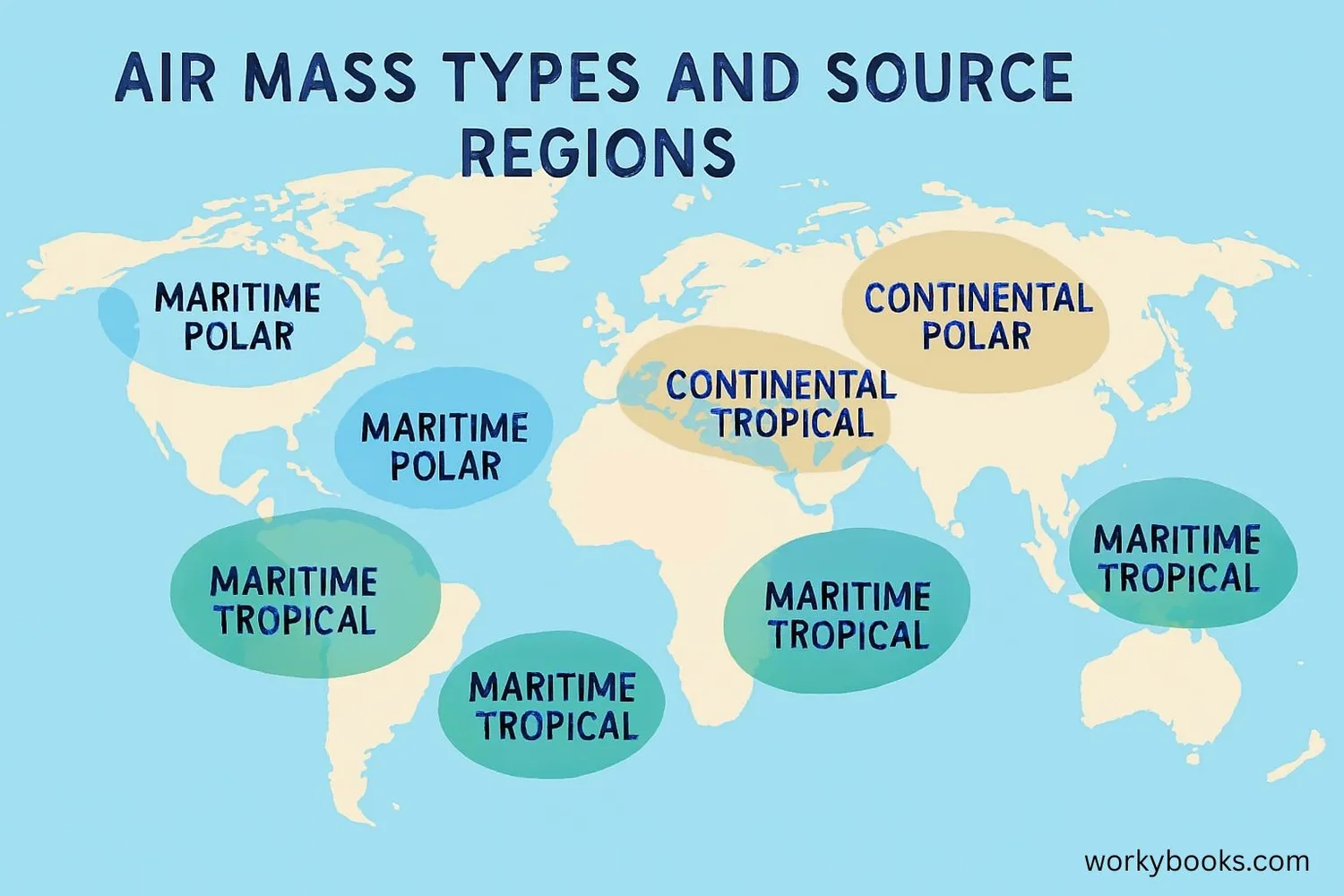
Air masses are vast bodies of air that have nearly uniform temperature and moisture throughout. Scientists observe that when large sections of air stay over the same region for several days or weeks, they take on the characteristics of that area. For example, if air remains over warm tropical oceans, it becomes warm and humid. These air masses are critical in understanding and predicting weather patterns across continents.
Formation and Classification of Air Masses
The process by which air masses form is called air mass modification. When air sits over a source region—a large area with consistent surface conditions—it gradually adopts the temperature and humidity of that surface. Scientists classify air masses based on where they form and their properties. The main categories are continental (c), which are dry and form over land, and maritime (m), which are humid and form over oceans. Air masses are also labeled by temperature: tropical (T) for warm, polar (P) for cold, and arctic (A) for very cold. Combined, these labels give specific types, such as cT (continental tropical: hot and dry), cP (continental polar: cold and dry), mT (maritime tropical: warm and humid), and mP (maritime polar: cold and humid).
Movement and Effects on Weather
Once formed, air masses do not stay in place. Winds push them across continents and oceans, often traveling hundreds or thousands of kilometers. As they move, air masses interact with other air masses and with the Earth's surface. For example, when a cold, dry cP air mass from Canada moves south into the United States, it can bring cold, clear weather. In contrast, a warm, humid mT air mass from the Gulf of Mexico can cause hot, muggy conditions and thunderstorms. These movements explain why weather can change rapidly in some regions, especially where different air masses meet.
Interactions and Real-World Impacts
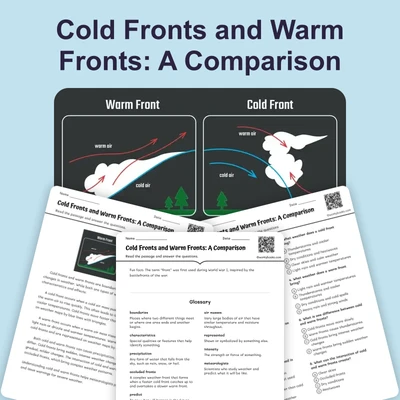
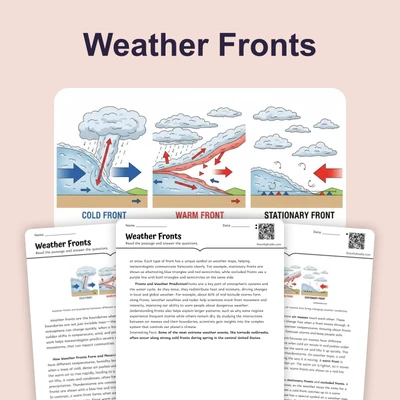
At the boundaries where air masses meet, called fronts, dramatic weather changes often occur. For instance, a cold front forms when a cold air mass pushes under a warm air mass, causing the warm air to rise quickly. This process can lead to heavy rain, storms, or even snow. In North America, the most influential air masses are mT (from the Gulf of Mexico), cP (from Canada), and mP (from the Pacific or Atlantic Oceans). Their interactions shape seasonal weather patterns, influence agriculture, and even affect energy demand in cities. Understanding air masses helps meteorologists forecast weather with greater accuracy, which is essential for public safety and planning.
In summary, air masses are fundamental to Earth's weather system. Their formation, movement, and interaction explain much of the daily and seasonal variation in climate. By studying air masses, scientists can make better weather predictions and help communities prepare for changing conditions.
Interesting Fact: The largest air mass on Earth is the Siberian High, a cold and dry air mass that can cover more than 9 million square kilometers during winter!
Comprehension quiz (10 questions)
1. What is an air mass?
2. Where do continental air masses form?
3. Which of these is a correct combination for a warm and humid air mass?
4. What happens when two different air masses meet?
5. The word 'maritime' in the passage most likely means:
6. What does 'source region' refer to in the passage?
7. Why do air masses play an important role in predicting weather?
8. If a cP (continental polar) air mass moves south into the United States, what is MOST likely to happen?
9. True or False: Maritime air masses are always dry.
10. True or False: Fronts are boundaries where air masses meet and weather changes can happen.
Perfect for the way you teach
- Build comprehension skills
- Auto-graded quiz
- Differentiated reading
- Read together at home
- Improve fluency
- Quiet reading time
- Reading curriculum support
- Independent practice
- Track Lexile growth