Weather Fronts
Interactive passage with audio narration, comprehension questions, and printable PDF.
By completing this purchase you agree to our Terms of Use and Privacy Policy. Your subscription renews automatically until you cancel. You can cancel anytime from your account settings. All sales are final and non-refundable. Digital content is available for download in your account immediately upon purchase.
What's included
Weather Fronts preview and details
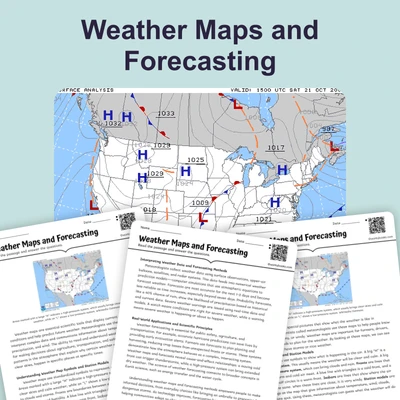
About this printable Weather Fronts science reading passage, NGSS-aligned (Grades 5-8)
Sample passage and quiz from Weather Fronts
Reading passage and comprehension quiz preview
Weather Fronts
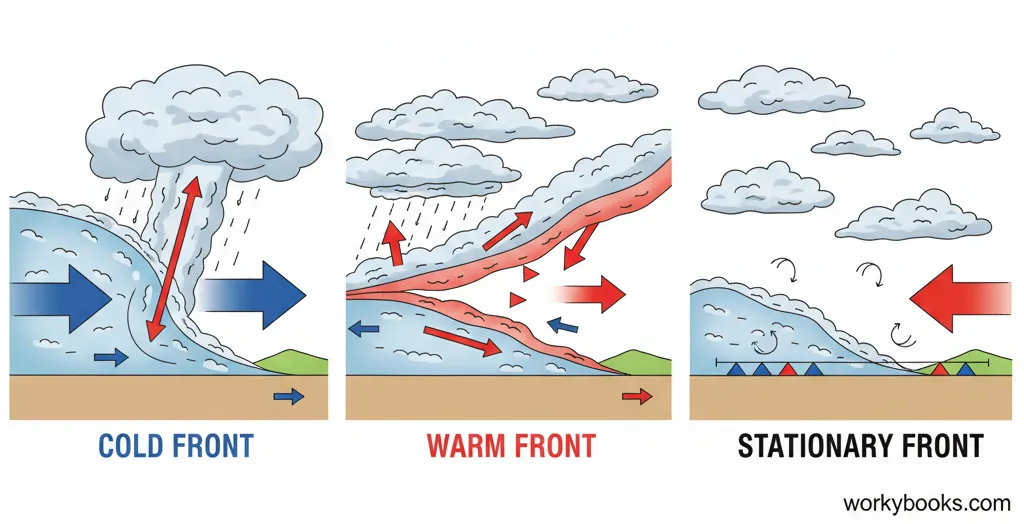
Weather fronts are the boundaries where two different air masses meet. These boundaries are not just invisible lines—they are dynamic zones where the atmosphere can change quickly. When a front moves through an area, it can bring sudden shifts in temperature, wind, and precipitation. Understanding how fronts work helps meteorologists predict severe weather events, such as thunderstorms or snowstorms, that can impact communities.
How Weather Fronts Form and Move
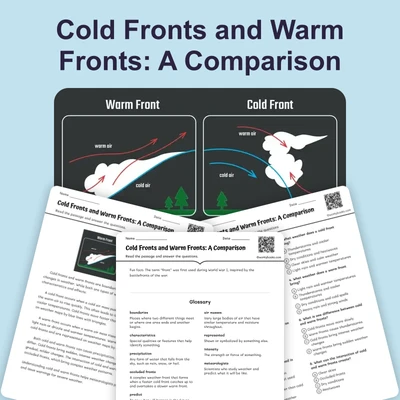
Weather fronts occur because air masses have different temperatures, humidity levels, and densities. A cold front happens when a mass of cold, dense air pushes underneath warmer, lighter air. This causes the warm air to rise rapidly, leading to a steep slope at the boundary. As the warm air lifts, it cools and condenses, often forming a narrow band of clouds and intense precipitation. Thunderstorms are common along cold fronts. On a weather map, cold fronts are shown with a blue line and triangles pointing in the direction of movement. In contrast, a warm front forms when warm air gradually slides up and over a retreating cold air mass. Since warm air is less dense, it rises more gently, creating a broad area of layered clouds and steady precipitation. Warm fronts are marked by a red line with semicircles facing the direction the front is moving.
Types of Fronts and Their Effects
Besides cold and warm fronts, there are stationary fronts and occluded fronts. A stationary front occurs when neither the cold nor the warm air mass advances, leading to persistent clouds and precipitation over the same area for days. An occluded front happens when a fast-moving cold front overtakes a warm front, causing complex weather patterns, such as heavy rain or snow. Each type of front has a unique symbol on weather maps, helping meteorologists communicate forecasts clearly. For example, stationary fronts are shown as alternating blue triangles and red semicircles, while occluded fronts use a purple line with both triangles and semicircles on the same side.
Fronts and Weather Prediction
Fronts are a key part of atmospheric systems and the water cycle. As they move, they redistribute heat and moisture, driving changes in local and global weather. For example, about 60% of mid-latitude storms form along fronts. Weather satellites and radar help scientists track front movement and intensity, improving our ability to warn people about dangerous weather. Understanding fronts also helps explain larger patterns, such as why some regions experience frequent storms while others remain dry. By studying the interactions between air masses and their boundaries, scientists gain insights into the complex system that controls our planet's climate.
Interesting Fact: Some of the most extreme weather events, like tornado outbreaks, often occur along strong cold fronts during spring in the central United States.
Comprehension quiz (10 questions)
1. What is a weather front?
2. Which symbol represents a cold front on a weather map?
3. What usually happens when a cold front moves through an area?
4. Why do cold fronts often cause thunderstorms?
5. What is the difference between a stationary front and an occluded front?
6. What is precipitation?
7. How do meteorologists use weather map symbols?
8. Which statement is true about warm fronts?
9. Weather fronts are important for predicting severe weather events. (True/False)
10. About 60% of mid-latitude storms form along weather fronts. (True/False)
Perfect for the way you teach
- Build comprehension skills
- Auto-graded quiz
- Differentiated reading
- Read together at home
- Improve fluency
- Quiet reading time
- Reading curriculum support
- Independent practice
- Track Lexile growth