Clouds and Precipitation
Interactive passage with audio narration, comprehension questions, and printable PDF.
By completing this purchase you agree to our Terms of Use and Privacy Policy. Your subscription renews automatically until you cancel. You can cancel anytime from your account settings. All sales are final and non-refundable. Digital content is available for download in your account immediately upon purchase.
What's included
Clouds and Precipitation preview and details
About this printable Clouds and Precipitation science reading passage, NGSS-aligned (Grades 5-8)
Sample passage and quiz from Clouds and Precipitation
Reading passage and comprehension quiz preview
Clouds and Precipitation
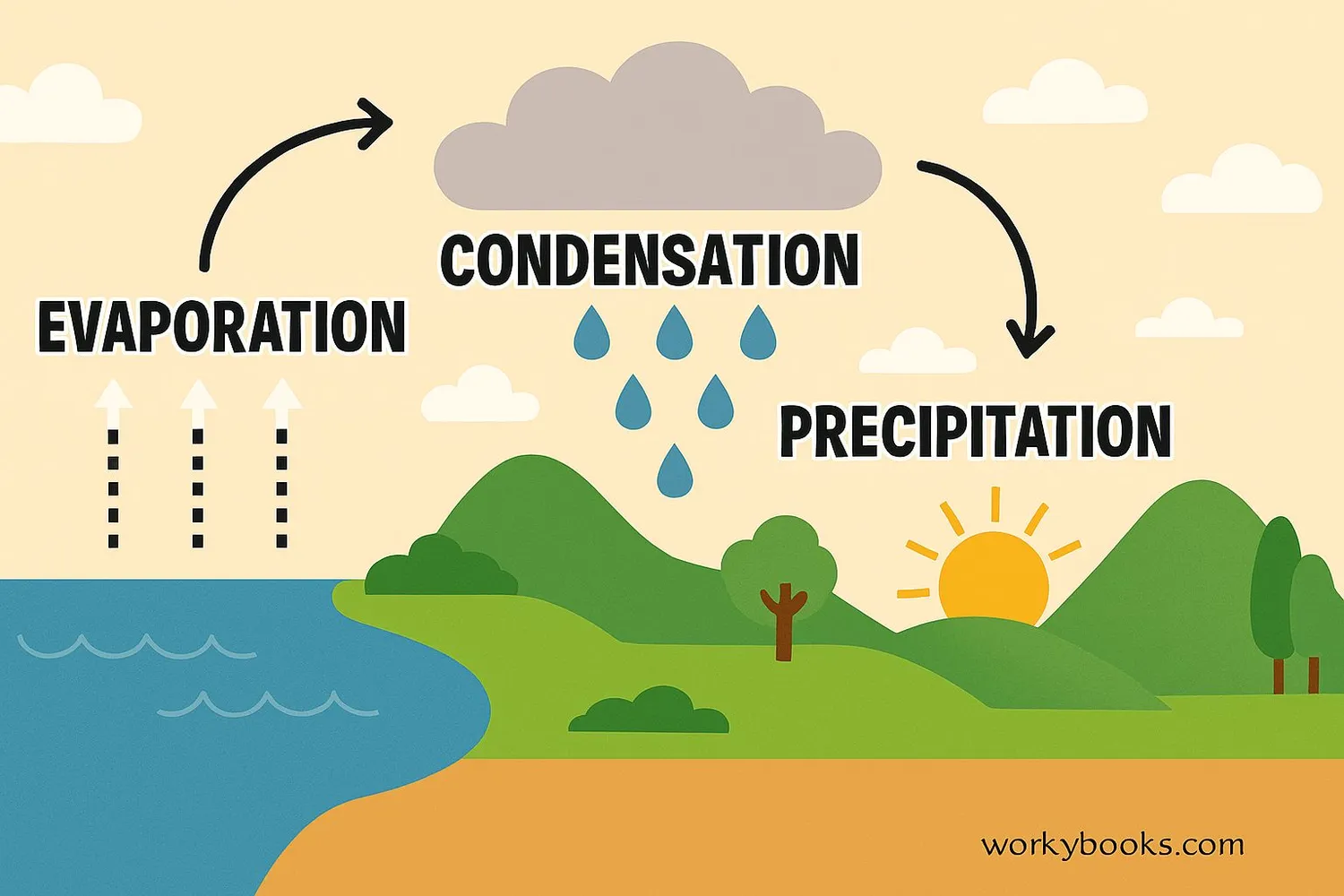
Clouds are a constant part of Earth's atmosphere and play a crucial role in the weather that affects people every day. Scientists study clouds to predict rain, storms, and even climate patterns. Understanding cloud formation and how different types of precipitation occur helps explain the complex systems that shape our environment.
How Clouds Form in the Atmosphere
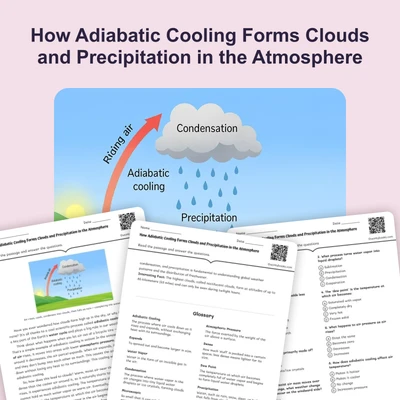
Clouds form when air containing water vapor rises in the atmosphere. As the air rises, it cools. When it cools enough, the water vapor condenses—changes from a gas to a liquid—onto tiny particles called condensation nuclei, such as dust or salt. Billions of these microscopic droplets join together to create a cloud. The altitude, or height, where this happens determines the type of cloud. For example, high clouds such as cirrus form above 6,000 meters and are made mostly of ice crystals. Middle-level clouds, like altostratus and altocumulus, form between 2,000 and 6,000 meters. Low clouds, such as stratus, develop below 2,000 meters. Some clouds, like cumulonimbus, have vertical development and can reach from low to high in the sky.
Types of Clouds and Their Weather Connections
The appearance and type of a cloud often signal the weather to come. Cirrus clouds are thin and wispy, usually indicating fair weather but sometimes signaling a change is coming. Cumulus clouds look fluffy and white, often appearing during fair weather but capable of growing into rain clouds. Stratus clouds form flat layers, covering the sky and bringing light drizzle or mist. Clouds with "nimbus" in their names, such as nimbostratus or cumulonimbus, produce precipitation. Cumulonimbus clouds are especially important; they can extend through all layers of the atmosphere and are responsible for thunderstorms and even hail.
Precipitation: The Many Forms of Water from Clouds
Precipitation falls from clouds to Earth in several forms, depending on temperature and atmospheric conditions. Rain is the most common form, occurring when droplets in clouds combine and grow large enough to fall. If temperatures are below freezing high in the clouds, water vapor forms snow—ice crystals sticking together in flakes. Sleet forms when raindrops freeze as they fall through a cold layer of air. Freezing rain occurs when rain falls through warmer air but freezes when it hits cold surfaces. Hail forms in strong updrafts inside thunderstorms, where ice pellets are lifted, coated with water, and freeze into large balls before falling to the ground. Scientists use weather balloons, satellites, and ground observations to study these processes, helping to make accurate forecasts.
Clouds and precipitation are key parts of Earth's water cycle, transferring water between the atmosphere and the surface. These processes affect agriculture, transportation, and water supply. Understanding them connects to larger scientific ideas, such as energy transfer and the cycling of matter within systems.
Interesting Fact:
At any given moment, about 67% of Earth's surface is covered by clouds!
Comprehension quiz (10 questions)
1. What must happen for clouds to form in the atmosphere?
2. Which type of cloud is most likely to bring thunderstorms and hail?
3. What is the main difference between sleet and freezing rain?
4. According to the passage, how do condensation nuclei help form clouds?
5. What weather is typically signaled by cirrus clouds?
6. What is the most common form of precipitation?
7. Which of the following best describes cumulonimbus clouds?
8. True or False: Sleet forms when rain freezes as it falls through a cold layer of air.
9. True or False: All precipitation falls as rain, regardless of temperature.
10. What role do clouds and precipitation play in the water cycle?
Perfect for the way you teach
- Build comprehension skills
- Auto-graded quiz
- Differentiated reading
- Read together at home
- Improve fluency
- Quiet reading time
- Reading curriculum support
- Independent practice
- Track Lexile growth