Altitude Definition
Interactive passage with audio narration, comprehension questions, and printable PDF.
By completing this purchase you agree to our Terms of Use and Privacy Policy. Your subscription renews automatically until you cancel. You can cancel anytime from your account settings. All sales are final and non-refundable. Digital content is available for download in your account immediately upon purchase.
What's included
Altitude Definition preview and details
About this printable Altitude Definition science reading passage, NGSS-aligned (Grade 6)
Sample passage and quiz from Altitude Definition
Reading passage and comprehension quiz preview
Altitude Definition
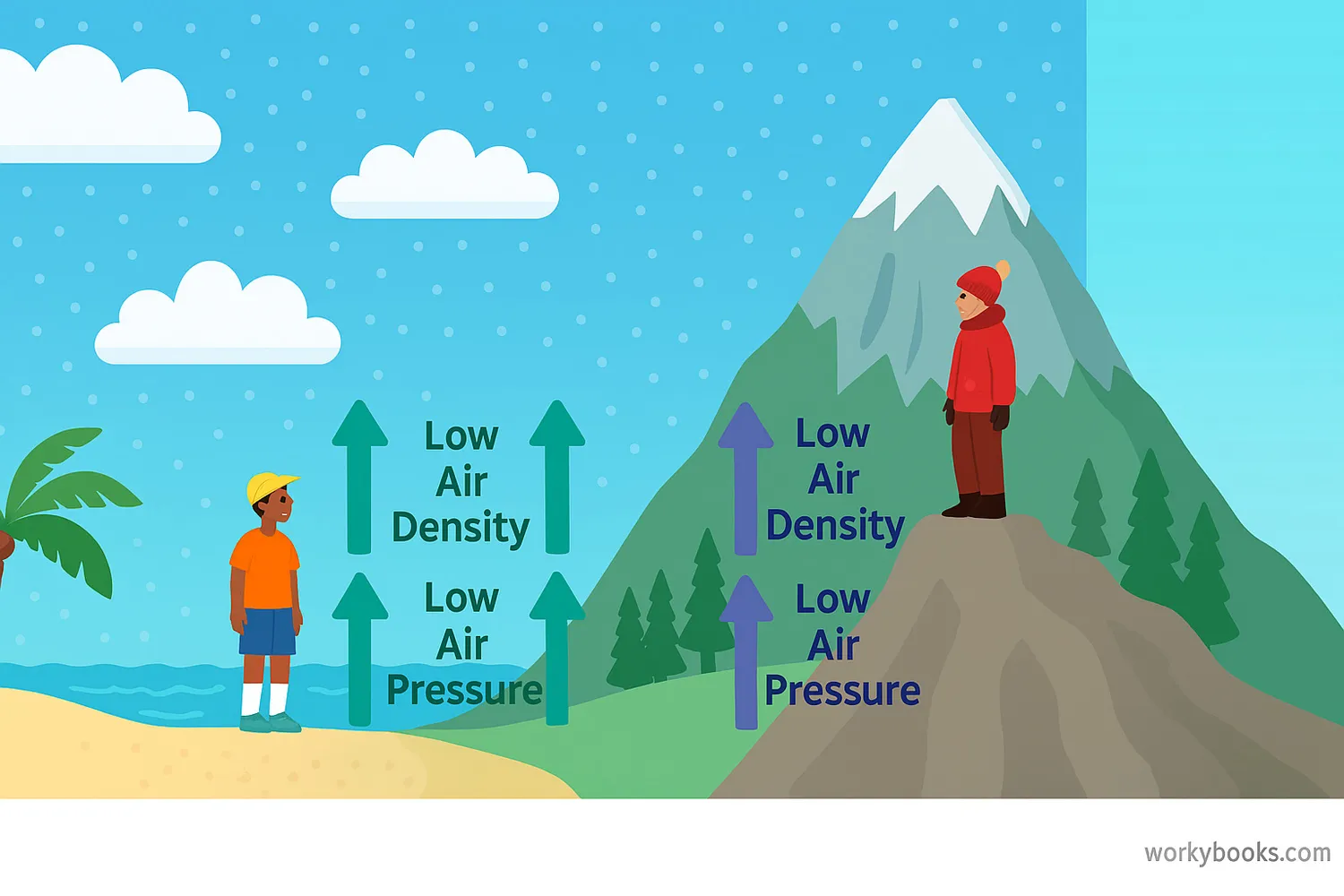
Have you ever wondered why it feels harder to breathe at the top of a tall mountain? Or why the weather can be so different in the mountains compared to the beach? The answer often relates to altitude. Altitude is simply the measurement of how high something is above sea level. Sea level is the average height of the ocean's surface, which scientists use as a starting point for measuring elevation around the world.
The Earth is surrounded by layers of gases called the atmosphere. The air we breathe is part of this atmosphere. As you go higher in altitude, the air becomes less dense, meaning there are fewer air molecules packed into the same space. This is why breathing can be more challenging at high altitudes – there's less oxygen available with each breath. Think of it like a crowded room: at sea level, the room is full of people (air molecules), but at high altitude, many people have left, making the room feel emptier.
Altitude also greatly affects air pressure. Air pressure is the force that air exerts on a surface. At sea level, there's a huge column of air above you pushing down, so the air pressure is higher. As you increase in altitude, there's less air above you, which means less weight pushing down, and therefore lower air pressure. This change in air pressure is a key factor in how weather conditions develop. For example, low air pressure often leads to stormy weather, while high pressure usually brings clear skies. Understanding these changes helps scientists predict weather patterns.
Another important factor linked to altitude is temperature. Generally, as you go higher in altitude, the temperature drops. This is because the air at higher altitudes is thinner and less able to hold heat from the sun. That's why mountain peaks often have snow even in summer. So, whether you're climbing Mount Everest or just going up a hill, you'll notice changes in the air and temperature. These changes are all related to altitude, a fundamental concept in earth science and meteorology.
Interesting Fact: The highest point on Earth, Mount Everest, has an altitude of about 8,848.86 meters (29,031.7 feet) above sea level, where the air pressure is only about one-third of what it is at sea level!
Comprehension quiz (10 questions)
1. What is altitude a measurement of?
2. What surrounds the Earth?
3. At higher altitudes, air is:
4. Why is breathing harder at high altitudes?
5. What generally happens to temperature at higher altitudes?
6. Low air pressure often leads to:
7. Sea level is a fixed measurement that never changes. (True/False)
8. Which science studies weather patterns?
9. How does reduced air pressure impact boiling water?
10. If you climb a mountain, what would you expect to need?
Perfect for the way you teach
- Build comprehension skills
- Auto-graded quiz
- Differentiated reading
- Read together at home
- Improve fluency
- Quiet reading time
- Reading curriculum support
- Independent practice
- Track Lexile growth