America Enters the War: 1917
Interactive passage with audio narration, comprehension questions, and printable PDF.
By completing this purchase you agree to our Terms of Use and Privacy Policy. Your subscription renews automatically until you cancel. You can cancel anytime from your account settings. All sales are final and non-refundable. Digital content is available for download in your account immediately upon purchase.
What's included
America Enters the War: 1917 preview and details
About this printable America Enters the War: 1917 reading passage (Grades 5-8)
Sample passage and quiz from America Enters the War: 1917
Reading passage and comprehension quiz preview
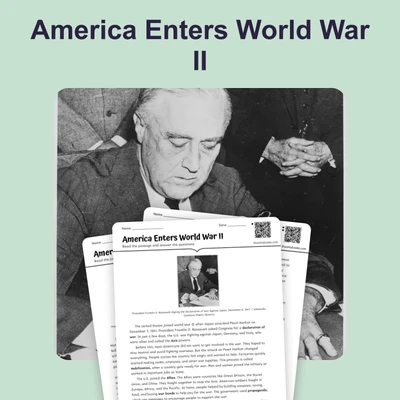
America Enters the War: 1917
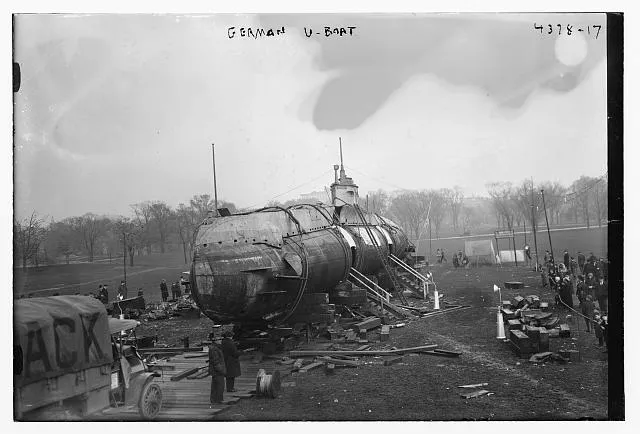
Source: Library of Congress - Bain News Service
In 1917, the United States made a crucial decision to join World War I, changing both the war’s outcome and its own place in world affairs. For nearly three years, the U.S. remained neutral, refusing to take sides in the conflict that had consumed Europe. However, a series of dramatic events forced the country to abandon neutrality and enter the war alongside the Allied Powers.
One of the main reasons America joined the war was Germany’s policy of unrestricted submarine warfare. German submarines, called U-boats, attacked ships trading with Britain and France, even those carrying American citizens. On May 7, 1915, the British passenger ship Lusitania was sunk by a German U-boat off the coast of Ireland, killing 1,198 people, including 128 Americans. This attack sparked outrage in the U.S. and was widely reported in newspapers, with President Woodrow Wilson demanding that Germany stop these attacks. Despite promises, Germany resumed unrestricted submarine warfare in early 1917, hoping to weaken Britain before the U.S. could respond.
Another key factor was the Zimmermann Telegram. In January 1917, British intelligence intercepted a secret message from German Foreign Minister Arthur Zimmermann to Mexico. The telegram proposed a military alliance: if Mexico joined Germany and attacked the U.S., Germany promised to help Mexico regain lost territories in Texas, New Mexico, and Arizona. When British officials shared the telegram with President Wilson, it was published in American newspapers, shocking the public and increasing support for war.
By April 1917, President Wilson asked Congress to declare war on Germany, stating, “The world must be made safe for democracy.” Congress agreed, and the U.S. officially entered World War I on April 6, 1917. Soon, American soldiers, known as the American Expeditionary Force, traveled to Europe. Their arrival provided a much-needed boost to the exhausted Allied armies and helped turn the tide against the Central Powers. The U.S. contributed not only troops but also resources, technology, and economic support. The war ended in November 1918 with the defeat of Germany and its allies.
America’s entry into World War I marked a turning point in both the conflict and U.S. history. The decision ended the country’s traditional isolationism and established the U.S. as a global power. The war also changed American society, leading to new roles for women, increased propaganda, and debates about civil liberties. Understanding why and how the U.S. entered the war helps us see the connections between world events, geography, and the responsibilities of nations.
This moment links to broader themes in world history, such as how alliances, technology, and public opinion can shape the course of wars and the fate of societies.
Interesting Fact: During World War I, the U.S. government created the Committee on Public Information to spread news and encourage support for the war through posters, movies, and speeches.
Comprehension quiz (8 questions)
1. When did the U.S. enter World War I?
2. What ship was sunk by a U-boat?
3. Who was U.S. President in 1917?
4. Why did Germany resume submarine warfare in 1917?
5. How did the Zimmermann Telegram affect Americans?
6. What was a result of U.S. entry?
7. America joined the Allies in 1917. True or false?
8. What does 'neutral' mean?
Perfect for the way you teach
- Build comprehension skills
- Auto-graded quiz
- Differentiated reading
- Read together at home
- Improve fluency
- Quiet reading time
- Reading curriculum support
- Independent practice
- Track Lexile growth