League of Nations
Interactive passage with audio narration, comprehension questions, and printable PDF.
By completing this purchase you agree to our Terms of Use and Privacy Policy. Your subscription renews automatically until you cancel. You can cancel anytime from your account settings. All sales are final and non-refundable. Digital content is available for download in your account immediately upon purchase.
What's included
League of Nations preview and details
About this printable League of Nations reading passage (Grades 5-8)
Sample passage and quiz from League of Nations
Reading passage and comprehension quiz preview
League of Nations:
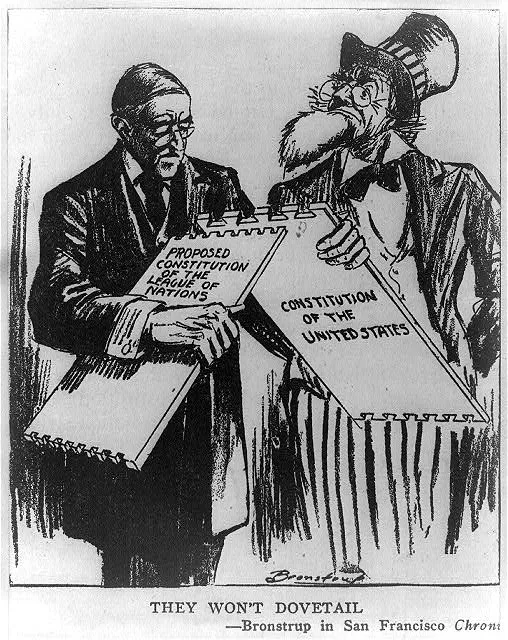
Source: Library of Congress
The League of Nations was established in 1919 as an international organization dedicated to maintaining peace after the devastation of World War I. Its creation was one of the most significant outcomes of the Treaty of Versailles, which officially ended the war in Paris, France. The League brought together countries from around the world to discuss problems and prevent future conflicts. It was the first attempt to create a global system where nations could settle disputes through dialogue rather than war.
The idea for the League came from U.S. President Woodrow Wilson, who proposed it in his famous Fourteen Points speech in 1918. Although Wilson worked hard to promote the League, the United States never joined, due to opposition in the U.S. Senate. Despite this, 42 countries became founding members in January 1920, gathering in Geneva, Switzerland. The League's main goals were to promote collective security, disarmament, and better living conditions worldwide. Its structure included an Assembly, a Council, and a Secretariat that managed day-to-day affairs. The Assembly allowed each member nation a voice, regardless of size or power.
Throughout the 1920s, the League achieved some successes. It helped resolve border disputes, such as between Sweden and Finland over the Åland Islands in 1921, using peaceful negotiation instead of military force. In 1922, the League responded to a humanitarian crisis by providing food and aid to refugees after the collapse of the Ottoman Empire. The League also worked to stop the spread of diseases and improve labor conditions. However, the League faced major challenges. Without the participation of powerful nations like the United States, and later Germany and Japan, its influence was limited. When Italy invaded Ethiopia in 1935, the League condemned the aggression but could not stop the invasion, showing its weakness in enforcing decisions.
Primary sources, such as the League's own Covenant (the organization’s founding document), reveal its ambitious goals and the optimism of its founders. However, letters written by world leaders—like British Prime Minister Ramsay MacDonald in 1933—expressed disappointment in the League's inability to prevent rising tensions in Europe. Many historians agree that the League laid the foundation for future international cooperation, even though it failed to prevent World War II. The League's legacy continued in the form of the United Nations, created in 1945 with lessons learned from the League's shortcomings.
The League of Nations represented a bold experiment in diplomacy and global governance during the early 20th century. Despite its failures, it marked an important change in how countries addressed conflict and promoted peace. Studying the League helps us understand the development of international organizations and the ongoing challenges of maintaining peace in a complex world.
This topic connects to broader themes in world history, such as how nations seek order after times of crisis and the importance of international cooperation.
Interesting Fact: The League of Nations once banned the use of lead paint in toys, making it one of the first organizations to protect children’s health on a global scale.
Comprehension quiz (8 questions)
1. When was the League of Nations founded?
2. Which city hosted the first League meeting?
3. Which country did not join the League?
4. Why was the League created?
5. What was one success of the League?
6. Why was the League sometimes weak?
7. The League banned lead paint in toys. True or False?
8. What does 'collective security' mean?
Perfect for the way you teach
- Build comprehension skills
- Auto-graded quiz
- Differentiated reading
- Read together at home
- Improve fluency
- Quiet reading time
- Reading curriculum support
- Independent practice
- Track Lexile growth