Leaders and Decisions in World War II
Interactive passage with audio narration, comprehension questions, and printable PDF.
By completing this purchase you agree to our Terms of Use and Privacy Policy. Your subscription renews automatically until you cancel. You can cancel anytime from your account settings. All sales are final and non-refundable. Digital content is available for download in your account immediately upon purchase.
What's included
Leaders and Decisions in World War II preview and details
About this printable Leaders and Decisions in World War II reading passage (Grades 5-8)
Sample passage and quiz from Leaders and Decisions in World War II
Reading passage and comprehension quiz preview
World War II Leaders and Their Decisions
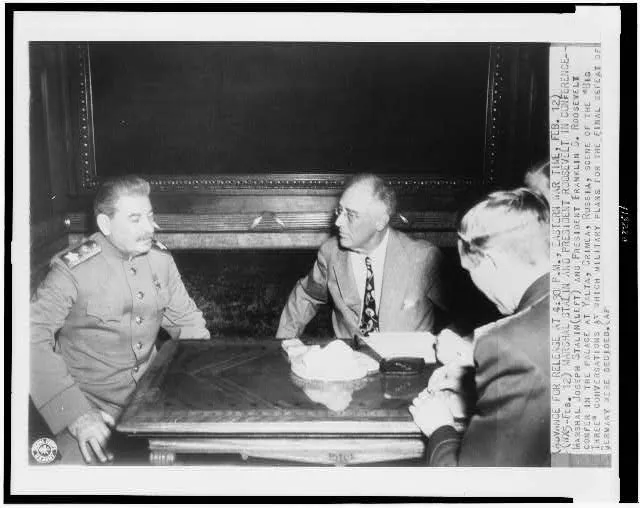
Source: Library of Congress
World War II was shaped by the powerful decisions of national leaders. The conflict, which lasted from 1939 to 1945, drew in countries from every continent and resulted in dramatic changes around the globe. The actions of leaders such as Franklin D. Roosevelt, Winston Churchill, Adolf Hitler, and Joseph Stalin determined the course and outcome of the war. Their choices about alliances, military strategy, and diplomacy contributed to the defeat of the Axis Powers and the future of international relations.
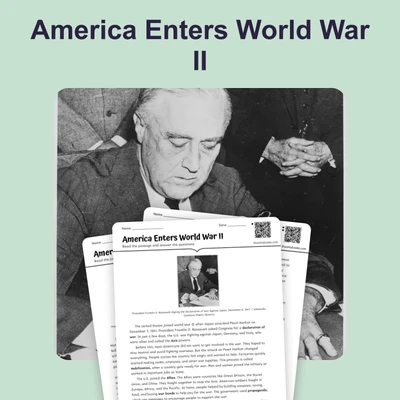
Franklin D. Roosevelt, the President of the United States, played a key role in organizing the **Allied Powers**. After the Japanese attack on Pearl Harbor on December 7, 1941, Roosevelt delivered his famous “Day of Infamy” speech to Congress, which is a primary source that shows his commitment to defending democracy. His decision to support Britain and the Soviet Union with supplies through the **Lend-Lease Act** (1941) strengthened the alliance. Roosevelt also worked closely with British Prime Minister Winston Churchill. Churchill was known for his powerful speeches and determination to resist Nazi Germany, especially during the **Battle of Britain** (1940). He inspired the British people with phrases like, “We shall never surrender,” as recorded in historical broadcasts.
On the other side, Adolf Hitler, the dictator of Germany, made decisions that led to devastation across Europe. He invaded Poland in 1939, starting the war, and orchestrated the **Holocaust**, a systematic campaign to exterminate Jews and other groups. Hitler’s choices, such as invading the Soviet Union in 1941, stretched German resources and opened multiple fronts of conflict. Joseph Stalin, the leader of the Soviet Union, at first signed a **non-aggression pact** with Germany. However, after Hitler broke this agreement, Stalin joined the Allies. Under Stalin’s command, the Soviet Union played a crucial role in the defeat of Nazi Germany, especially at the **Battle of Stalingrad** (1942–1943), which was a turning point in the war.
The decisions of these leaders were influenced by their nations’ geographic positions, resources, and political systems. For example, the United States’ distance from Europe allowed it to become the “Arsenal of Democracy,” producing weapons and supplies for the Allies. Britain, as an island nation, relied on its navy and air force to defend itself. The Soviet Union’s vast territory gave it strategic depth, but also meant immense suffering during invasions. Social hierarchies and daily life changed as women entered the workforce and entire populations were mobilized for war.
In conclusion, World War II leaders made choices that shaped the 20th century. Their decisions about war and peace, cooperation and conflict, continue to influence the world today. Understanding these leaders helps us grasp the complexity of history and the power of individual and collective decision-making.
This study of leadership in World War II connects to larger themes in world history, such as the causes and consequences of war, the impact of geography, and the ways societies respond to crisis.
Interesting Fact: At the Yalta Conference in 1945, Roosevelt, Churchill, and Stalin met to plan the postwar world, setting the stage for the Cold War.
Comprehension quiz (8 questions)
1. Who was the U.S. President during WWII?
2. Which battle was a turning point for the Allies?
3. When did Japan attack Pearl Harbor?
4. Why did Roosevelt support Britain and the Soviet Union?
5. What effect did Hitler's invasion of the Soviet Union have?
6. What was a result of the Yalta Conference?
7. Hitler led the Holocaust.
8. What is a primary source?
Perfect for the way you teach
- Build comprehension skills
- Auto-graded quiz
- Differentiated reading
- Read together at home
- Improve fluency
- Quiet reading time
- Reading curriculum support
- Independent practice
- Track Lexile growth