Amplitude and Volume
Interactive passage with audio narration, comprehension questions, and printable PDF.
By completing this purchase you agree to our Terms of Use and Privacy Policy. Your subscription renews automatically until you cancel. You can cancel anytime from your account settings. All sales are final and non-refundable. Digital content is available for download in your account immediately upon purchase.
What's included
Amplitude and Volume preview and details
About this printable Amplitude and Volume science reading passage, NGSS-aligned (Grades 5-8)
Sample passage and quiz from Amplitude and Volume
Reading passage and comprehension quiz preview
Amplitude and Volume
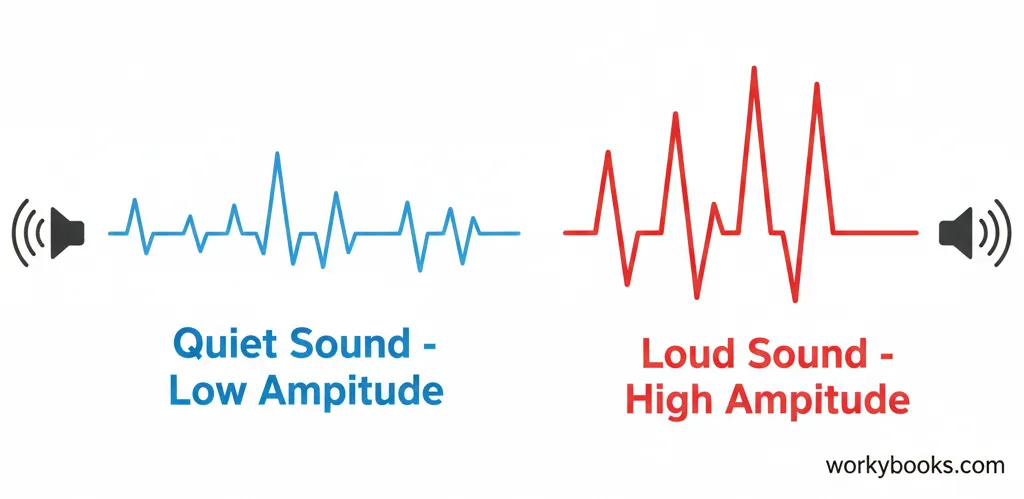
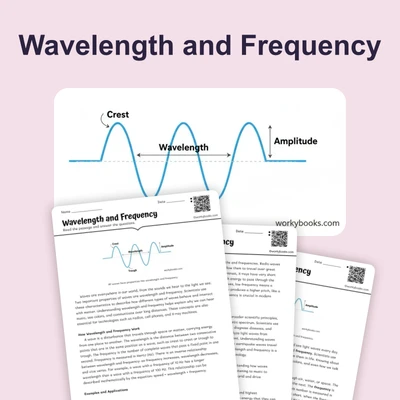
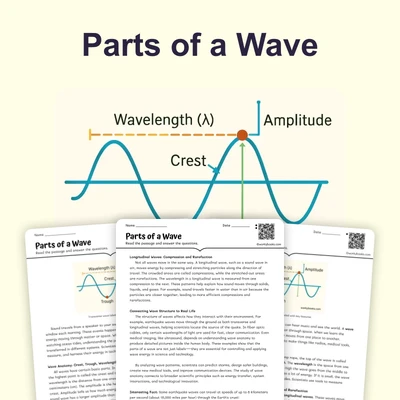
Sound moves through the air as invisible waves that carry energy from one place to another. The loudness of a sound, such as the difference between a whisper and a shout, depends on a key property of these waves called amplitude. Amplitude is the maximum displacement, or height, of the wave from its resting position. Scientists study amplitude to understand how energy in a wave is related to how we perceive sound.
How Amplitude Works in Sound Waves
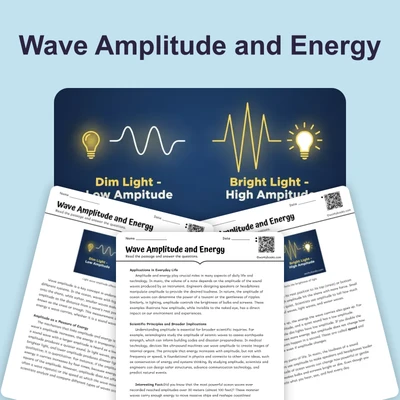
Every sound wave is produced by a vibrating object, like a speaker or a drum. These vibrations push air particles back and forth, creating regions of high and low pressure. Amplitude measures how far the particles move from their normal position. A wave with a larger amplitude means the particles are moving more, which happens when the source puts in more energy. For example, when you hit a drum hard, you send more energy into the drumhead, making the air vibrate more strongly. This produces a sound wave with a higher amplitude. In contrast, a gentle tap on the drum creates a wave with a smaller amplitude and less energy.
Volume: How We Perceive Amplitude
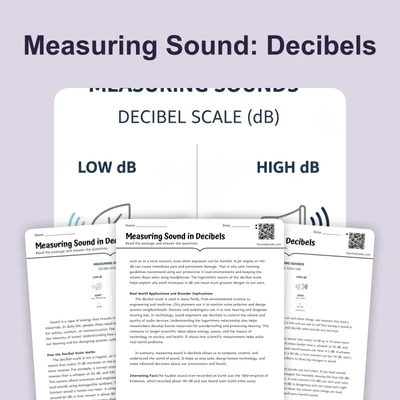
The volume or loudness of a sound is how our ears and brain interpret the amplitude of a sound wave. Greater amplitude equals louder sound; smaller amplitude equals quieter sound. For example, when someone whispers, the amplitude is low, so the sound is soft. When someone shouts, the amplitude is high, so the sound is loud. Scientists can measure amplitude using instruments and see the pattern on an oscilloscope, which shows tall waves for loud sounds and short waves for quiet sounds. Amplitude is measured in units called decibels (dB). A normal conversation is around 60 dB, while a rock concert can reach 120 dB.
Applications and Broader Implications
Understanding amplitude and volume is important for many reasons. In technology, microphones and speakers must be built to handle different amplitudes to produce clear sounds. In health, loud sounds with very high amplitude can damage our ears over time, leading to hearing loss. Environmental scientists study how noise pollution—from traffic or construction—affects humans and animals. Regulations often set limits on the maximum allowable amplitude of sounds in cities. The relationship between amplitude, energy, and loudness helps us design safer, more comfortable environments and better technology.
Amplitude and volume are just two parts of the bigger system of how waves carry energy and information. By studying these properties, scientists can better understand not only sound but also other types of waves, such as light and earthquakes.
Interesting Fact: Some animals, like bats and whales, use sound waves with very high amplitudes to communicate and navigate, even in complete darkness!
Comprehension quiz (10 questions)
1. What is amplitude in a sound wave?
2. What does a higher amplitude mean for a sound?
3. Which unit is used to measure the amplitude of sound?
4. What is the main difference between whispering and shouting in terms of sound waves?
5. What tool do scientists use to see the pattern of sound waves?
6. In the passage, what does 'hearing loss' mean?
7. Why is it important for cities to set limits on sound amplitude?
8. What happens to air particles when a sound wave has a higher amplitude?
9. True or False: Amplitude is not related to the loudness of a sound.
10. True or False: A rock concert usually has a higher amplitude than a normal conversation.
Perfect for the way you teach
- Build comprehension skills
- Auto-graded quiz
- Differentiated reading
- Read together at home
- Improve fluency
- Quiet reading time
- Reading curriculum support
- Independent practice
- Track Lexile growth